
.jpg?width=720&height=720&name=main-sims-2%20(2).jpg)
eSIM for IoT, built on eUICC hardware and multi IMSI technology, is how enterprise teams are solving this without swapping physical cards in the field.
This guide walks through what eUICC actually changes, how roaming SIM replacement works in practice, and what to check before choosing a provider for a fleet that needs to work the same way in Oslo, Osaka, and Sao Paulo.
What Is eSIM for IoT? eUICC and Multi IMSI SIM Explained
An eUICC (embedded Universal Integrated Circuit Card) is a SIM chip that can hold and switch between multiple network profiles over the air, instead of being locked to one operator for the life of the device. Rather than a card etched with one operator's identity, it ships with a bootstrap profile and downloads additional profiles remotely once the device is deployed.
A multi-IMSI SIM takes a related but different approach. It stores several IMSIs (subscriber identities) tied to one home operator's roaming agreements, and cycles between them so the device appears as a local subscriber on the network it currently sits on. eUICC goes a step further: it can pull in a profile from a completely different mobile network operator, even one with no commercial relationship to the original provider, giving connected devices connectivity that isn't capped by a single operator's roaming footprint.
Both approaches solve the same underlying problem from different angles, and many enterprise deployments use them together: multi IMSI for fast, automatic switching within a roaming agreement, and eUICC for the cases where a genuinely local profile is required.
Why Roaming SIM Replacement Matters for Global IoT Coverage
A traditional roaming SIM works by having a device's home operator negotiate agreements with foreign networks, so the device "roams" wherever those agreements reach. That model has three growing weaknesses for global IoT coverage.
First, coverage is only as good as the home operator's roaming agreements, which can change or lapse without warning. Second, roaming data tends to cost more than local data, and that gap compounds across a fleet of thousands of devices over a multi year lifecycle. Third, and increasingly the deciding factor, a rising number of countries are tightening rules on how long a device can operate on a foreign SIM before it must register locally.
Regulators in markets including India, Brazil, China, Turkey, Nigeria, and the UAE have introduced or strengthened permanent roaming restrictions. Brazil, for example, generally tolerates a device on a foreign SIM for around 90 continuous days before the visited network can restrict traffic, at which point a local SIM or an eUICC profile downloaded in country is required. Roaming SIM replacement with eUICC lets a device fleet stay compliant market by market without shipping a different physical card for every country of deployment.
eUICC vs Multi IMSI SIM: Comparing Two Paths to Global IoT Coverage
| Factor | Multi IMSI SIM | eUICC (eSIM) |
|---|---|---|
| How it works | Rotates between IMSIs tied to one home operator's roaming partners | Downloads full operator profiles from any GSMA-connected network |
| Network relationship | Requires existing roaming agreements | Can activate a profile from an unrelated local operator |
| Compliance with local SIM rules | Improves compliance, but still roaming based | Provides genuine local registration in country |
| Hardware | Physical SIM or soldered chip, single SKU | Physical or soldered chip, single SKU, profile managed remotely |
| Best fit | Fast failover within a known roaming footprint | Long term deployments in regulated or high risk markets |
How eSIM Provisioning Works: From Bootstrap Profile to Local Network
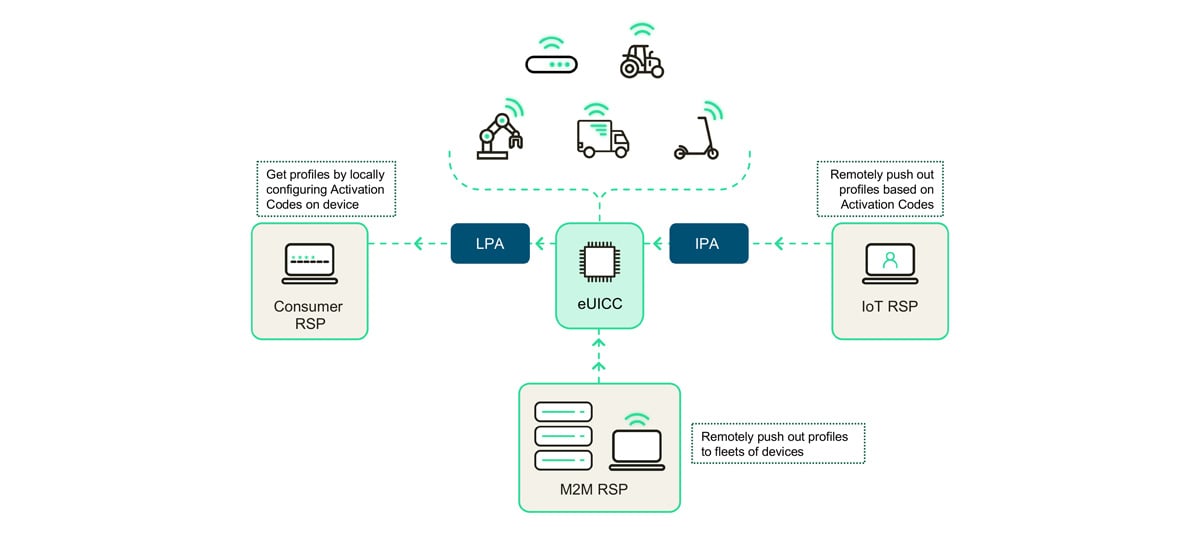
eSIM provisioning starts before a device ever leaves the factory. The manufacturer installs a bootstrap profile, a minimal operator identity whose only job is to get the device online long enough to reach a Remote SIM Provisioning (RSP) platform. Once connected, the RSP platform pushes down the operator profile that matches the device's actual deployment location.
From there, profile management happens over the air. If a device moves to a new country, experiences a coverage problem, or its provider changes commercial terms, the RSP platform can retire the old profile and activate a new one without anyone touching the hardware. If provisioning fails at any point, most implementations fall back automatically to the bootstrap profile so the device does not go dark.
The standard driving this for IoT specifically is GSMA SGP.32, published in 2023 and now reaching commercial scale through 2026. Unlike the older M2M standard (SGP.02), SGP.32 is IP based rather than SMS dependent, works over low power networks like NB-IoT and LTE-M, and supports asynchronous delivery, so a sensor that wakes up briefly to transmit a reading can also receive and apply a new profile in that same short window instead of needing a constant connection.
Roaming SIM Replacement in Practice: Migrating Connected Devices to eUICC
Migrating an existing fleet away from roaming SIMs does not usually happen in one step. The practical sequence enterprise teams follow looks like this.
- Audit the current fleet to identify which devices are running on roaming agreements that are aging out, becoming expensive, or falling foul of local regulation.
- Specify eUICC capable hardware for new devices going forward, even if the immediate rollout still uses multi IMSI or a proprietary pre standard solution.
- Select an RSP platform and confirm it supports the profiles and markets the fleet actually needs, not just a general claim of "global coverage."
- Pilot the migration in one or two regulated markets first, typically where permanent roaming restrictions are already being enforced.
- Roll out profile switching to the rest of the fleet, keeping the bootstrap profile as a fallback throughout.
Because the hardware itself does not need to change once it supports eUICC, this migration can happen gradually, market by market, without a mass hardware refresh or a truck roll to every device.
How to Evaluate an eSIM for IoT Provider in 2026
Technology support is table stakes. What separates providers in practice comes down to a handful of concrete questions.
Standards and certification. Confirm GSMA eSA (eSIM Security Assurance) certification, and ask specifically which SGP versions are supported: SGP.02 for legacy M2M, SGP.22 for consumer style provisioning, and SGP.32 for the IoT specific standard. A provider that only supports SGP.02 will not carry a fleet through the next several years of regulatory change.
Profile management control. Look for a centralized platform where you can see every device's current profile, trigger switches, and set automated rules, rather than relying on the provider's back office for every change.
Market by market network list. Ask for the actual operator list per country your devices will ship to, not a headline "200 countries" figure. Confirm whether local profiles are genuinely local registrations or still routed through roaming.
Regulatory compliance support. A provider that already tracks permanent roaming rules across markets like Brazil, India, and China can flag compliance risk before a device stops working, rather than after.
Fallback and resilience design. Ask how the platform behaves if a profile switch fails mid deployment, and whether the bootstrap profile is reliable enough to keep a remote device reachable while the issue is resolved.
eSIM for IoT: The Bottom Line for Connected Devices Connectivity
Roaming SIMs were a reasonable default when IoT fleets were smaller and regulatory scrutiny was lighter. Neither condition holds today. eSIM for IoT, delivered through eUICC hardware and increasingly standardized through SGP.32, gives connected devices connectivity that can adapt to local rules and local networks without a physical SIM swap. The migration does not need to happen overnight, but new deployments should be specifying eUICC capable hardware now, and existing fleets in regulated markets are the right place to start planning roaming SIM replacement first.