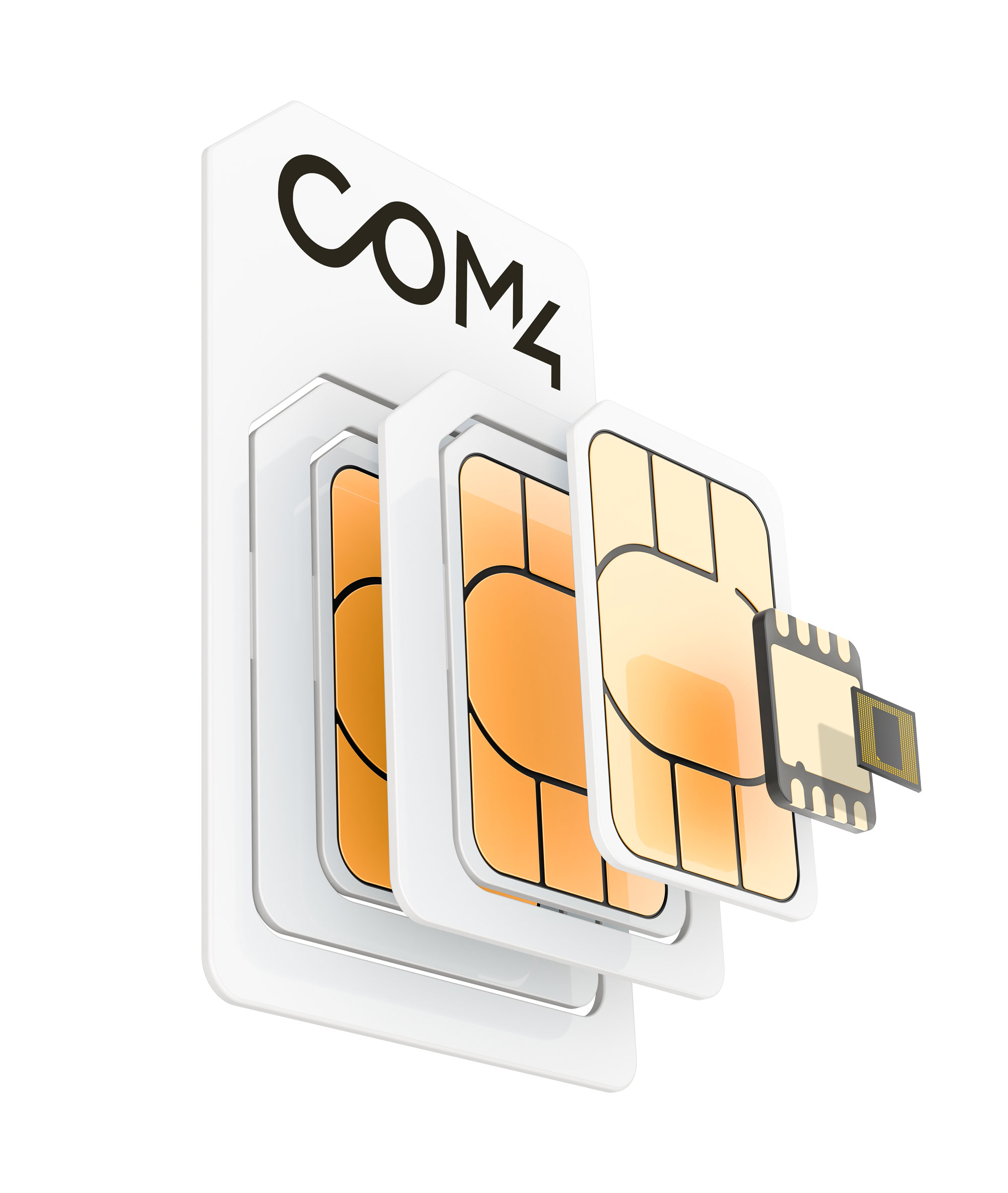
Abstract network visualisation representing the next-generation GSMA SGP.32 eSIM standard

GSMA SGP.32 – the next standard for IoT connectivity

Smarter, scalable, and future-ready IoT eSIM technology

SGP.32 is the GSMA standard for remote SIM provisioning in IoT devices. It lets you download, switch and manage eSIM profiles over the air on devices that have no screen or user, so you can change connectivity profile without touching the hardware. Built for efficiency, security and interoperability, it makes large IoT deployments simpler to run over a device’s whole lifetime.

Com4’s SGP.32 SIM cards are available to order now. Talk to our IoT experts about using them in your next deployment, or get pricing.

Last updated: 19 October 2026

Com4 embedded IoT SIM chip designed for SGP.32 eSIM standard

What Is GSMA SGP.32?

SGP.32 is a global GSMA eSIM specification created to support IoT devices that operate without user interfaces.

It enables remote SIM provisioning (RSP), allowing eSIM profiles to be activated, switched, or updated securely over the air — across thousands of devices, anywhere in the world.

Earlier eSIM standards (SGP.02 for M2M and SGP.22 for consumer devices) were limited by complex provisioning processes or required manual interaction.

SGP.32 bridges that gap, introducing lightweight protocols and remote management designed specifically for IoT scalability and low-power performance.

Connected shipping trucks using IoT devices for global fleet monitoring and data insights

How SGP.32 Works

SGP.32 introduces two new components that enable smarter and more efficient IoT eSIM management:
  • eIM (eSIM IoT Remote Manager): The remote management system that securely provisions and updates eSIM profiles.
  • IPA (IoT Profile Assistant): A lightweight module integrated into the IoT device that communicates with the eIM using optimized protocols such as CoAP, UDP, and DTLS.

Together, they make large-scale eSIM deployment and management fully automated — even for remote or battery-powered devices.

Evolution of eSIM Standards

From M2M to IoT – how eSIM technology has advanced
Feature
SGP.02 (M2M)
SGP.22 (Consumer)
SGP.32 (IoT)
Primary Use Case
Industrial M2M systems
Consumer electronics
IoT devices
Profile Management
Server-driven via SMS/TCP-IP
User-initiated via device UI
Remote and automated via IoT Profile Assistant
User Interaction
None
Required
None
Protocols
SMS / TCP/IP
TCP/IP
Lightweight (CoAP, UDP, DTLS)
Power Optimization
Limited
Moderate
High
Scalability
Complex
Manual
Designed for large-scale IoT
Security
Standard encryption
Consumer-grade
End-to-end encryption
Best Suited For
Industrial modules
Smartphones, tablets
Sensors, meters, trackers, industrial IoT

Why SGP.32 Matters for IoT

The new GSMA SGP.32 standard addresses the challenges of managing IoT connectivity at scale:
Control

Scalable eSIM Management

Remotely manage entire fleets of IoT devices with centralized provisioning and updates.

Battery

Optimized for Low-Power Devices

Lightweight protocols minimize power usage, extending battery life in small and embedded IoT devices.

Cloud

Simplified Deployment

No physical SIM handling required. Devices connect automatically and securely across multiple networks.

Security

Enhanced Security

SGP.32 introduces improved encryption and authentication for safe provisioning and profile management.

Global connectivity

Future-Proof Connectivity

Fully compatible with LTE-M, NB-IoT, 4G, 5G, and satellite networks — ensuring long-term global operability.

Magnus Amble from Com4 explaining the new GSMA SGP.32 standard for IoT Remote SIM Provisioning (IoT RSP) and its impact on global IoT connectivity.
Norwegian forest symbolizing Com4’s roots and IoT connectivity in the Nordics

The Com4 Advantage

At Com4, we deliver GSMA SGP.32-ready IoT connectivity with unmatched reliability and flexibility.

Our IoT SIM and eSIM solutions are designed for secure, scalable, and global communication — built on Nordic engineering excellence and private core infrastructure.

  • Multi-operator connectivity in 190+ countries.
  • Secure provisioning via Com4’s private core network.
  • Compliance with GSMA SGP.32.
  • Full support for LTE-M, NB-IoT, 4G, 5G, and satellite.
  • Reliable and redundant architecture for mission-critical IoT.

SGP.32 FAQ

What is GSMA SGP.32?

SGP.32 is the GSMA technical specification for remote SIM provisioning in IoT devices. It lets eSIM profiles be downloaded, switched and managed over the air on devices with no screen or user. Its companion document, SGP.31, defines the architecture and requirements. Together they are often called "eSIM IoT".

Can I order SGP.32 SIM cards from Com4?

Yes. Com4’s SGP.32 SIM cards are available to order now. Talk to our IoT experts about your devices and deployment plans, or request pricing.

How is SGP.32 different from SGP.02 (M2M eSIM)?

SGP.02 is controlled by the SM-SR, a server usually run by the operator, so changing provider typically means integrating or handing over between SM-SR operators. SGP.32 removes the SM-SR. An eSIM IoT remote Manager (eIM) chosen by the device owner tells the eUICC which profiles to download or enable. Profiles come from a standard SM-DP+ server. The result is that switching connectivity provider no longer depends on the incumbent operator.

How is SGP.32 different from consumer eSIM (SGP.22)?

Consumer eSIM assumes a person: the user scans a QR code and confirms the download on the device. SGP.32 keeps the SM-DP+ and profile format from SGP.22 but replaces the user with the eIM, which sends signed instructions the eUICC can act on without local confirmation. That makes it practical for sensors, meters and trackers deployed by the thousand.

What are the eIM and the IPA?

They are the two new roles SGP.32 introduces.

  • eIM (eSIM IoT remote Manager): the remote management server that decides which profile operations happen and can apply them to single devices or whole fleets.
  • IPA (IoT Profile Assistant): the component that carries out those instructions. It can sit in the device (IPAd) or inside the eUICC itself (IPAe). That choice affects how much the device firmware needs to support.

Can my existing eSIM devices be upgraded to SGP.32?

Usually not by software alone. SGP.32 requires an eUICC that supports it, and SGP.02 or SGP.22 eUICCs in the field generally cannot be converted. For new products, SGP.32 support is a design-time decision covering the eUICC, the module and, with IPAd, the device firmware. Existing fleets can keep running on their current setup while new hardware is introduced.

Is SGP.32 more secure than earlier standards?

SGP.32 builds on the proven SGP.22 security model rather than replacing it. Profiles are encrypted and bound to a specific eUICC, and every eIM instruction is signed and verified by the eUICC. What changes is who can trigger profile operations. Securing and controlling access to the eIM therefore becomes an important part of your overall security design.

Does SGP.32 replace multi-IMSI or global roaming SIMs?

No, they solve different problems and work well together. A multi-IMSI or global roaming profile gives immediate coverage across many networks from day one. SGP.32 adds the option to download a different profile later, for example a local profile where permanent-roaming rules or cost make that the better choice. Many deployments start on a global profile and keep SGP.32 as a long-term flexibility option.

Which IoT devices benefit most from SGP.32?

Devices with long lifecycles, large fleets or deployments across several countries benefit most. Typical examples are smart meters, EV chargers, asset trackers and industrial sensors. They often stay in the field for 10 years or more, are hard to reach physically, and may need a different operator profile during their lifetime.