
Your devices will operate across borders, in regulated markets, and under conditions where downtime costs money. The right partner gives you control, visibility, and resilience. The wrong one locks you into limitations that only surface after deployment.
Com4 delivers secure global IoT connectivity across 750+ networks in 190+ countries, backed by a proprietary mobile core network and 24/7 technical support. Before signing any agreement, ask these seven questions to evaluate whether a provider can meet your enterprise requirements.
Quick guide: 7 questions for evaluating IoT connectivity partners
- Network coverage depth: Does the provider offer multi-network access in each country?
- Control and visibility: Can you manage SIMs and monitor connectivity from a single platform?
- Security architecture: What protections exist at the network level?
- Pricing model: Is billing predictable and transparent across regions?
- Technology support: Does the provider support eSIM, iSIM, LTE-M, NB-IoT, and 5G?
- Managed services: What level of technical support and testing is available?
- Scalability: Can you expand to new markets without renegotiating contracts?
How we identified these evaluation criteria
Enterprise IoT deployments fail for predictable reasons: fragmented coverage, security gaps, surprise costs, and lack of operational control. We identified these seven questions based on what matters most when devices operate unattended across multiple countries for years at a time.
- Multi-network redundancy prevents downtime when a single carrier experiences issues in a region
- Centralized management reduces the operational burden of coordinating with multiple local providers
- Network-level security protects headless devices that cannot run endpoint agents
- Transparent pricing eliminates bill shock from roaming charges and hidden fees
- Future-proof technology ensures your deployment can adapt as networks evolve
- Technical expertise helps you solve problems before devices reach the field
- Contractual flexibility allows you to scale without rebuilding your connectivity stack
7 critical questions to ask IoT connectivity partners
1. How many networks can devices access in each country?
Single-network access creates a single point of failure. When that network experiences congestion, maintenance, or outages, your devices go offline. Ask potential partners whether their SIMs connect to multiple operators per country.
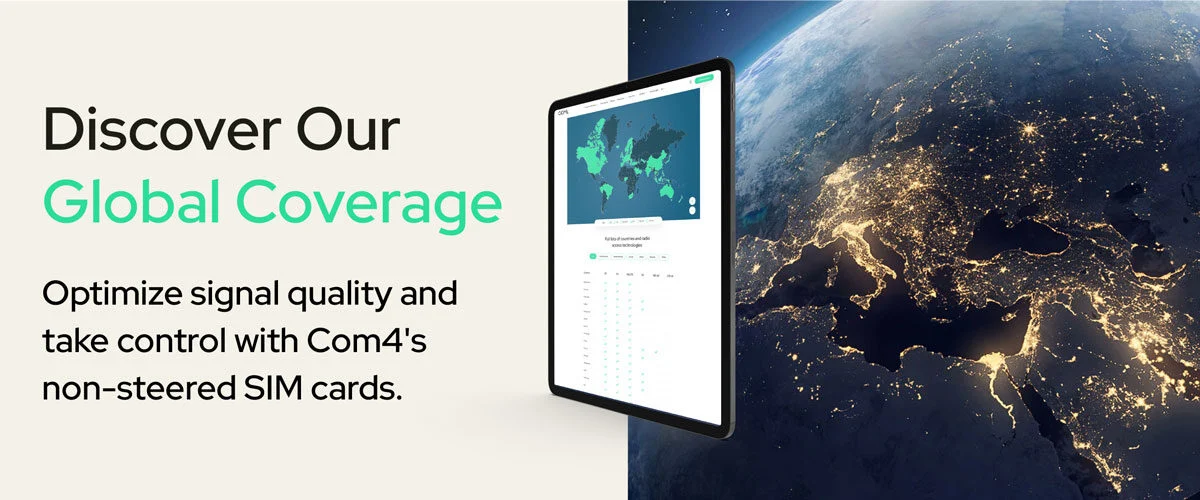
Com4's carrier-agnostic SIM cards connect to over 750 networks spanning 190 countries. This multi-network approach means devices automatically connect to available networks when one operator has issues, maintaining uptime across your fleet.
2. What control do you have over SIM management and connectivity?
Multinational deployments require real-time visibility into device status, data consumption, and network performance. Without centralized control, troubleshooting becomes a time-consuming exercise involving multiple support channels and delayed responses.
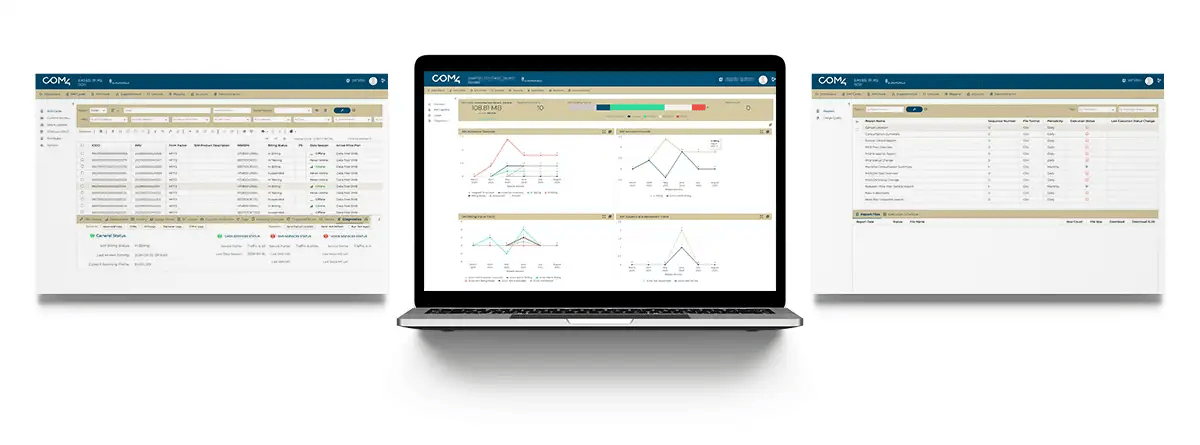
Ask whether the provider offers a connectivity management platform with self-service capabilities. Look for features like automated alerts, remote SIM lifecycle management, and API access for integration with your existing systems. Com4's CMP enables real-time monitoring, policy-based automation, and fleet-wide diagnostics from a single interface.
3. What security measures protect devices at the network level?
IoT devices face threats including SIM theft, unauthorized endpoint communication, and DDoS attacks. Devices deployed in remote locations cannot rely on traditional endpoint security. Protection must be built into the connectivity infrastructure itself.
Evaluate whether the provider offers private APN and VPN configurations that isolate your devices from public internet traffic. Com4 provides enterprise-grade security with private networks, encrypted tunnels, and fixed public IP addressing for consistent device accessibility.
4. How transparent and predictable is the pricing model?
Roaming charges, overage fees, and region-specific pricing create budget uncertainty. For multinational deployments, unpredictable costs can undermine project viability. Ask for clear documentation of how pricing works across different countries and usage scenarios.
Look for providers that offer consolidated billing with a single invoice regardless of where devices operate. Com4 uses flexible pay-as-you-go and data pool pricing that scales with your usage, helping you avoid unexpected costs while maintaining full visibility into data consumption.
5. Which connectivity technologies does the platform support?
Different applications require different technologies. Battery-powered sensors benefit from LTE-M and NB-IoT for extended battery life. High-bandwidth applications need 4G or 5G. Remote deployments may require satellite connectivity. A partner locked into one technology limits your options.
Com4 supports LTE-M, NB-IoT, 4G, 5G, and satellite connectivity through a single SIM. This multi-technology approach means you can deploy the right connectivity for each use case without managing multiple providers.
6. What managed services and technical support are available?
Connectivity issues in the field are expensive to diagnose and fix. Ask whether the provider offers pre-deployment testing, technical expertise during integration, and ongoing support for troubleshooting. The availability of a dedicated test lab can identify potential issues before devices ship.
Com4 operates a test lab that validates device performance, security, and interoperability before deployment. Specialized telecom engineers provide end-to-end support, helping reduce field failures and the operational burden of managing distributed devices.
7. Can you expand into new markets without rebuilding your connectivity infrastructure?
International expansion should not require negotiating new contracts, changing SIM cards, or integrating additional platforms. Ask whether the provider's infrastructure supports entering new countries with the same setup you use today.
Com4's global connectivity infrastructure covers 190+ countries. Devices deployed with Com4 SIMs can operate in new markets immediately, with the same management interface, security configurations, and billing structure. This removes barriers to international scaling.
Comparison table: Key IoT connectivity partner evaluation criteria
| Evaluation Criteria | Com4 | Single-Network Providers | Regional MVNOs |
|---|---|---|---|
| Networks per Country | Multiple | 1 | 1-2 |
| Countries Covered | 190+ | Varies | Limited regions |
| Private APN/VPN | ✓ | Limited | ✓ |
| Own Mobile Core | ✓ | ✗ | ✗ |
How do permanent roaming restrictions affect multinational deployments?
Regulators in countries like Brazil, Turkey, and India enforce local presence requirements for cellular devices. When devices roam beyond permitted periods, connectivity can be suspended without warning. This creates operational risk for globally distributed fleets.
Multi-IMSI SIMs with network-managed profile switching allow devices to connect through local carriers without physical intervention. Com4 supports multi-IMSI configurations and eSIM/iSIM technology that enables remote provisioning and profile management, maintaining connectivity during regulatory enforcement.
What role does pre-deployment testing play in multinational IoT success?
Field failures are expensive. Sending technicians to remote locations to troubleshoot connectivity issues drains budgets and delays project timelines. Pre-deployment testing identifies potential problems before devices ship.
A dedicated test lab validates device performance across network conditions, security configurations, and interoperability requirements. Com4's testing facilities help enterprise teams reduce deployment risk by catching issues during development rather than after rollout.
Why Com4 is the right IoT connectivity partner for multinational deployments
Enterprise IoT decision-makers need a partner that delivers control, security, and global reach without operational complexity. Com4 operates its own mobile core network, giving you direct control over performance and security that reseller arrangements cannot match.
Com4 connects your devices to 750+ networks in 190+ countries through carrier-agnostic SIMs. The connectivity management platform puts real-time monitoring, automated alerts, and SIM lifecycle management in your hands. Enterprise-grade security with private APN and VPN configurations protects your data from unauthorized access.
With support for iSIM, eSIM, LTE-M, NB-IoT, 4G, 5G, and satellite, Com4 future-proofs your deployment. Dedicated telecom engineers and a pre-deployment test lab ensure your devices work reliably from day one. Request a free IoT test kit to evaluate Com4's connectivity for your multinational deployment.
FAQs about choosing an IoT connectivity partner
What is the most important factor when selecting an IoT connectivity partner for multinational deployments?
Multi-network coverage and centralized control matter most for multinational deployments. Your devices need redundant network access to maintain uptime, and you need a single platform to manage connectivity across countries. Com4 delivers both through carrier-agnostic SIMs and a unified connectivity management platform.
How does Com4 ensure reliable connectivity across 190+ countries?
Com4 operates its own mobile core network and maintains relationships with 750+ networks globally. Non-steered SIMs connect to available networks rather than being locked to a single carrier, ensuring your devices maintain connectivity even when individual networks experience issues.
What security features should enterprise IoT deployments require?
Enterprise deployments should require private APN access, VPN configurations, and fixed IP addressing. These features isolate device traffic from public internet and enable secure communication between devices and backend systems. Com4 provides all three with enterprise-grade encryption.
Can I start with a small pilot and scale to global deployment with Com4?
Yes. Com4 offers a free IoT test kit to evaluate connectivity before committing to a larger deployment. The same infrastructure that supports your pilot scales to enterprise-level deployments across 190+ countries without changing SIM cards or management platforms.
How does pricing work for multinational IoT deployments with Com4?
Com4 uses flexible pay-as-you-go and data pool pricing with consolidated billing. You receive a single invoice regardless of where devices operate, with full transparency into data consumption by region and device. This eliminates surprise roaming charges and budget uncertainty.



-1.webp)