The best LTE-M and NB-IoT provider for IoT sensors is one that offers both technologies on the same SIM, on more than one network in each country you deploy in, with PSM and eDRX enabled so batteries last for years, and a platform that can handle thousands of low-data SIMs. Com4 supports LTE-M, NB-IoT, 4G and 5G on one SIM, with access to 750+ networks in 190+ countries, SGP.32 eSIM, private APN and the Polaris connectivity management platform.
Sensors are the quiet majority of IoT. They measure temperature, humidity, level, pressure, vibration or occupancy, send a few bytes, then sleep. They are fitted in basements, tanks, fields, cold stores and plant rooms, and they are expected to run for years on one battery.
LTE-M and NB-IoT were built for exactly this. But the technology is only half the decision. The other half is the provider: which networks your sensors can use in each country, whether power-saving features are switched on, and how the price works for tiny data volumes. This guide compares the providers sensor makers most often consider. We're Com4, so we've put ourselves first. Everything we say about other providers comes from their own public pages and press releases, checked in November 2026.

LTE-M or NB-IoT for sensors?
- NB-IoT suits fixed sensors that send small, infrequent messages from hard-to-reach places, such as basements, underground chambers and inside concrete. It has the deepest indoor reach and can give 10+ years of battery life with infrequent messages.
- LTE-M suits sensors that move, send more data, need faster responses or regular firmware updates. LTE-M roaming is available on more networks than NB-IoT.
Most sensor makers use a dual-mode module so the device can use whichever is available and strongest at each site. Read more in our LTE-M vs NB-IoT decision guide.
What to look for in an LTE-M and NB-IoT provider
- Real availability per country and network. NB-IoT is not live on every network, and NB-IoT roaming is more limited than LTE-M. Ask for a per-network list for every market, not a global number. In Poland, for example, T-Mobile runs the country's only nationwide commercial NB-IoT network.
- More than one network per country. Sensors can't be moved to find signal. A multi-network SIM gives each sensor the best chance of a connection where it is installed.
- PSM and eDRX support. Battery life depends on power-saving modes being supported on the network your sensor uses. Ask which networks support them.
- A price model for small data. Sensors send kilobytes, not gigabytes. Check pooled data, active-SIM billing and what happens to inactive SIMs.
- Provisioning at scale. Pre-activated SIMs, bulk actions and an API save time when you ship thousands of sensors.
- A lifetime plan. Sensors outlive contracts. eUICC and SGP.32 let you change profiles over the air.
- Security. Private APN and VPN keep sensor data off the public internet.
LTE-M and NB-IoT providers for IoT sensors
1. Com4
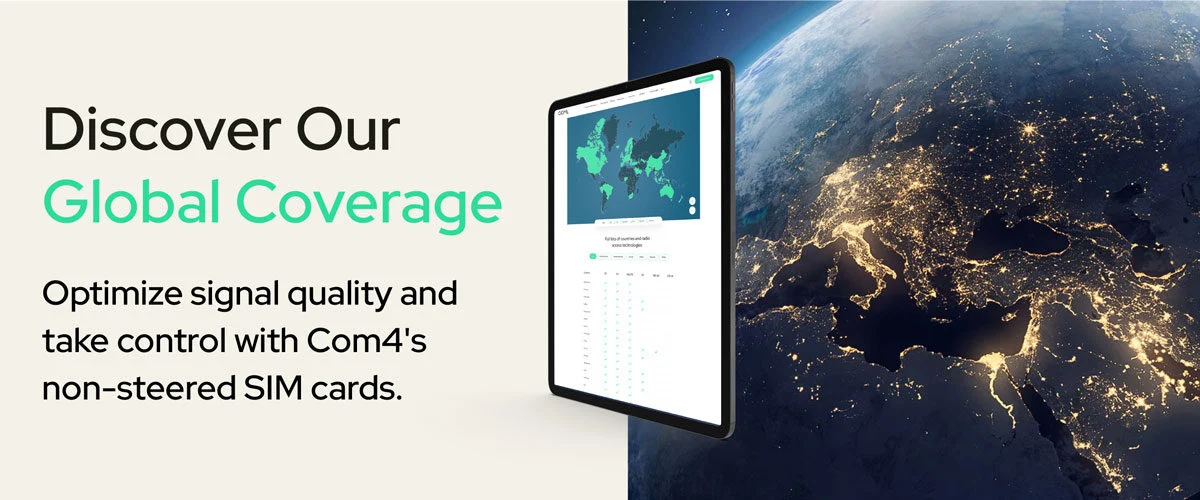
Com4 is a Nordic IoT connectivity provider and part of Wireless Logic, with 15 years of IoT experience and 1000+ customers and 20M+ connections across the group. Com4's multi-network SIMs support LTE-M, NB-IoT, 4G and 5G on one profile, with access to 750+ networks in 190+ countries and dedicated NB-IoT access across Europe. SIMs ship pre-activated, data can be pooled, traffic can run over a private APN through Com4's own mobile core based on Nokia 5G SA, and every SIM is managed in Polaris with API access. SGP.32 eSIM is available. Read more about NB-IoT and LTE-M at Com4.
Good fit for: Sensor makers and integrators deploying across several European countries who want both technologies and more than one network on one SIM.
Worth checking: NB-IoT availability per country. Com4 can confirm it network by network. Com4's support team works from 08:00 to 16:00 on all business days.
2. Telenor IoT
Telenor IoT has local operations in the Nordics and roaming agreements with 500+ networks in 200 countries. It began delivering standardised SGP.32 SIMs in April 2026.
Good fit for: Sensor deployments in Telenor's home markets.
Worth checking: How NB-IoT and LTE-M roaming works in each market outside the Nordics.
3. Telia
Telia runs national mobile networks in Sweden, Norway and Finland, with NB-IoT and LTE-M, and offers Telia Global IoT Connectivity on a Telia eSIM.
Good fit for: Single-country sensor projects in Telia's home markets.
Worth checking: A second network where Telia's coverage is weak at a sensor site.
4. Tele2 IoT
Tele2 IoT runs its own LTE-M network in Sweden and says it works with 670+ network partners in more than 190 countries. It launched a commercial SGP.32 solution with IDEMIA and Cisco in March 2026.
Good fit for: Swedish sensor deployments on an operator-run LTE-M network.
Worth checking: NB-IoT and LTE-M partner networks outside Sweden.
5. 1NCE
1NCE sells a prepaid IoT Lifetime Flat that covers a device for up to ten years for a one-off fee, with connectivity in 173 countries.
Good fit for: Very low-data sensors where a fixed, prepaid price is the deciding factor.
Worth checking: Data limits, and what happens after the flat period ends.
6. Onomondo
Onomondo has its own core network and offers non-steered connectivity on 680+ networks in 180+ countries, with its own SGP.32 eIM.
Good fit for: Developer-led sensor makers that want control over network selection.
Worth checking: NB-IoT availability per country on its coverage list.
7. emnify
emnify has a cloud-native core with access to 550+ networks in 195+ countries, supports LTE-M and NB-IoT, and launched SGP.32 with its own eSIM IoT Manager in March 2026.
Good fit for: Sensor makers who want API-led control from one European provider.
Worth checking: Pricing for very low data volumes over many years.
LTE-M and NB-IoT providers compared
| Type | Networks | SGP.32 (Nov 2026) | Good fit for | |
| Com4 | Nordic specialist, part of Wireless Logic | 750+ in 190+ countries, several per country | Available | Multi-country sensor rollouts |
| Telenor IoT | Operator group IoT unit | Own networks plus roaming, 500+ | Delivering since April 2026 | Telenor home markets |
| Telia | Nordic operator | Own network in home markets | Check with Telia | Single-country projects |
| Tele2 IoT | Swedish operator | Own LTE-M in Sweden plus 670+ partners | Commercial since March 2026 | Swedish LTE-M sensors |
| 1NCE | Global specialist | 173 countries | Check with 1NCE | Price-led, low-data sensors |
| Onomondo | Global specialist | 680+, non-steered | Available, own eIM | Developer-led makers |
| emnify | Global specialist | 550+ in 195+ countries | Available, own eIM | API-led makers |
Facts about other providers come from their own websites and press releases, checked in November 2026. Offers change, so confirm the details with each provider.
A checklist for your next provider call
- Which networks offer LTE-M and which offer NB-IoT in each country we deploy in?
- Are PSM and eDRX supported on those networks?
- Can the SIM use more than one network per country?
- Can we test sensors at real installation sites before rollout?
- How does pricing work for a few kilobytes a day over ten years?
- Do SIMs ship pre-activated, and is there an API for bulk actions?
- Is SGP.32 eSIM available?
- What are the support hours during rollout?
The short version
For sensors, choose a provider that gives you LTE-M and NB-IoT on one SIM, more than one network per country, power-saving modes that actually work on those networks, and a price model built for tiny data. Then test at real sites before you scale.
Sensors last for years. So should the connectivity decision.
Com4 can test our SIMs with your sensors where they will be installed. Start with a free IoT test kit or book a talk with our team.