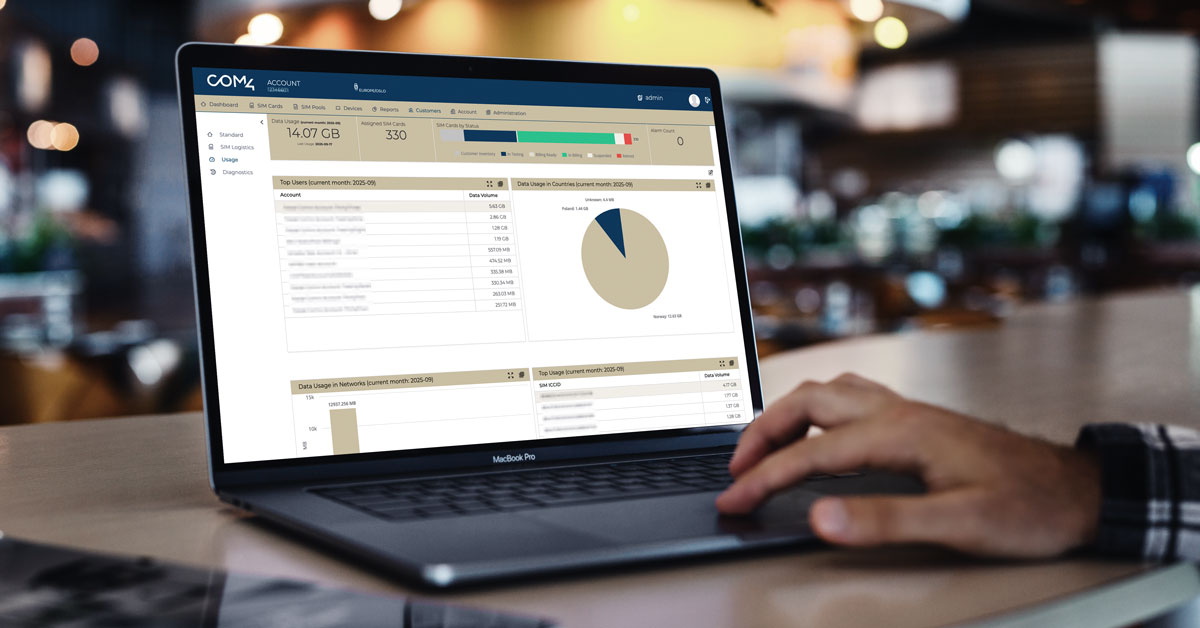
Short answer: eUICC is the best choice for connected devices that will be sold in several countries, stay in the field for many years, or must avoid lock-in to one operator, because it lets you switch operator profiles over the air instead of replacing SIM cards. It is not always the best choice for low-cost devices used in one country for a short time, where a standard or multi-IMSI SIM is simpler. The new GSMA standard for IoT is SGP.32, built for devices without a screen or user. Com4's SGP.32 eUICC SIMs are available now, alongside multi-network SIMs on 750+ networks in 190+ countries and the Polaris connectivity management platform.
The SIM is often the cheapest part of a connected device, and the hardest one to change. Once a device is built, shipped and mounted on a wall, a pole or a vehicle, swapping its SIM means a truck roll. Multiply that by thousands of devices and a ten-year life, and the SIM decision becomes one of the most expensive choices in the project.
eUICC exists to make that choice reversible. This guide explains when it is worth it, and when it isn't.
What eUICC is, in plain terms
A traditional SIM holds one operator's profile, written at the factory. An eUICC (embedded universal integrated circuit card) can hold several operator profiles and receive new ones remotely. The device keeps the same physical SIM for its whole life, while the operator behind it can change.
eUICC is not a form factor. It can be a removable SIM card or a chip soldered onto the board (MFF2). "eSIM" is often used for the same idea. Read more in Nano SIM, Micro SIM or eSIM.
Why SGP.32 changes the answer
eUICC for IoT has existed for years under the older GSMA M2M standard, SGP.02. It worked, but it was complex: each operator integration was a project, and switching between providers was hard in practice. Many companies looked at eUICC, decided it wasn't worth the effort, and stayed with roaming SIMs.
SGP.32, the GSMA eSIM IoT specification, was designed for devices without a screen or user, with tight power budgets and patchy coverage. It adds an eIM (eSIM IoT Manager) that manages profiles across a whole fleet, and an IPA (IoT Profile Assistant) on the device or the eUICC that carries out the commands. The result is a more open, standard way to move devices between operators. SGP.32 is about switching operator over the air. It is not about moving from one network generation to another.
When eUICC is the best choice
- Devices sold in many countries. One SKU for every market, with a local profile downloaded where needed.
- Markets with permanent-roaming restrictions. In countries such as Brazil and Turkey, a local profile keeps the device compliant. See permanent roaming challenges and our overview of IoT SIM regulations.
- Long device lifetimes. Smart meters, EV chargers, alarms and infrastructure that stay in place for 10 to 15 years will see operator changes, network shutdowns and new prices.
- Hard-to-reach devices. Sealed units, mounted equipment or devices on customer sites where a visit is expensive.
- Avoiding lock-in. If a provider raises prices or loses coverage, you can move without touching the hardware.
When eUICC may not be the best choice
- Short-lived or low-cost devices in one country. If the device stays local and lives three years, the extra cost and setup may not pay back.
- Modules or firmware that don't support it. SGP.32 needs support in the module or the eUICC (IPA). Check before you design it in.
- Coverage already solved by multi-IMSI. A multi-IMSI SIM with good networks in your markets may give you everything you need today.
eUICC, multi-IMSI and roaming SIMs compared
| Roaming SIM | Multi-IMSI SIM | eUICC (SGP.32) | |
| Networks | One home operator plus roaming | Several identities on the SIM | New operator profiles over the air |
| Permanent-roaming markets | Risk of blocking | Helps where a local identity exists | Local profile can be downloaded |
| Changing provider | Replace SIMs | Replace SIMs | Remote profile switch |
| Best for | Simple, short-term, single market | Multi-country coverage today | Long life, many markets, no lock-in |
The strongest setup for many fleets combines multi-IMSI and eUICC: multi-IMSI for broad coverage from day one, and eUICC to add local profiles or change provider later. Read how to replace roaming SIMs with eUICC.
What to check before choosing eUICC
- Is the eUICC SGP.32-compliant, or based on the older SGP.02 standard?
- Does your module support the IPA, or is it built into the eUICC?
- Which eIM will manage your profiles, and can you change it?
- Which operator profiles are available in your target markets today?
- How are profile switches tested and rolled back if something fails?
- What does each profile download and switch cost?
- Is the eUICC managed in the same platform as the rest of your SIMs?
- Which form factor fits your hardware: removable card or soldered MFF2?
The short version
eUICC is the best choice when you need your SIM decision to stay open: many markets, a long life in the field, or a need to avoid being stuck with one operator. SGP.32 makes it practical for IoT at scale. For simple, local, short-lived devices, a standard or multi-IMSI SIM can still be the smarter buy.
Choose the SIM you won't have to replace.
If you're deciding between eUICC, multi-IMSI and roaming SIMs, Com4 can test the options on your hardware and in your markets. Start with a free IoT test kit or book a talk with our team.