Short answer: For most 2G replacements, LTE-M is the better choice: it supports moving devices, firmware updates and lower latency, and its roaming is more widely available. NB-IoT is better for static devices that send very little data from deep indoors, such as meters. The right provider is the one that has the technology you need on more than one network in every country you sell into, with power saving features enabled and a way to test on your own hardware. Com4's multi-network SIMs support LTE-M and NB-IoT alongside 4G and 5G, with access to 750+ networks in 190+ countries.
2G was the default for IoT for twenty years. It was cheap, it was everywhere, and it worked for small amounts of data. Now it is being switched off. In Sweden, Tele2 and Telenor shut down 2G and 3G in 2025, and Telia's 2G is planned to close at the end of 2027. In Norway, Telia shut down 2G in 2025, and Telenor has said it will start shutting down from 31 December 2027. Read our full guide to LTE-M vs 2G.
For most devices, the replacement is one of the two cellular low-power technologies, LTE-M or NB-IoT. This guide explains when to pick which, and compares the providers you are likely to meet. We're Com4, so we've put ourselves first. Everything we say about other providers comes from their own public pages and press releases, checked in November 2026.
LTE-M vs NB-IoT at a glance
| LTE-M (Cat-M1) | NB-IoT (Cat-NB) | |
| Best for | Moving or interactive devices, alarms, trackers, wearables | Static devices with tiny data, meters, sensors |
| Mobility | Handover between cells, like 4G | Limited, built for devices that stay put |
| Data rate | Up to about 1 Mbit/s | Tens of kbit/s |
| Latency | Tens to hundreds of milliseconds | Seconds |
| Firmware updates over the air | Practical | Slow for large files |
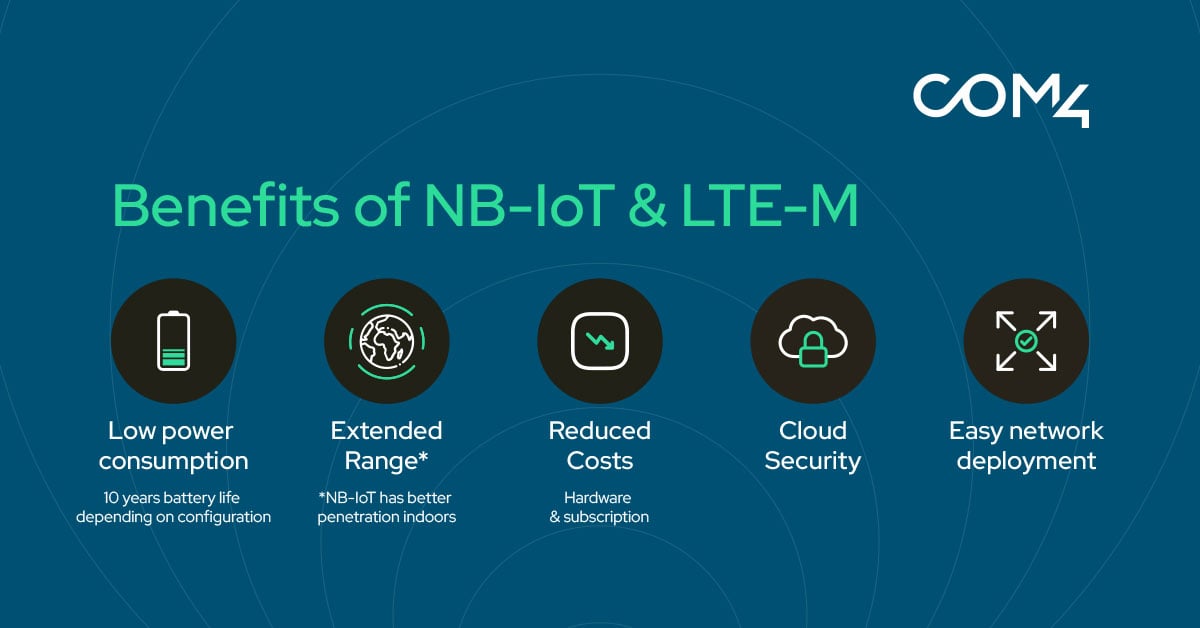
| Indoor and rural reach | Better than 4G | Best, built for deep indoor |
| Battery life | Long, with PSM and eDRX | Longest, with PSM and eDRX |
| Roaming in Europe | Widely available | Patchier, check per country |
Both technologies run on existing 4G networks and support Power Saving Mode (PSM) and extended Discontinuous Reception (eDRX), so a device can sleep for long periods and still be reachable. Figures above are typical values. Real performance depends on the module, the network and the site.
When LTE-M is the right 2G replacement
- The device moves. Trackers, vehicles, wearables and anything carried by a person need handover between cells.
- The device must respond quickly. Alarm communicators and lone worker devices need low latency for alarms and status updates.
- You need firmware updates over the air. LTE-M's higher data rate makes updates practical.
- The device crosses borders. LTE-M roaming is more widely available in Europe than NB-IoT roaming.
When NB-IoT is the right 2G replacement
- The device never moves and sends a few bytes a few times a day.
- The device sits deep indoors, in a basement, a manhole or a cabinet.
- Battery life is everything, and the device can wait seconds for a message to arrive.
- The device stays in one country, or you have checked NB-IoT roaming for every market.
Not sure? A dual-mode module that supports both, on a SIM that can use both, lets each device take the technology that works best at its site. Read about multi-IMSI SIMs for how a single SIM can use several networks.
What to look for in an LTE-M or NB-IoT provider
- Coverage per technology, per country. "Supports LTE-M" can mean one network in one country. Ask for the list of networks with LTE-M and NB-IoT in each of your markets.
- Roaming for the technology you use. Roaming on 4G does not mean roaming on NB-IoT.
- More than one network. A multi-network SIM keeps working if one operator has an outage or a gap at the site.
- PSM and eDRX enabled. Some networks limit timer values. Check that your device's sleep settings will be accepted.
- A plan for the next shutdown. eUICC with SGP.32 lets you switch IoT profiles over the air if a network changes. Read is eUICC the best choice?
- Testing on your hardware. Low-power behaviour depends on the module and the network together. Test before you order thousands.
LTE-M and NB-IoT providers for 2G migration
1. Com4
Com4 is a Nordic IoT connectivity provider and part of Wireless Logic. Com4's multi-network SIMs support LTE-M and NB-IoT alongside 4G and 5G, with access to 750+ networks in 190+ countries, so a device can use the strongest network at each site. Com4 helps customers audit 2G devices, test LTE-M and NB-IoT on their own hardware and pick the right SIM profiles. SGP.32 eSIMs are available, and every SIM is managed in Polaris, Com4's connectivity management platform. See our fire and intruder alarm and lone worker device pages for two common 2G migrations.
Good fit for: Companies replacing 2G devices in several countries who want more than one network per device and help with testing.
Worth checking: Com4's support team works from 08:00 to 16:00 on all business days.
2. Telia
Telia runs its own LTE-M and NB-IoT networks in its Nordic home markets and is keeping 2G in Sweden until the end of 2027, which gives Telia customers extra time to migrate.
Good fit for: Migrations that stay inside Telia's home markets.
Worth checking: Roaming for LTE-M and NB-IoT outside Telia's own networks.
3. Telenor IoT
Telenor IoT runs its own networks in its home markets and has roaming agreements with 500+ networks in 200 countries. It began delivering standardised SGP.32 SIMs in April 2026.
Good fit for: Existing Telenor customers moving 2G fleets to LTE-M.
Worth checking: Which roaming partners support LTE-M and NB-IoT in your markets.
4. Tele2 IoT
Tele2 IoT launched its own LTE-M network in Sweden in 2020 and says it works with 670+ network partners in more than 190 countries. It launched a commercial SGP.32 solution with IDEMIA and Cisco in March 2026.
Good fit for: Swedish fleets moving from 2G to LTE-M.
Worth checking: LTE-M and NB-IoT availability through partners outside Sweden.
5. 1NCE
1NCE offers a prepaid IoT Lifetime Flat for up to ten years for a one-off fee, with connectivity in 173 countries and support for LTE-M and NB-IoT on its network partners.
Good fit for: Low-data devices where a fixed, prepaid price matters most.
Worth checking: Which networks carry LTE-M or NB-IoT in each of your countries.
6. Onomondo
Onomondo is a Danish IoT connectivity provider with its own core network, offering non-steered connectivity on 680+ networks in 180+ countries.
Good fit for: Product companies that want control over network selection and a developer-led platform.
Worth checking: LTE-M and NB-IoT coverage per country for your device.
LTE-M and NB-IoT providers compared
| Type | LPWA approach | SGP.32 (Nov 2026) | Good fit for | |
| Com4 | Nordic specialist, part of Wireless Logic | LTE-M and NB-IoT on multi-network SIMs, 750+ networks | Available | Cross-border 2G replacements |
| Telia | Nordic operator | Own LTE-M and NB-IoT networks | Check with Telia | Home-market migrations |
| Telenor IoT | Operator group IoT unit | Own networks plus 500+ roaming networks | Delivering since April 2026 | Existing Telenor customers |
| Tele2 IoT | Swedish operator | Own LTE-M network in Sweden, 670+ partners | Commercial since March 2026 | Swedish LTE-M programmes |
| 1NCE | Global specialist | Prepaid lifetime flat, 173 countries | Check with 1NCE | Low-data, price-led devices |
| Onomondo | Global specialist | Non-steered, 680+ networks | Available, own eIM | Developer-led product companies |
Facts about other providers come from their own websites and press releases, checked in November 2026. Offers change, so confirm the details with each provider.
A checklist for your 2G migration
- List every device that still uses 2G or 3G, and where it is installed.
- Decide per device type: LTE-M, NB-IoT or dual-mode.
- Ask each provider for the networks with LTE-M and NB-IoT in every country you need.
- Confirm roaming for the technology you will use, not just for 4G.
- Check PSM and eDRX settings against your device's power budget.
- Test with real SIMs at real sites before ordering at scale.
- Plan the migration before the last 2G network in your market closes.
The short version
LTE-M is the default 2G replacement for anything that moves, responds or needs updates. NB-IoT wins for static, deep-indoor devices with tiny data. Pick the provider that can show you the networks for your technology in every country, and lets you test before you commit.
Replace 2G once, and pick a network you won't have to replace again.
If you're planning a 2G migration, Com4 can help you audit your devices and test LTE-M and NB-IoT on your own hardware. Start with a free IoT test kit or book a talk with our team.