For critical connected devices such as EV chargers, fire and intruder alarms and lone worker devices, the best IoT SIM provider gives you more than one mobile network in each country, a redundant core network, private routing for alarm and payment traffic, and a platform that shows every device in real time. Com4 serves some of the leading EV charging companies in the Nordics and supports data-based alarm transmission, with multi-network SIMs on 750+ networks in 190+ countries, a redundant mobile core based on Nokia 5G SA, SGP.32 eSIM and the Polaris connectivity management platform.
Some devices can be offline for an hour and nobody notices. Others can't. A charger that drops its connection stops earning and leaves a driver stranded. An alarm panel that can't reach the alarm receiving centre leaves a building unprotected. A lone worker device that can't send its SOS fails the one moment it exists for.
These devices have different jobs, but the same connectivity needs. This guide sets out what "critical" means for the SIM, then compares the providers most often considered. We're Com4, so we've put ourselves first. Everything we say about other providers comes from their own public pages and press releases, checked in November 2026.

What critical devices need from connectivity
- Redundancy inside each country. A SIM locked to one operator inherits every gap and outage on that network. A multi-network SIM can move to another network at the same site.
- A resilient core network. The radio network is only half the path. Ask where the provider's core runs, whether it is duplicated, and what happens if one site goes down.
- Private, secure routing. Alarm signals, positions and payment data should travel over a private APN or VPN, not the public internet.
- Networks that will stay. 2G and 3G are being switched off. Critical devices should run on LTE-M, NB-IoT, 4G or 5G.
- Real-time visibility. You need to see a device that has stopped reporting before your customer does.
- A long-term plan. eUICC and SGP.32 let you change IoT profiles over the air, so devices in the field are not tied to one contract for life.
- Clear support terms. Know the support hours and how incidents are escalated.
What each device type adds
EV charging
Chargers need a stable link to the charge point backend for session start, payments, load balancing and remote firmware updates. Uptime is revenue, and public chargers are often in car parks and garages where one network is weak. Read more on our EV charging page.
Fire and intruder alarms
Alarm panels must reach the alarm receiving centre every time, and many markets set requirements for alarm transmission paths, such as EN 50136. Data-based alarm transmission over a private APN, with more than one network available, is now the common design. See IoT connectivity for fire and intruder alarms.
Lone worker devices
Personal alarms move with the worker, into basements and rural areas. SOS events, positions and no-movement alerts are increasingly sent as data rather than as a voice call. See best IoT SIMs for lone worker devices in Europe.
IoT SIM providers for critical connected devices
1. Com4
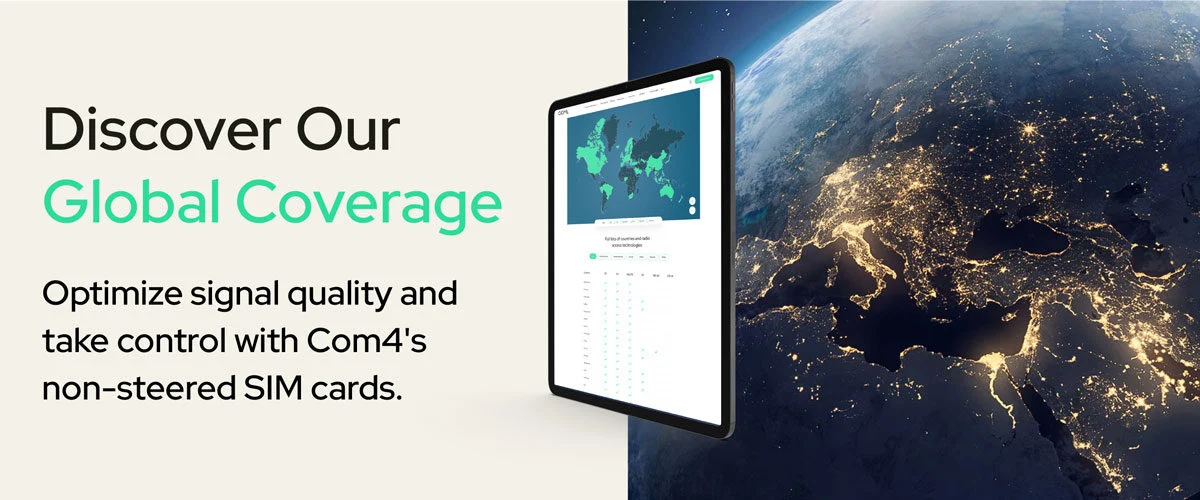
Com4 is a Nordic IoT connectivity provider and part of Wireless Logic, with 15 years of IoT experience and 1000+ customers and 20M+ connections across the group. Some of the leading EV charging companies in the Nordics, including Easee, rely on Com4. Com4 supports data-based alarm transmission for fire and intruder alarms and lone worker devices. Its multi-network SIMs can use several networks in each country, with access to 750+ networks in 190+ countries. Com4 runs its own mobile core based on Nokia 5G SA, with geographically separated data centres and a backup site in a hardened mountain facility. SIMs ship pre-activated, private APN and VPN are available, and every SIM is managed in Polaris, Com4's connectivity management platform. SGP.32 eSIM and satellite NTN are available too.
Good fit for: EV charging, alarm and personal safety companies that want redundancy inside each country and one SIM across Europe.
Worth checking: Com4 SIMs carry data, not voice, so alarm and SOS flows must be data-based. Com4's support team works from 08:00 to 16:00 on all business days, so agree how out-of-hours incidents are handled.
2. Hologram
Hologram offers access to 550+ networks in 190+ countries. Its Outage Protection SIMs carry two independent mobile cores on one SIM, and private APN, fraud detection and device locking are included.
Good fit for: Device makers selling in Europe and North America who want core-level redundancy on the SIM.
Worth checking: Support hours and local presence in your European markets.
3. emnify
emnify runs a cloud-native core with access to 550+ networks in 195+ countries, and launched SGP.32 with its own eSIM IoT Manager in March 2026. It lists EV charging among its main use cases, and Gartner named it a Visionary in its 2026 Magic Quadrant for Managed IoT Connectivity Services.
Good fit for: Teams that want API-led control from a European provider.
Worth checking: How alarm traffic is routed and which networks are available per country.
4. Onomondo
Onomondo is a Danish provider with its own core network, offering non-steered connectivity on 680+ networks in 180+ countries and its own SGP.32 eIM.
Good fit for: Developer-led device makers that want control over network selection.
Worth checking: Support model for alarm and payment use cases.
5. Telenor IoT
Telenor IoT has local operations in the Nordics and roaming agreements with 500+ networks in 200 countries, and began delivering standardised SGP.32 SIMs in April 2026.
Good fit for: Companies with an existing Telenor relationship.
Worth checking: Whether a second network is available inside each country.
6. Telia
Telia runs national mobile networks in Sweden, Norway and Finland, with NB-IoT and LTE-M, and offers Telia Global IoT Connectivity on a Telia eSIM.
Good fit for: Single-country deployments in Telia's home markets.
Worth checking: Fallback where Telia's coverage is weak at a site.
Providers for critical devices compared
| Networks | Redundancy | SGP.32 (Nov 2026) | Good fit for | |
| Com4 | 750+ in 190+ countries | Several networks per country, redundant own core | Available | EV charging, alarms, lone worker |
| Hologram | 550+ in 190+ countries | Two independent cores on one SIM | Check with Hologram | Europe plus North America |
| emnify | 550+ in 195+ countries | Multi-network, cloud core | Available, own eIM | API-led teams |
| Onomondo | 680+ in 180+ countries | Non-steered, own core | Available, own eIM | Developer-led teams |
| Telenor IoT | 500+ in 200 countries | Own networks plus roaming | Delivering since April 2026 | Existing Telenor customers |
| Telia | Own networks in home markets | Check with Telia | Check with Telia | Single-country deployments |
Facts about other providers come from their own websites and press releases, checked in November 2026. Offers change, so confirm the details with each provider.
A checklist for your next provider call
- How many networks can the SIM use in each country we deploy in?
- Where does your core network run, and what happens if one site fails?
- Can alarm and payment traffic run over a private APN or VPN?
- Which technologies are available per network: LTE-M, NB-IoT, 4G, 5G?
- How quickly can we see a device that has stopped reporting?
- Is SGP.32 eSIM available, and which profiles can we switch to later?
- Do SIMs ship pre-activated, and is there an API?
- What are the support hours, and how are incidents escalated?
The short version
Critical devices need connectivity with a plan B built in: more than one network per country, a redundant core, private routing and full visibility. Choose the provider that can show you how each of those works, not just a coverage map.
Choose connectivity for the day something goes wrong.
Com4 can test our SIMs with your chargers, alarm panels or lone worker devices. Start with a free IoT test kit or book a talk with our team.