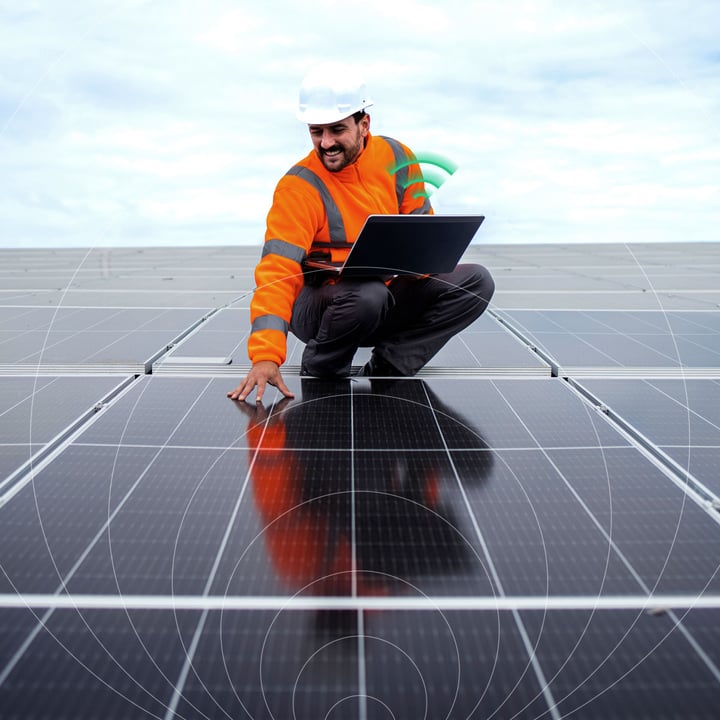
As renewable energy accelerates the transition away from fossil fuels, solar energy must be not only clean, but also reliable, scalable, and cost-efficient. This is where IoT connectivity plays a critical role.
At Com4, we work closely with energy companies, technology providers, and system integrators that rely on secure, resilient IoT connectivity to monitor, manage, and optimize solar power assets — often in remote and demanding environments.
In this article, we explore how IoT connectivity is transforming solar panel monitoring, system operations, and energy management across industrial, commercial, and residential applications.
Why Solar Power Needs IoT Connectivity
Solar energy systems are inherently distributed. A single solar farm may consist of tens of thousands of panels spread across large geographic areas. Residential and commercial systems are even more fragmented, connected to smart grids and local energy markets.
Without IoT connectivity, operators face several challenges:
- Limited visibility into real-time performance
- Difficulty identifying underperforming panels or faults
- High operational and maintenance costs
- Delayed response to failures and outages
- Inefficient use of generated energy
IoT connectivity enables continuous data collection, remote access, and centralized control, turning solar installations into intelligent, connected energy assets.
IoT-Based Solar Panel Monitoring Explained
Solar panel monitoring using IoT involves deploying connected sensors, gateways, and communication modules across solar installations. These devices collect and transmit data such as:
- Power output (current and voltage)
- Panel and inverter temperature
- Irradiance and environmental conditions
- Battery status and charge cycles
- Panel degradation, dirt, or physical damage
- System availability and uptime
Using cellular IoT connectivity — including LTE-M, NB-IoT, 4G, 5G, or satellite — this data is securely transmitted to cloud platforms where it can be visualized, analyzed, and acted upon in real time.
Industrial and Utility-Scale Solar Applications
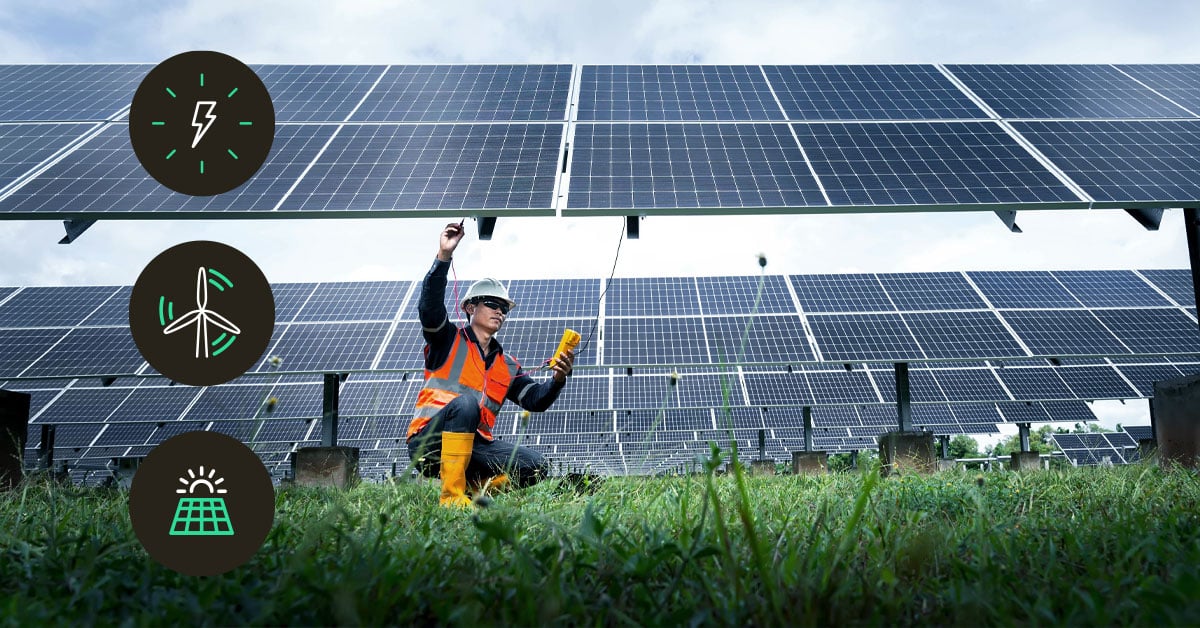
For large solar farms and grid-connected installations, monitoring goes far beyond basic energy output. Real-Time Performance and Fault Detection
IoT connectivity enables operators to:
- Monitor every string or individual panel
- Detect performance degradation early
- Pinpoint faults down to a specific component
- Compare output across zones and installations
This eliminates the need for frequent manual inspections and significantly reduces troubleshooting time.
Predictive Maintenance and Reduced Downtime
By continuously collecting operational data, energy companies can move from reactive to predictive maintenance. Patterns in temperature, voltage fluctuations, or output loss can indicate upcoming failures — allowing repairs to be scheduled before production is affected.
For solar farms in remote locations, this can save significant operational costs and reduce unnecessary site visits.
Secure Remote Operations
Many solar installations are located in rural or isolated areas. IoT connectivity supports:
- Remote system access
- Integration with security cameras and sensors
- Automated alerts in case of intrusion, vandalism, or extreme weather
With secure cellular connectivity from Com4, operators can access systems from anywhere, without relying on local fixed infrastructure.
Commercial and Residential Solar Monitoring
IoT is not limited to large-scale installations. Businesses and homeowners increasingly rely on connected solar systems to manage energy more intelligently.
Energy Visibility and Optimization
IoT-enabled monitoring allows users to:
- Track how much energy is generated and consumed
- Identify inefficient appliances
- Optimize self-consumption vs. grid export
- Monitor battery storage and charge cycles
This transparency helps reduce energy costs while maximizing the value of solar investments.
Smart Grids and Energy Trading
Connected solar systems can interact with smart grids, enabling surplus energy to be fed back into the grid or traded dynamically. Reliable connectivity is essential to ensure accurate data exchange, billing, and compliance.
Key Benefits of IoT Connectivity in Solar Energy
Centralized Control of Distributed Assets
IoT allows thousands of geographically dispersed solar assets to be managed from a single platform, improving operational efficiency and decision-making.
Lower Operational Costs
- Fewer manual inspections
- Reduced downtime
- Optimized maintenance schedules
- Faster fault resolution
Improved Energy Efficiency
By combining real-time data with analytics, operators can better balance supply and demand, forecast production, and adapt to changing conditions.
Scalability and Flexibility
As solar installations grow, IoT connectivity makes it easier to scale systems without redesigning infrastructure.
Beyond Monitoring: Expanding Solar Use Cases with IoT
Solar energy and IoT connectivity extend far beyond traditional panel monitoring.
Solar Tracking Systems
IoT-connected tracking systems automatically adjust panel orientation based on sun position, weather forecasts, and time of day — increasing energy yield without manual intervention.
Solar-Powered Mobility
Solar-powered vehicles, boats, and charging stations rely on IoT to monitor performance, battery health, temperature, and safety-critical parameters in real time.
Vegetation and Site Management
Autonomous, solar-powered robots and sensors help manage vegetation around solar farms, ensuring panels are not obstructed and performance remains optimal.
Microgrids and Off-Grid Solar
In developing regions and remote areas, IoT-enabled solar microgrids provide reliable electricity where traditional grids are unavailable. Connectivity enables remote monitoring, billing, and maintenance — critical for long-term sustainability.
The Role of IoT Connectivity in Reliable Solar Operations
Connectivity is the foundation of any IoT-based solar solution. Without reliable communication, even the most advanced sensors and analytics platforms fail to deliver value.
At Com4, we support solar and energy companies with:
- Global cellular IoT connectivity
- Support for LTE-M, NB-IoT, 4G, 5G, and satellite
- Secure, managed IoT SIM solutions
- Connectivity designed for long lifecycles and remote deployments
Solar assets are often expected to operate for 20–30 years. Choosing the right IoT connectivity partner is therefore critical to ensure long-term reliability, security, and scalability.
Solar Energy, IoT, and the Road Ahead
As renewable energy continues to expand, solar power will increasingly depend on intelligent, connected systems. IoT connectivity enables better performance, lower costs, and more resilient energy infrastructure — from utility-scale farms to residential rooftops and off-grid communities.
By combining solar energy with secure IoT connectivity, energy companies can unlock the full potential of their assets and contribute to a cleaner, smarter energy future.



.webp)
.jpg)