
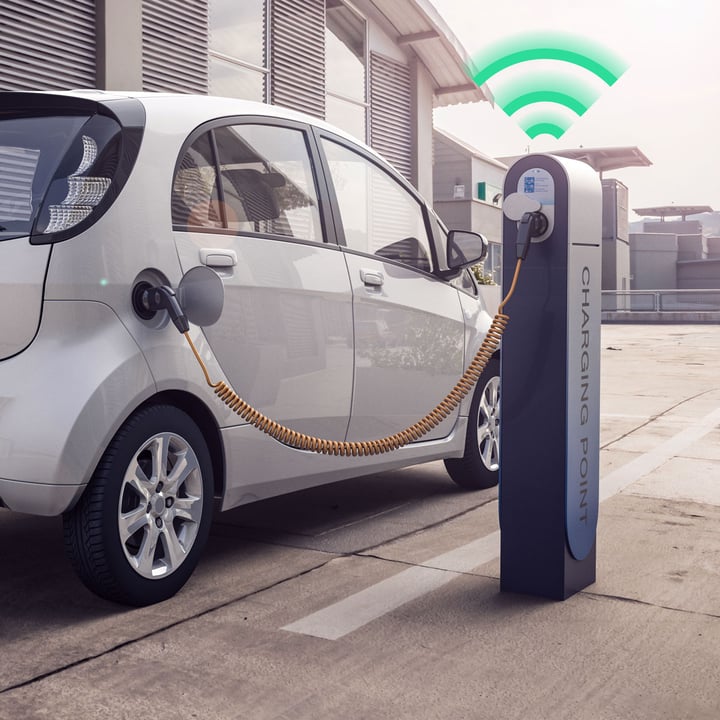
As per the IEA's report, EVs could account for around 40% of global new car sales by 2030, with that share expected to double by 2035 as entire vehicle fleets transition to electric.
While this growth is promising, it brings new challenges. Behind every EV charger lies a complex system of connectivity, data, and security. Keeping chargers online and communicating securely with the cloud is not just important; it’s essential. That’s where IoT connectivity comes in, and why more charging operators are turning to partners like Com4.
A Global Push for Reliable EV Charging Networks
From Europe to Asia to North America, the race to expand charging infrastructure is accelerating. The European Union aims for more than 15 million public charging points by 2030, while China is investing heavily to reach its goal of EVs making up more than 70 per cent of new vehicle sales within the same timeframe.
In the United States, the Department of Energy estimates there will be over 33 million EVs on the road by 2030, supported by nearly 28 million charging ports nationwide.
Globally, the EV charging infrastructure market is forecast to grow from USD 47 billion in 2025 to over USD 415 billion by 2034. The scale of this investment highlights one key reality: the EV revolution depends on reliable, secure, and scalable connectivity.
 Why Connectivity is the Heart of Every EV Charging Network
Charging networks are built on more than electricity; they rely on continuous digital communication. Each charger must authenticate users, process payments, send usage data, and receive real-time updates. Any disruption in connectivity can result in downtime, lost revenue, and frustrated customers.
Just as drivers expect fuel at a petrol station, EV owners expect chargers to work 24/7. This reliability is only possible when every charging point stays connected to the network through robust IoT connectivity, capable of handling secure data flow and real-time communication across thousands of devices.
The Moment That Defines the Customer Experience
Every EV charging session depends on one critical moment. The moment a driver plugs in, taps to pay, and expects charging to start instantly. When it works, the experience feels seamless. When it fails, the entire brand experience breaks.
Behind that moment, several systems must work in real time:
-
Payment authorization
-
Communication with backend platforms
- Charger availability and status updates
All of this depends on stable and continuous connectivity. If connectivity drops, the session fails. It does not matter how advanced the charger is. It does not matter where it is located. No connectivity means no charging.
Why Most EV Charging Failures Are Misdiagnosed
When a charger fails, the first assumption is often hardware. But in reality, many of the most common issues are caused by connectivity:
-
Card terminals that do not respond
-
Mobile app payments that fail
-
Chargers that appear offline
- Slow or frozen interfaces
These are not random faults.
They are symptoms of unstable communication between the charger and backend systems. In large-scale IoT environments, this is a known pattern. Devices appear offline even when they are fully functional. The issue is not the device. It is the connection.
Com4 sees this across thousands of deployments where uptime is critical. When connectivity is improved, failure rates drop and operational efficiency increases.
Connectivity Challenges in EV Charging Industry
As the EV charging sector grows, so do its connectivity challenges. Operators often face high deployment costs, slow fixed-line installations, and coverage gaps in remote or urban areas. Cellular IoT connectivity eliminates these barriers by allowing chargers to go online anywhere, without relying on local internet infrastructure.
Managing hundreds or thousands of chargers can also be complex. That's why an advanced Connectivity Management Platform is critical. It provides a unified view of all devices, networks, and data usage, simplifying operations and improving reliability.
Security is another major concern. With charging stations processing payments and sensitive user data, IoT security services are essential for protecting against cyber threats such as data interception, unauthorized device access, and payment fraud. As charging networks scale, so does their exposure; every additional connected charger is another potential entry point, making a consistent, network-wide security approach non-negotiable.
How is Nexcharge Scaling EV Charging Across Poland?
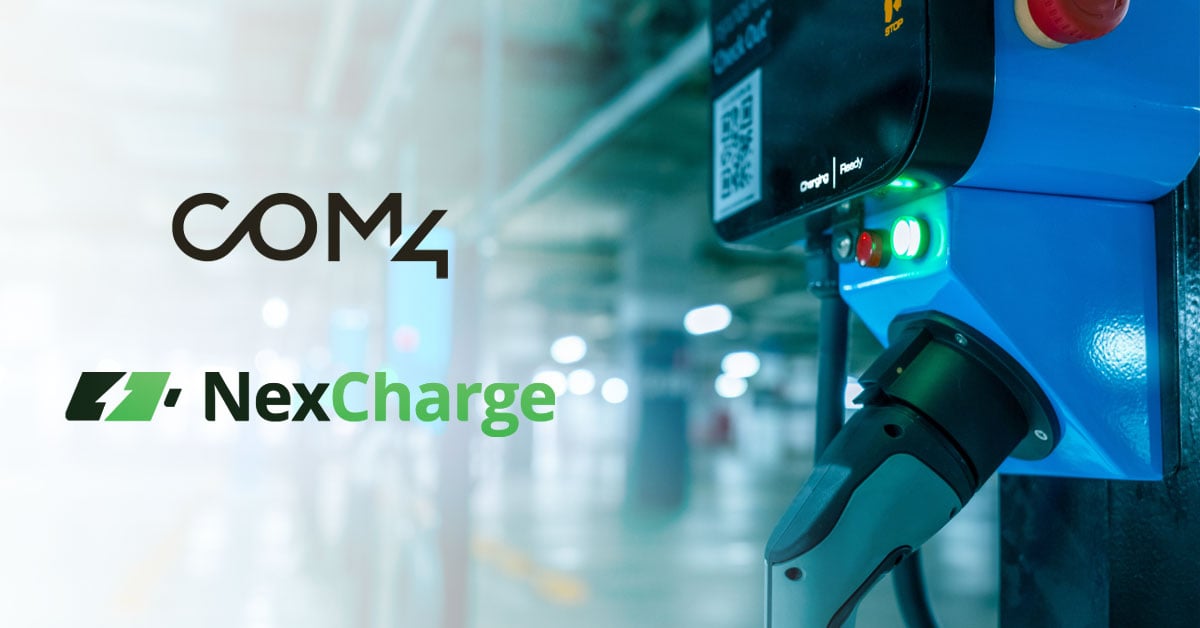
One company addressing the challenge of accessible widespread charging is NexCharge, a forward-thinking operator based in Poland. NexCharge is committed to increasing access to energy and mobility solutions in public spaces, including shopping malls, office buildings, parks, and transportation hubs.
With their offering, NexCharge delivers:
-
Inclusive solutions for people with disabilities, ensuring charging infrastructure is accessible to all.
-
A business model for owners of public spaces and companies that enables both energy cost control and revenue generation through charging services.
To support the scale and diversity of installation sites (urban centers, retail hubs, outdoor public zones, etc.), NexCharge required connectivity that is both robust and secure, capable of delivering reliable data and service across varying network conditions. By partnering with Com4, NexCharge now employs non-steered roaming SIMs that automatically connect to the strongest available mobile network across Poland.
This setup ensures each charger remains online, enabling key operations like billing, monitoring, maintenance updates, and data exchange to perform without interruption. With Private APN and VPN encryption, all communications between the charging stations and backend systems are secured end-to-end. And the Connectivity Management Platform (CMP) gives NexCharge a single dashboard to monitor and manage every connected device.
The result is a network that is dependable, secure, and designed for growth, empowering NexCharge to expand rapidly while maintaining a high-quality charging experience for every user.
Future-Proofing EV Charging with eSIM and Advanced IoT
The global shift from 2G and 3G to 4G, 5G, and LPWAN technologies means EV infrastructure must evolve too. eSIM and eUICC technology provide a future-proof solution by allowing operators to update network profiles and manage devices over the air remotely.
This flexibility means CPOs and OEMs can use a single universal SIM across all regions, reducing logistics, avoiding roaming issues, and maintaining consistent performance worldwide. As EV adoption expands through 2030, 2035, and beyond, eSIM-enabled IoT connectivity will be the key to keeping infrastructure scalable and adaptable.
Why EV Charging Operators Choose Com4
Com4 provides the connectivity backbone that powers EV charging networks globally. With access to over 750 networks in 190 countries, Com4 provides unmatched global reach and reliability. Its ISO 27001-certified infrastructure, dual-core redundancy, and compliance with OCPP 1.6 and 2.0 make it a trusted choice for mission-critical IoT deployments.
Through the Com4 Connectivity Management Platform, customers gain complete control of their SIMs, data usage, and device performance in real time. This simplifies administration, improves transparency, and helps ensure every charging station remains online and operational.
For operators like Nexcharge, partnering with Com4 means more than just connectivity. It means unlocking growth, ensuring data security, and future-proofing infrastructure for the next decade of electrification.

Looking Ahead: Connectivity as the Foundation of the EV Future
As EV adoption accelerates, charging networks will become one of the most essential components of modern transportation. Reliable IoT connectivity will determine how fast operators can scale, how efficiently they can manage their assets, and how secure their networks remain.
The partnership between Com4 and Nexcharge illustrates how advanced IoT connectivity can drive innovation, operational excellence, and sustainability. By combining secure communication, flexible management, and future-ready technologies, Com4 helps charging networks deliver on the promise of a truly connected and electrified future.
Reliable IoT connectivity is not just part of the EV revolution, it powers it.



.webp)
.jpg)