
.jpg?width=720&height=720&name=multi-IMSI-hero-2%20(2).jpg)
The wrong SIM won't reveal itself in a lab test. It will reveal itself eighteen months from now, when a batch of meters silently stops reporting, or when a regulator in Brazil enforces a permanent-roaming rule your provider never mentioned, or when your CFO asks why data costs tripled after a carrier renegotiation you weren't told about. By then the hardware is deployed, the firmware is frozen, and your options are narrow and expensive.
This piece walks through the factors that actually matter. These are the questions seasoned enterprise IoT teams ask about before they sign, and the ones inexperienced teams wish they had.
Start with the workload, not the SIM
Before you evaluate a single provider, describe your device honestly.
How often does it transmit, and how much data each time? Is it battery-powered, mains-powered, or somewhere in between? Does it need firmware over the air updates, and if so how large and how often? Where in the world will it live: one country, a handful, or genuinely global? What's the expected life of the hardware in the field?
These answers dictate everything downstream. A water meter that sends 200 bytes a day has almost nothing in common with a fleet tracker streaming location every thirty seconds, even though both are "IoT." Choosing a SIM without pinning down the workload is choosing shoes without knowing whether you're walking, running, or climbing.
With that in hand, here are the factors to press providers on.
Real LTE-M and NB-IoT connectivity, not just a checkbox
Most providers will tell you they support LTE-M and NB-IoT. Fewer can tell you where, on which local networks, and with which fallback behaviour when the preferred network is unavailable.
LTE-M and NB-IoT are the two low-power wide-area (LPWA) technologies purpose-built for IoT. They matter because they let a battery-powered device sip power instead of gulping it, and they reach into buildings and basements where regular LTE struggles. But their roaming availability is nowhere near as mature as consumer LTE. A country that has LTE-M live on one operator may not have any roaming agreement that lets your SIM use it.
Ask specifically:
- Which countries have live LTE-M roaming on your SIM today, not "coming soon" or "on the roadmap"?
- Which have NB-IoT roaming enabled, and is it stable enough for firmware updates, or only for tiny periodic payloads?
- What happens when neither is available? Does the device fall back to 2G, LTE Cat-1, or nothing at all?
- In markets where 2G and 3G are being sunset, what's the migration plan for devices already in the ground?
The fallback question is the one most buyers forget. A SIM that quietly drops off LTE-M and can't fall back cleanly will drain batteries, generate support tickets, and skew every KPI you set for the deployment. Get the fallback ladder in writing, per country.
Multi-IMSI architecture that fits your device
Multi-IMSI SIM cards give you more than one network identity, so a single SIM can present itself as a local subscriber in several countries or fall back to a second profile when the first can't attach. The value is obvious: better attach rates, fewer permanent-roaming issues, and a hedge against a single carrier deal going sideways.
What's less obvious is how differently vendors implement it, and how much that implementation matters for low-power devices.
Autonomous switching on the SIM. The SIM detects a failed attach or degraded signal and switches IMSI on its own. Best for devices that can't be trusted to help: long sleep cycles, minimal firmware headroom, no server-side connectivity between wakes.
Device-triggered switching. The device tells the SIM when to switch, usually via AT commands. More flexible, but only useful if your firmware team is willing to implement and test the logic across every device revision.
Server-side steering. A back-end platform pushes profile changes over the air. Elegant when it works, useless when the device can't reach the back end to receive the instruction, which is precisely when you needed the switch in the first place.
For a low-power device that wakes for thirty seconds and goes back to sleep, the wrong mechanism means the SIM never gets a chance to change identity before the radio powers down. Match the mechanism to your device's power profile and firmware capability, not to the diagram in the sales deck.
While you're at it, ask about eUICC (remote SIM provisioning). It's not the same thing as multi-IMSI, but it's the future most serious IoT connectivity providers are moving toward. If your hardware supports eUICC, you gain the ability to load and switch entire operator profiles remotely, which is a stronger form of the same idea and a real hedge against provider lock-in.
Coverage you can verify, not just a green map
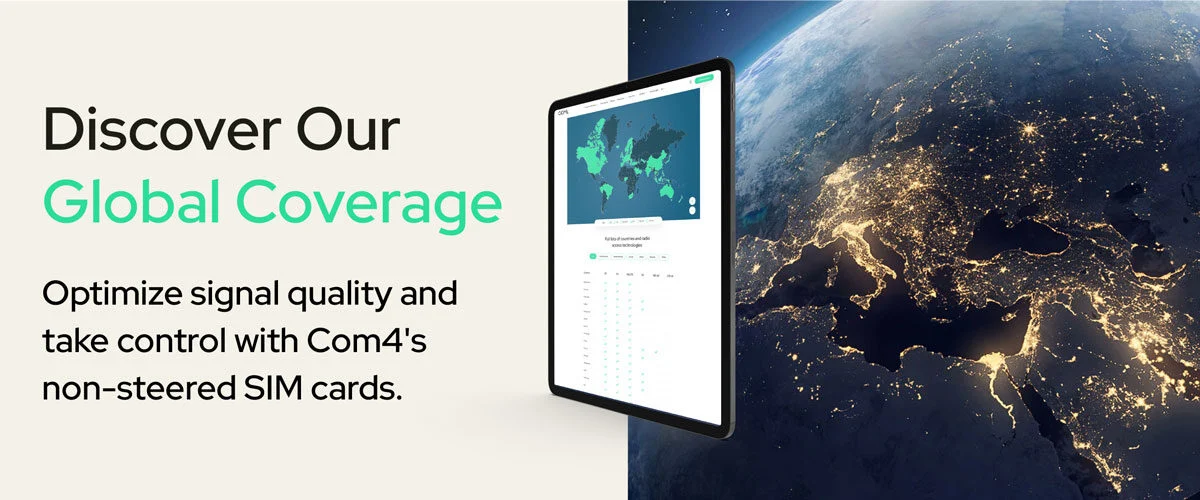
Global cellular coverage maps are the most-lied-with artefact in the industry. A country shaded green usually means "we have a roaming agreement with at least one operator here." It doesn't mean "your device will get a strong LTE-M signal in the specific warehouse, port, or rural depot where it lives."
Before signing, ask for:
- Per-country lists of the actual host networks, not just country flags.
- Signal-quality data or a pilot allowance so you can test in your real deployment sites.
- Clarity on permanent-roaming restrictions in markets that enforce them: the US, Brazil, Turkey, Canada, and a growing list of others. In these markets, a SIM that sits on a foreign network for too long can be blocked outright, regardless of how good the roaming agreement looks on paper.
- Redundancy at the operator level. If your SIM's only agreement in a given country is with a single MNO, you're one commercial dispute away from a coverage gap.
A provider that hands over this information without friction is a provider that has nothing to hide. A provider that answers with a generic map and a smile is telling you something too.
Test in the actual environment. A basement in Rotterdam behaves differently from a basement in Riga. A logistics yard next to a port with heavy RF interference is not the same as a business park. Whenever the deployment site is important, and for IoT it almost always is, insist on a pilot with real hardware before you commit to a fleet-wide rollout.
Control over your SIMs, your data, and your future
The connectivity contract you sign today is the contract you'll live with for the life of the hardware. Ask what control you actually retain over the deployment.
Visibility. Can you see per-SIM data usage, signal history, network attach events, and location (where legal), in something better than a monthly PDF? Is there an API that plugs into your own monitoring and alerting?
Policy. Can you set alerts, cap runaway consumption per SIM, apply usage bundles across groups, and suspend a rogue device yourself, or do you have to email support and wait?
Security. Are private APNs available? IPsec or VPN tunnels back to your infrastructure? Fixed IP addresses where you need them? What's the story on SIM cloning protection and IMSI privacy?
Reporting. Can you slice and export the data your finance and operations teams need without waiting on the provider to build a report?
Portability. If you outgrow this provider, can you migrate the SIMs, or the profile on eUICC hardware, to someone else without replacing the fleet in the field?
Lock-in is rarely written into the contract. It's built into the platform. A connectivity management platform that only looks good in the demo but hides the exports, throttles the API, or gates every operational lever behind a support ticket is a slow-motion trap. You'll notice a year in, when you can't answer a simple question about your own fleet without asking permission.
Migration risk, the factor most buyers underestimate
Roaming SIM replacement is not a swap. It's a project. Even if the SIM form factor is identical, you're changing APNs, IP ranges, sometimes DNS behaviour, sometimes authentication, sometimes the way devices are addressed from your platform. Devices already in the field have to be reconfigured, re-provisioned, or physically visited, and every one of those steps costs money you won't recover.
Before you commit, walk through the migration end to end with the provider.
Can they run the old and new SIMs in parallel while you cut over, so devices can be swapped without a coverage gap? What's their process for devices that fail to attach after the swap? Rollback plan? Field service coordination? How do they handle the tail, the last 5% of devices that don't come back cleanly, the ones in cabinets nobody has opened in three years? Can they help with logistics, such as pre-provisioned SIMs shipped in the exact order devices are scheduled for a visit? Who is responsible, and who pays, if a batch of devices bricks in the field because of a configuration mismatch?
A provider who has done this migration a hundred times will have crisp answers, a runbook, and named references you can call. A provider who hasn't will improvise, and you'll pay for the improvisation.
The corollary matters too: the way you enter a provider is the way you'll one day leave them. Ask up front what an exit migration looks like. A confident answer is a good sign. Hesitation, or a change of subject, is a good sign of a different kind.
Commercial terms that survive the deployment lifecycle
IoT hardware lives in the field for five to ten years. Your connectivity contract should be able to survive the same span without turning into a fight. Look for:
- Predictable pricing. Per-SIM, per-megabyte, or pooled? Overage rates? What happens to pricing at renewal? Is it indexed, capped, or open-ended?
- Fair pooling. If you're buying a data pool, does unused data roll over, expire, or get quietly rebilled?
- Real SLAs. Uptime commitments on the connectivity platform, response times on support, and, crucially, remedies when they're missed. An SLA without remedies is a letter of intent.
- Contract flexibility. Can you scale SIMs up and down as your deployment grows and contracts? Are you locked into a minimum spend that assumes best-case adoption?
The cheapest headline price at signing frequently isn't the cheapest total cost by year three. Model the full lifecycle, not just the first invoice.
The partner behind the platform
The last factor is the hardest to put on a spec sheet: the people. When something goes wrong at 2am, and eventually something will, the difference between a good provider and a bad one is who answers the phone, how quickly, and how much of your problem they own.
Watch for a named account contact who actually knows your deployment, not a rotating queue. Engineering escalation paths that don't require you to explain the basics every time. Willingness to sit in a room with your firmware team and debug an attach failure, not just point at a coverage map. A track record with deployments that look like yours: same industry, same scale, same LPWA profile.
The best IoT connectivity providers behave like an extension of your team. The rest behave like a vendor. You'll know which you have within the first ninety days.
The short version
The best IoT connectivity providers for low-power IoT network support aren't the ones with the biggest coverage map or the lowest headline price. They're the ones who can tell you exactly how their multi-IMSI SIM cards behave on the ground, hand you the data to verify it, walk you through a migration without flinching, and pick up the phone when it matters.
Choose the partner who's already thought through the ugly parts. Your devices will be in the field for a decade. Pick a SIM that will still be the right answer in year seven.
A checklist to take into your next vendor call
- Per-country list of live LTE-M and NB-IoT networks on the SIM today.
- Fallback behaviour when the preferred network is unavailable, per country.
- Multi-IMSI switching mechanism (autonomous, device-triggered, or server-side) and how it behaves under your device's power profile.
- Permanent-roaming exposure in the markets you'll deploy in.
- Pilot allowance to test in real deployment sites, with real hardware.
- Platform capabilities: visibility, policy, security, exports, APIs.
- Migration runbook, inbound and outbound. Named references who've done both.
- Commercial terms across the full hardware lifecycle, not just year one.
- SLA with real remedies.
- Named account and engineering contacts, and evidence they've supported deployments like yours.
If you're weighing a roaming SIM replacement and want a straight conversation about coverage, control, and migration risk on your specific deployment, we're happy to have it. No slides. Just the numbers, the networks, and the trade-offs that apply to your devices.




.webp)