.jpeg?width=720&height=720&name=NB-vs-LTE-hero%20(1).jpeg)
Both were standardized by 3GPP specifically to serve the low-power, wide-area use cases that 2G used to handle, and both are built to stay supported well into the 5G era. But they are not interchangeable. Choosing between them - or deciding you need both - depends on how your devices move, how much they need to send, how long they need to run on a battery, and which networks are actually available where your assets sit. This guide walks through the decision on the criteria that matter most, so you can move off 2G with a technology that fits your fleet rather than one you'll be migrating away from again in a few years.
Why 2G Replacement Can't Wait
There is no single global shutdown date. Each mobile network operator sets its own timeline based on spectrum needs and subscriber migration, and the result is a patchwork: some countries have already switched off 2G and 3G, others are phasing it out gradually through the rest of this decade.
That unevenness is part of the challenge. A device fleet spread across several countries can be compliant in one market and stranded in another, and firmware, hardware, and roaming agreements rarely transfer cleanly between network generations. Waiting for a clearer signal usually means reacting under pressure - emergency truck-rolls, rushed hardware swaps, gaps in service - instead of planning the migration on your own schedule. LTE-M and NB-IoT exist precisely to give 2G's use cases a durable landing spot within the 4G/5G ecosystem, so the earlier a fleet moves, the more choice there is in how.
LTE-M and NB-IoT at a Glance
Both are cellular LPWAN technologies delivered over licensed spectrum through the same carriers that run 4G and 5G networks. That matters for IoT buyers: both benefit from carrier-grade security and long-term operator support, and both sit inside the 5G Massive IoT roadmap rather than being a stopgap.
LTE-M (Long Term Evolution for Machines) runs on a 1.4 MHz channel and behaves much like a stripped-down 4G connection: it supports handover between cells, moderate data rates, and even voice (VoLTE), while still using power-saving modes to extend battery life.
NB-IoT (Narrowband IoT) runs on a much narrower channel of roughly 180-200 kHz, trading throughput and mobility for deeper coverage penetration and significantly lower power draw. It is built for devices that sit still and communicate very little, very rarely.
Coverage: Reach vs. Depth
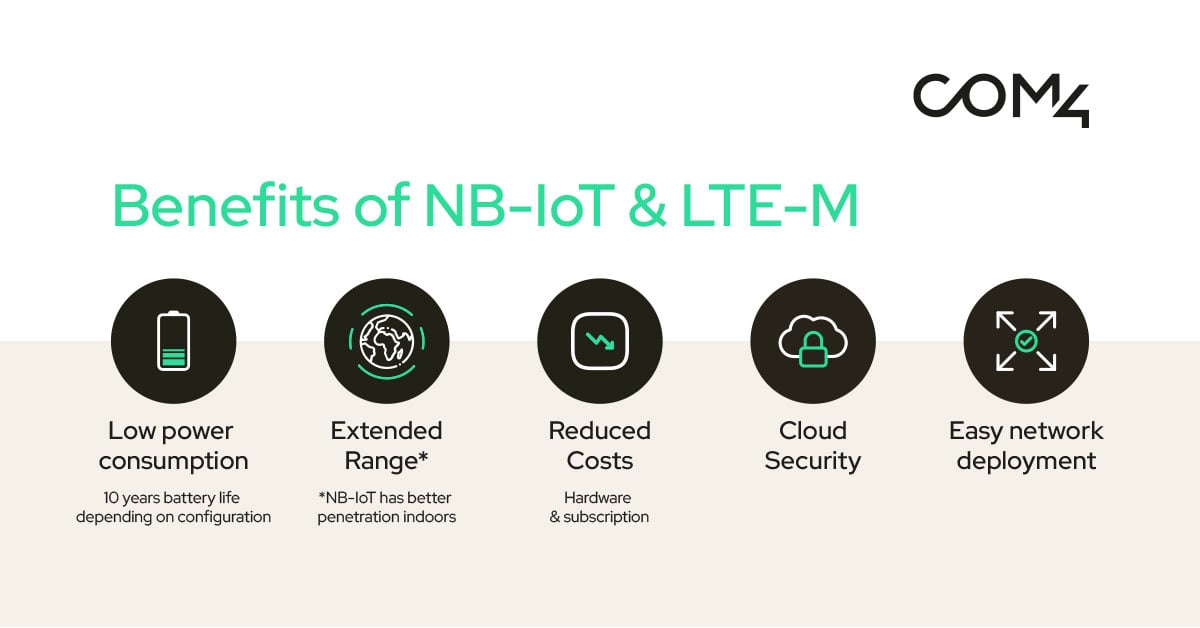
On paper, NB-IoT has the edge in the hardest-to-reach locations. Its narrow channel gives it a maximum coupling loss of around 164 dB, compared to roughly 156-161 dB for LTE-M. In practice, that difference translates into meaningfully better signal penetration into basements, meter cabinets, underground utility vaults, and deep interior spaces.
LTE-M's coverage is still strong, and for most above-ground and moderately indoor deployments, the practical difference is negligible. The distinction shows up in edge cases: a water meter in a concrete basement or a gas sensor underground is where NB-IoT's extra link budget pays off. A delivery vehicle or an outdoor asset rarely needs it.
Battery Life: Years in the Field
Both technologies rely on the same power-saving mechanisms - Power Saving Mode (PSM) and extended Discontinuous Reception (eDRX) - to let devices sleep between transmissions. The difference comes down to how much data moves and how often.
NB-IoT devices sending small, infrequent payloads routinely reach 10-plus years on a single battery. LTE-M can match that in low-traffic deployments, but its extra capabilities - mobility, more frequent transmissions, higher throughput - draw more current in practice, so typical field life sits closer to 5-10 years for devices that are more active. If a device's entire job is to report a reading once a day and otherwise stay silent, NB-IoT will generally outlast LTE-M under the same conditions. If the device needs to report more often or move around, LTE-M's power budget is still respectable - it is simply spent differently.
Mobility: Fixed Assets vs. Moving Ones
This is the cleanest dividing line between the two technologies. LTE-M supports full cell handover, so a device keeps its connection while moving between cell towers - the same mechanism a phone uses on a road trip. That makes it the only sensible choice for vehicle tracking, fleet telematics, mobile medical equipment, or any asset that needs continuous location updates while in motion.
NB-IoT has no handover support; a moving device has to drop and reselect a new cell, which introduces gaps and delay that make it unsuitable for anything beyond near-static assets. A smart meter that never leaves its installation point doesn't need handover. A tracked shipping container does.
Migration Fit: Planning Your 2G to LTE Migration
The technology choice is only half the migration. A few practical realities shape how the transition actually plays out:
- Hardware refresh is usually unavoidable. 2G/3G modules don't transition to LTE-M or NB-IoT with a firmware update alone - the radio itself has to change, which typically means a new module and, in many cases, a new device or a retrofit kit.
- Dual-mode and multi-mode modules reduce risk. Many current-generation modules support both LTE-M and NB-IoT, and often fall back to LTE Cat-1, letting the network - rather than the hardware design - decide which mode a device uses based on local coverage. This is increasingly the default choice for buyers who aren't yet certain which technology will dominate in every market they operate in.
- Roaming maturity varies by technology and region. LTE-M has broader, more established roaming agreements in some markets; NB-IoT roaming is improving but still patchier in parts of the world. For fleets that cross borders, this can matter more than the raw technology comparison.
- Firmware updateability differs sharply. LTE-M's higher bandwidth supports fast, reliable over-the-air firmware and security patches. NB-IoT's low throughput makes large OTA updates slow and power-intensive - fine for a device that never needs a substantial update, a real constraint for one that will.
- Network breadth and carrier neutrality. A provider that connects to hundreds of networks across many countries - rather than reselling a single carrier's footprint - gives you more flexibility as 2G shutdown dates and coverage quality shift market by market.
- Multi-IMSI and eSIM/eUICC support. The ability to switch a device between carrier profiles remotely, without a physical SIM swap, matters most for fleets that are hard or expensive to visit in person.
- A connectivity management platform (CMP). At fleet scale, visibility into usage, connection status, and diagnostics across thousands of devices is what turns a connectivity contract into something operationally manageable.
- Support for both LTE-M and NB-IoT - and LTE Cat-1 - from one platform. Since most enterprise fleets end up running a mix of static and mobile devices, a provider that supports multiple technologies under one contract and one management layer avoids splitting operations across vendors.
- Security and compliance handling. VPN/APN options, regulatory support across markets, and a track record with fleets of similar size reduce the operational load on your own team.
None of this needs to be solved perfectly on day one. A staged plan - piloting on one technology across a subset of the fleet, keeping dual-mode hardware as an option, and setting a clear cutover date ahead of the local 2G/3G shutdown - tends to outperform a single big-bang switch.
Choosing Among IoT Network Providers
Once the technology decision is made, the provider decision determines how much of the migration's complexity you have to manage yourselves. A few criteria are worth weighing regardless of which technology you land on:
LTE-M vs NB-IoT: The Comparison at a Glance
|
Feature |
LTE-M |
NB-IoT |
|
Channel bandwidth |
1.4 MHz |
~180-200 kHz |
|
Peak data rate |
Up to ~1 Mbps |
Up to ~200 kbps |
|
Typical latency |
10-100 ms |
1.6-10+ seconds |
|
Mobility / handover |
Full cell handover |
Cell reselection only |
|
Coverage (max coupling loss) |
~156-161 dB |
~164 dB |
|
Typical battery life |
5-10 years |
10+ years |
|
Voice (VoLTE) |
Supported |
Not supported |
|
OTA firmware updates |
Fast, reliable |
Slow, power-intensive |
|
Best fit |
Moving or data-heavier assets |
Static, low-data, hard-to-reach assets |
Decision Checklist
Use this as a starting point when mapping your 2G replacement plan against LTE-M and NB-IoT:
|
If your priority is... |
Choose |
|
Devices that move (vehicles, mobile assets) |
LTE-M |
|
Deepest indoor / underground coverage |
NB-IoT |
|
Larger or more frequent data payloads |
LTE-M |
|
Maximum battery life on infrequent data |
NB-IoT |
|
Voice or two-way real-time control |
LTE-M |
|
Lowest module cost at large scale |
NB-IoT |
|
Fast, reliable OTA firmware updates |
LTE-M |
|
Long-life static sensors |
NB-IoT |

Making the Call
There is no universal answer to LTE-M vs NB-IoT - the right one depends on what the device actually does. Choose LTE-M when devices move, need voice, send moderate-to-large data volumes, or require frequent firmware updates. Choose NB-IoT when devices are static, send small amounts of data infrequently, sit in hard-to-reach locations, and need to run untouched for a decade.
Many enterprise fleets need both, alongside LTE Cat-1 for use cases in between - which is why the practical decision often isn't “LTE-M or NB-IoT” but “which provider can give us both, plus the coverage and management tools to run them well, before the local 2G network goes dark.”
Com4 delivers managed IoT connectivity that brings LTE-M, NB-IoT, 4G, 5G, and satellite together under one carrier-agnostic platform, with eSIM and iSIM support across hundreds of networks worldwide - so your 2G replacement plan isn't limited to a single technology or a single carrier's coverage map.




-1.jpeg)