
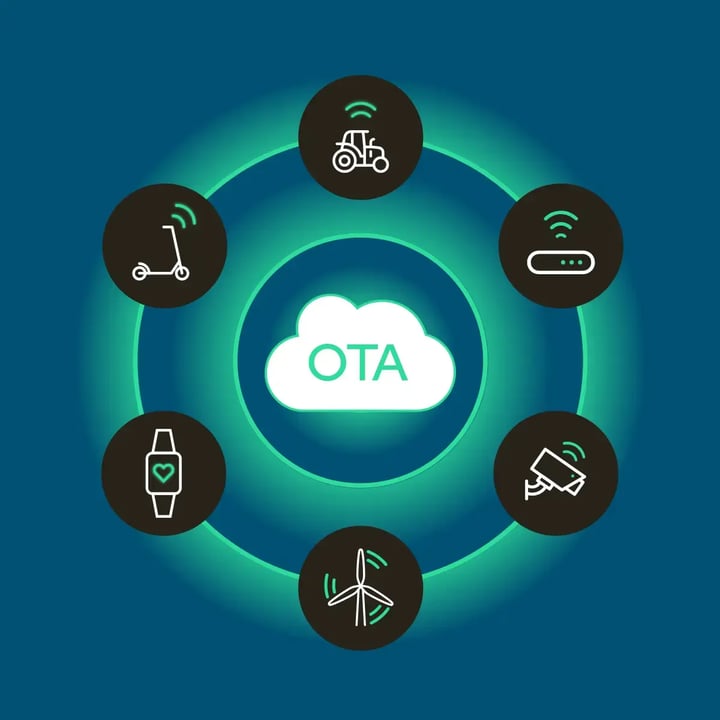
This guide is a deep dive into SIM OTA, Com4's core capability as a cellular IoT connectivity provider: how over-the-air SIM provisioning actually works, the difference between Multi-IMSI and eUICC, and how real Com4 customers manage connectivity remotely at scale.
Key takeaways:
- SIM OTA lets Com4 remotely activate, reconfigure, and manage a SIM's connectivity for the life of a deployment, without a technician ever visiting the device.
- Traditional SIM OTA provisioning runs over A2P SMS or HTTP, both of which work without requiring a persistent data session.
- eUICC (often called eSIM) allows a single SIM to host multiple operator profiles that can be added, removed, or switched entirely over the air.
- A2P SMS (Application-to-Person Short Message Service). The connectivity provider sends the SIM a specially formatted SMS message containing the update or command. Because it rides on the SIM's signaling channel rather than a data session, A2P SMS-based OTA works even when the device is not actively online or does not have an open data connection, which makes it a reliable fallback channel for provisioning commands.
What is OTA in IoT, and why does it matter?
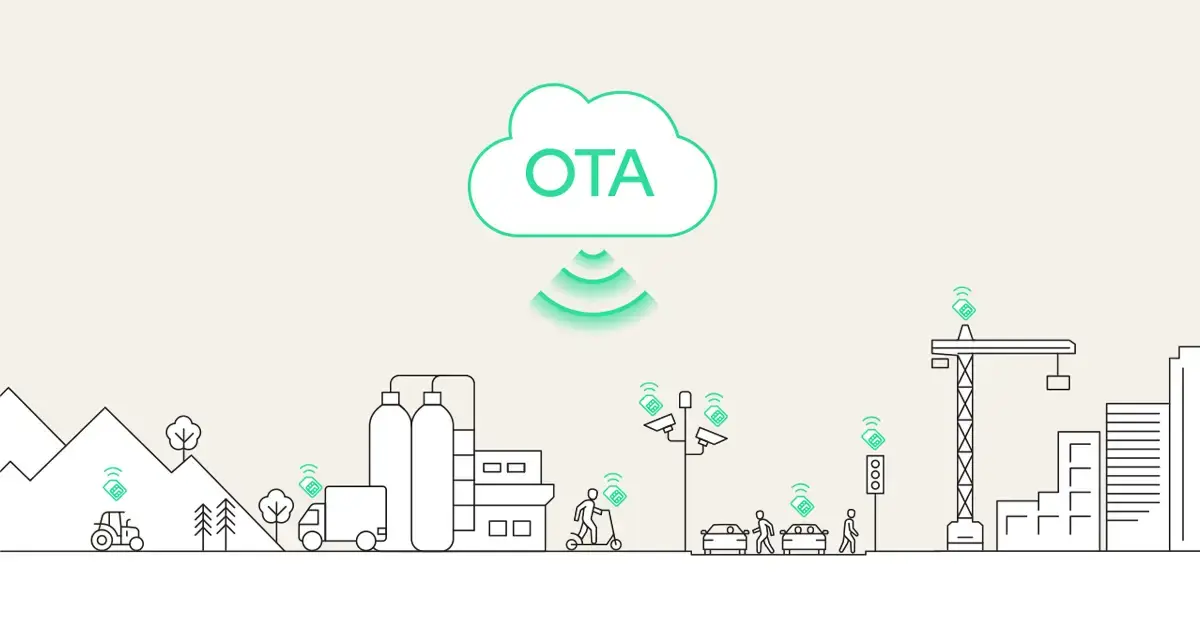
For any IoT deployment beyond a handful of pilot devices, physical access is the constraint that shapes almost every other decision. A device buried in a utility cabinet, mounted on a wind turbine, installed in a basement, or scattered across hundreds of retail locations cannot be visited every time something needs to change. OTA solves this by using a device's own connectivity to receive updates remotely, at scale, on a schedule someone else controls.
For Com4, that "something" is the SIM itself: its configuration, activation status, and network profile, owned and managed by the cellular connectivity provider, and delivered remotely over the device’s existing connection, without a technician ever needing to visit it.
How OTA Works
Over-the-air (OTA) updates allow IoT devices to receive new software, firmware, configuration, or connectivity settings without a technician on site. The process usually follows five steps:
-
The update package is built, signed with a private key, and matched to the right device model or SIM profile.
-
The package is hosted on a cloud service, OTA platform, or Remote SIM Provisioning system.
-
The device checks in over MQTT, HTTPS, CoAP, LwM2M, SMS, or a cellular management channel.
-
The device downloads the package, verifies the signature, checks the version, and confirms compatibility before installing it.
-
The device reports success, failure, or rollback status to the backend.
For firmware, safe OTA usually uses two memory slots. The device keeps the old version in one slot, writes the new version to the other, then rolls back if boot checks fail. Firmware and SIM OTA solve different remote update problems. Firmware OTA changes the device software, while SIM OTA changes the connectivity profile or SIM configuration.
Types of OTA in IoT
OTA in IoT splits into firmware and connectivity. Both follow the same sequence, though stakes, transport, and standards differ.
Firmware OTA
Firmware OTA updates a device's operating system, drivers, modem firmware, or application binary. A failed update can brick the device or expose it to attack.
The new image writes to an inactive partition, A/B architecture, while the device runs on the active one. The bootloader verifies it before switching, then rolls back on failure.
Delta updates transfer only the changed image portions, cutting bandwidth and power on NB-IoT and LTE-M. MCUboot handles microcontrollers, Mender covers embedded Linux, and AWS IoT Device Management or Azure Device Update covers cloud fleets.
SIM OTA
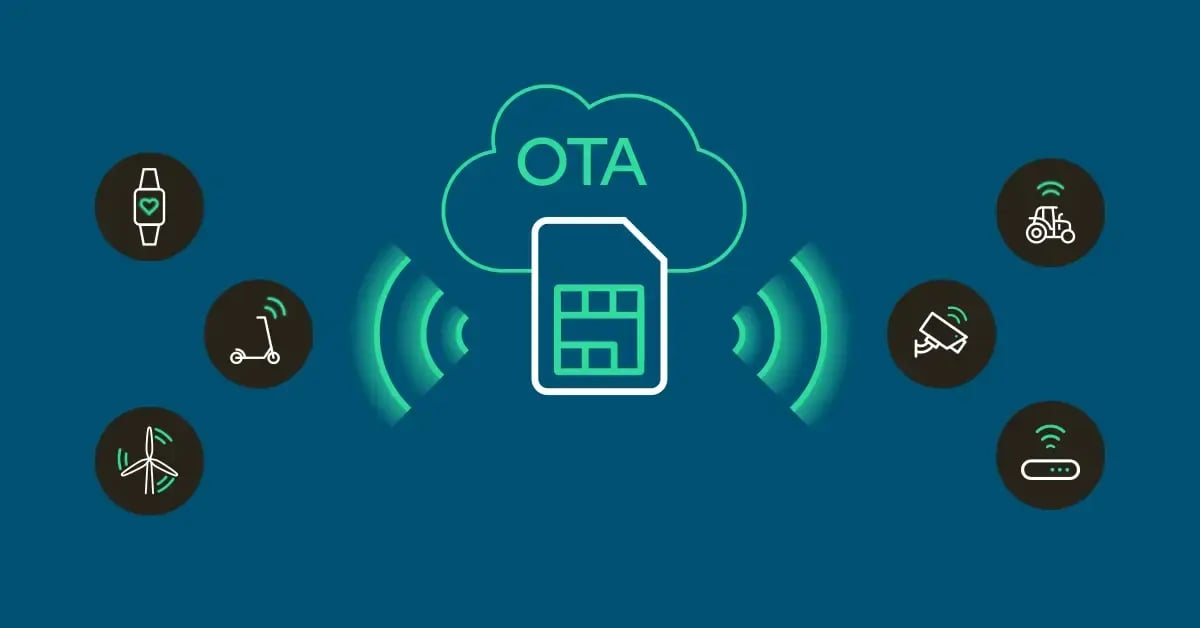
SIM OTA, or remote SIM provisioning, downloads, enables, disables, or deletes operator profiles on an eUICC without a physical SIM swap. GSMA standards govern the process: SGP.02 for M2M and industrial use, SGP.22 for consumer devices with a UI, and SGP.32 for headless devices needing zero-touch, fleet-scale provisioning.
The device authenticates to the subscription manager, downloads an encrypted profile, and installs it in the eUICC's secure element. The previous profile is disabled or deleted per policy, and the device connects to its new network using the newly enabled credentials.
Fleets can switch network operators or launch the same hardware into a new market without touching the device.
Multi-IMSI vs eUICC: two different approaches to OTA network switching
Both Multi-IMSI and eUICC use OTA to let a single SIM connect across multiple mobile networks, but they solve the problem differently, and the difference matters for how much control you retain over your connectivity.
|
|
Multi-IMSI |
eUICC (eSIM) |
|
What's stored on the SIM |
Multiple IMSIs (network identities) pre-loaded by the connectivity provider |
Multiple full operator profiles, provisioned and managed via GSMA-standardized remote provisioning |
|
How switching happens |
Managed by the connectivity provider, based on configured network priority and availability among the pre-loaded IMSIs |
Profiles can be downloaded, switched, or revoked over the air — the specifics depend on which eUICC specification (e.g., consumer vs M2M) is used |
|
Who controls network choice |
The connectivity provider, based on which IMSIs were pre-loaded |
Typically the device owner, within the scope of profiles made available — though this can also be fully controlled by the connectivity provider |
|
Best fit |
Straightforward multi-network coverage across a fixed, pre-approved set of networks, managed by the provider |
Long-term flexibility, including the ability to switch primary connectivity provider entirely, without a hardware change |
Com4 supports both approaches, and both are carrier-agnostic within Com4's network estate: SIMs can automatically switch across more than 750 networks in over 190 countries without manual intervention, while eUICC and eSIM formats add the ability to provision or change operator profiles entirely over the air.
Today, Com4 provisions eUICC as standard across its SIM estate, so that flexibility is built in by default rather than something you need to request separately. Multi-IMSI remains useful for deployments that only need fixed, provider-managed multi-network coverage. For fleets that need to launch the same hardware into multiple markets, or that may need to switch providers over a long device lifecycle, eUICC's full profile portability is the stronger long-term fit. Com4's guide to Multi-IMSI SIMs covers this decision in more depth, and the eSIM technology page has the eUICC specifics.
OTA provisioning with eUICC and eSIM
eUICC, the Embedded Universal Integrated Circuit Card, is the piece of technology that makes eSIM more than just a smaller SIM. It allows a single physical or embedded SIM to host multiple operator profiles, and, through a remote SIM provisioning (RSP) platform, those profiles can be added, removed, or switched entirely over the air.
This matters most at the manufacturing stage of an IoT deployment. A device can ship with a single bootstrap profile loaded at production, then have its operational, market-specific profile provisioned remotely once it reaches its actual deployment location, whether that is a different country, a different primary network, or simply a different customer contract. Without eUICC, that same flexibility would require physically swapping the SIM in every unit before or after shipping.
Why OTA Is Both the Fix and the Attack Surface
OTA keeps IoT fleets secure, pushing security patches, bug fixes, and certificate rotations to devices that are meant to be in the field for years. The EU Cyber Resilience Act directly addresses the lack of timely security updates for connected products and requires manufacturers to provide security updates during the support period.
The same channel also creates risk. OTA has permission to change the device’s most trusted layers. If an attacker compromises the update server, signing keys, provisioning flow, or download path, the damage can spread across an entire fleet.
Common failure points include:
-
Unsigned firmware, which allows malicious payloads.
-
Weak TLS checks, which allow package substitution.
-
No anti-rollback control, which lets devices accept older vulnerable versions.
-
No A/B storage, which can brick devices during a power loss.
-
Poor fleet visibility, which hides failed or partially updated devices.
Treat OTA as production infrastructure, not a convenience feature. Use asymmetric signing, secure boot, staged rollouts, rollback, device identity, and post-update reporting before scaling beyond a pilot.
Is SIM OTA right for your IoT deployment?
In most industrial, commercial, and consumer IoT applications, devices are difficult, expensive, or simply impractical to physically access once deployed, which is exactly the scenario SIM OTA is built for. Before you scope a deployment, it is worth being clear about what is actually in scope: network switching and profile management, delivered over the air through SIM OTA, alongside activation and suspension handled through Com4’s connectivity management platform — all without a site visit required.
This makes it much easier to understand exactly what a cellular IoT connectivity partner like Com4 is, and is not, responsible for.
Choosing the Right OTA Approach for IoT
There's no single correct OTA setup. The right approach depends on fleet size, hardware, connectivity, and how much control the team wants to own. The following decision matrix will help you to choose the ideal OTA path:
| Decision Factor | Best OTA Approach | Why It Fits |
| Small fleets and early prototypes | Native SDK OTA or a lightweight managed OTA platform | Small fleets are easier to test, monitor, and recover if an update fails. |
| Fleets in the thousands | Managed OTA platform with staged rollouts, rollbacks, and fleet observability | Large fleets need canary releases, failure tracking, rollback, and version visibility across devices. |
| Constrained microcontrollers | MCU boot-based OTA with dual-bank flash | Dual-bank flash keeps the working image safe while the new image installs. |
| Embedded Linux gateways | Mender, AWS IoT, Azure Device Update, or a similar full OTA platform | Linux gateways can support full images, application updates, containers, and richer telemetry. |
| NB-IoT or LTE-M devices | Delta updates, resumable downloads, and lightweight protocols | These devices need smaller payloads, restart-safe downloads, and low-power update sessions. |
| Always-on cellular or Wi-Fi devices | Full image OTA, with delta updates where cost or speed matters | Larger downloads are easier here, but delta updates still cut cost and network load. |
| Connectivity profile changes | SIM OTA using eUICC Remote SIM Provisioning, especially SGP.32 for headless IoT | Firmware OTA cannot change operator profiles or manage SIM connectivity after deployment. |
| Regulated or security-sensitive products | OTA with signed manifests, audit logs, staged rollout evidence, rollback, and version history | Teams need proof of what changed, when it changed, and which devices failed. |
| Com4 cellular IoT deployments | Firmware OTA for device software, SIM OTA for connectivity management | Firmware OTA updates software. SIM OTA keeps connectivity manageable across countries and operators. |
Real-world SIM OTA and remote connectivity management: Com4 customer examples
Dignio: OTA connectivity lifecycle management for a regulated medical device. Dignio's Pilly smart pillbox is deployed across more than 50 Norwegian counties and into Denmark, running on Com4's SIM technology over a private network with private APNs, end-to-end encryption, and auditable connectivity logs supporting GDPR, MDR, and IEC compliance. Com4 provides lifecycle management that keeps the connectivity layer compliant from first activation through end of life, meaning SIM status, security parameters, and network configuration can be managed remotely for the device's entire operational life, without a home visit just to update connectivity settings.
Gomero: remote connectivity management across nine countries. Gomero collects real-time equipment data for more than 100 companies across nine countries, enabling predictive rather than scheduled maintenance. Running that many connections across that many markets depends on centralized, remote management of SIM status and network performance rather than manual, per-device intervention, which is exactly the role Com4's Polaris CMP plays through SIM OTA provisioning.
ZetaDisplay: reliable connectivity as the foundation for the customer's own remote updates. ZetaDisplay's digital signage runs in locations including bus stops, the Oslo Airport Express Train, and Oslo Central Station, connected via industrial 4G modems and Com4 SIMs. Time-critical information, such as train departures, can be updated within seconds through ZetaDisplay's own cloud-based content management system, over the same secure, VPN-protected connection provisioned and managed by Com4. Com4 is not the one pushing those content updates, that is ZetaDisplay's platform, but the always-on, remotely manageable SIM connectivity underneath is what makes that kind of near-instant remote update possible at all.