
Each was engineered around a different tradeoff between range, power consumption, bandwidth, mobility, and infrastructure cost, and none of them is objectively "best." The right choice depends entirely on what a specific device actually needs to do. This guide breaks down the technical specifications behind each option, in detail, and walks through a decision framework for matching device requirements to the right network the first time.
Key takeaways:
- NB-IoT and LTE-M are both cellular LPWAN standards running on operator infrastructure, but they trade very different amounts of data rate for power efficiency and mobility support.
- LTE Cat-1 sits between LTE-M and full 4G, delivering up to 10 Mbps downlink and 5 Mbps uplink for IoT use cases that need more bandwidth than metering-style sensors.
- LoRaWAN is not a cellular standard at all. It runs on infrastructure the deploying business owns, trading that control for the lowest per-device cost at scale on a single site.
- Maximum Coupling Loss (MCL) is the technical measure of how deep a network's signal can penetrate, and it is a better predictor of real-world indoor and underground coverage than headline speed figures.
- Getting the network choice wrong is expensive to fix after hardware ships, since most of these standards are not interchangeable without a hardware or SIM change.
- Com4 provisions NB-IoT, LTE-M, Cat-1, standard 4G, and 5G connectivity, and helps businesses map device requirements to the right network before committing to hardware.
.jpg?width=1200&height=628&name=LoRaWAN-Chart%20(1).jpg)
What actually separates these four network options?
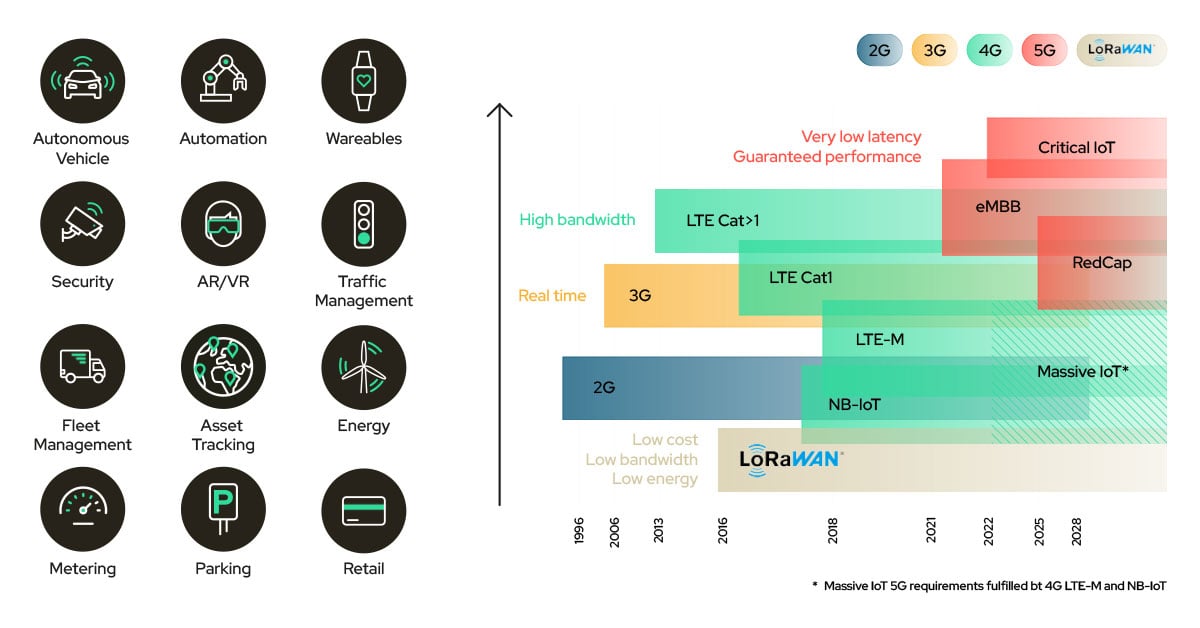
At a technical level, NB-IoT, LTE-M, and Cat-1 are all cellular standards defined within the same 3GPP LTE family, meaning they run on existing mobile operator infrastructure and are provisioned through a SIM card exactly like standard 4G. LoRaWAN is architecturally different: it operates on unlicensed spectrum through gateways that a business typically owns and maintains itself, not through a mobile operator's network. That single distinction, cellular versus self-deployed infrastructure, is the first and most important fork in the decision tree, before data rate or power consumption even enter the conversation.
NB-IoT: for simple, stationary, battery-powered sensors
NB-IoT (Narrowband IoT) is purpose-built for devices that send small amounts of data infrequently and need to run untouched on a battery for years. It uses a narrow, roughly 200 kHz channel bandwidth, which is what gives it exceptional power efficiency and deep signal penetration into basements, underground utility vaults, and dense building interiors. The original NB1 specification delivers a peak data rate around 26 Kbps downlink and 66 Kbps uplink; the newer NB2 standard roughly doubles that, to around 127 Kbps downlink and 159 Kbps uplink. NB-IoT's Maximum Coupling Loss (MCL) of 164 dB is the highest of the cellular options here, meaning it can maintain a connection through more physical obstruction than LTE-M or Cat-1, which is exactly why it is the default choice for smart water and gas meters, environmental sensors, and asset tags in fixed, hard-to-reach locations.
LTE-M (Cat-M1): for mobile or moderate-data devices
LTE-M, standardized as Cat-M1, uses a wider 1.4 MHz channel bandwidth than NB-IoT and delivers meaningfully higher throughput, up to around 1 Mbps, with typical downlink performance closer to 300 Kbps. Critically, LTE-M supports handover between cell towers, meaning a device can move between coverage areas and stay connected the way a phone does, which NB-IoT does not reliably support. LTE-M's MCL sits at 160.7 dB on 4G networks (164 dB where 5G NR support is available), slightly lower than NB-IoT's, trading a small amount of penetration depth for mobility and data rate. LTE-M also supports voice fallback in some implementations, which NB-IoT does not. That combination makes it the right choice for anything that travels: vehicle trackers, mobile payment terminals, and portable medical devices.
LTE Cat-1: for cellular IoT that needs more bandwidth
LTE Cat-1 sits between LTE-M and full consumer 4G in capability, delivering up to 10 Mbps downlink and 5 Mbps uplink, several times the throughput of LTE-M, while still being priced and positioned for machine-to-machine and IoT use cases rather than smartphone-grade connectivity. Its Maximum Coupling Loss is higher than both LTE-M and NB-IoT, since Cat-1 was not designed around the same extreme power and range optimization. Cat-1 suits applications like connected point-of-sale terminals, digital signage, and telematics systems that need meaningfully more bandwidth than a metering-style sensor but do not require the full complexity and cost of a standard 4G module. A related variant, Cat-1bis, simplifies the antenna configuration to reduce module cost further while keeping similar performance.
LoRaWAN: for private, site-based sensor networks
Unlike the three cellular options above, LoRaWAN does not run on mobile operator infrastructure at all. It requires deploying and maintaining your own gateways, or subscribing to a shared regional network where one exists. In exchange for that infrastructure responsibility, LoRaWAN can be significantly more cost-effective at scale on a single, fixed site, such as a factory, farm, port, or campus, where the business controls the coverage area and devices never need to roam beyond it. Com4's dedicated guide to LoRaWAN covers its network architecture, device classes, and frequency bands in full technical detail.
Technical specification comparison: NB-IoT vs LTE-M vs Cat-1 vs LoRaWAN
|
|
NB-IoT |
LTE-M (Cat-M1) |
LTE Cat-1 |
LoRaWAN |
|
Channel bandwidth |
~200 kHz |
1.4 MHz |
1.4 to 20 MHz |
Sub-GHz unlicensed |
|
Peak data rate |
~26 Kbps down / 66 Kbps up (NB2: ~127/159 Kbps) |
~300 Kbps down, up to 1 Mbps |
10 Mbps down / 5 Mbps up |
Very low (bytes per message) |
|
Maximum Coupling Loss (MCL) |
164 dB |
160.7 dB (4G) / 164 dB (5G) |
Higher than LTE-M/NB-IoT |
Highly variable by environment |
|
Mobility / handover |
Limited |
Full cell-to-cell handover |
Full cell-to-cell handover |
None, no managed handover |
|
Power efficiency |
Excellent, multi-year battery life |
Good |
Moderate |
Excellent |
|
Network ownership |
Mobile operator |
Mobile operator |
Mobile operator |
Self-deployed or shared gateways |
|
Voice support |
No |
Yes, in some implementations |
No |
No |
|
Typical module cost |
Low |
Moderate |
Moderate to higher |
Low (device), variable (gateway infrastructure) |
Why does Maximum Coupling Loss matter more than headline speed?
Maximum Coupling Loss, or MCL, measures the total signal loss a network can tolerate between a base station and a device while still maintaining a usable connection, expressed in decibels. A higher MCL means a network can maintain connectivity through more walls, more depth underground, or over a longer distance, which makes it a far more useful figure for predicting real-world coverage than peak data rate. This is precisely why NB-IoT, despite having the lowest throughput of the cellular options, is often the right choice for devices installed in basements, underground utility chambers, or deep inside industrial equipment: its narrow bandwidth is what buys the extra coupling loss budget.
How to choose: a step-by-step decision framework
Work through these questions in order, since each one eliminates options rather than ranking them:
- Does the device need to move and stay connected across coverage areas? If yes, that points to LTE-M or Cat-1, since NB-IoT and LoRaWAN do not reliably support handover-based mobility.
- Do you control the deployment site, and is it a single, fixed location? If yes, and the device count is high enough to justify gateway infrastructure, LoRaWAN is worth evaluating for cost efficiency at scale.
- How much data does the device send, and how often? Infrequent, small payloads favor NB-IoT or LoRaWAN; richer, more frequent data points to LTE-M or Cat-1.
- How long does the battery need to last without replacement? Multi-year battery life strongly favors NB-IoT or LoRaWAN over LTE-M or Cat-1, which draw more power to support higher throughput and mobility.
- How deep or obstructed is the installation location? Basements, underground vaults, and dense building interiors favor NB-IoT's higher MCL over LTE-M or Cat-1.
- Does the device need voice fallback or firmware updates requiring higher bandwidth? If so, LTE-M or Cat-1 are the only realistic options among the cellular standards.



.jpg)