
Different LTE profiles exist because IoT devices have different needs. Some focus on low power use. Others support mobility or higher data rates. These choices affect battery life, performance and device cost.
Here we will learn about the different types of LTE, what each one is designed for and how to choose the right option for an IoT project. We also explain how SIM technology supports reliable global connectivity and how Com4 helps organisations plan for these requirements.
What LTE Means in the IoT World?
LTE is part of the 4G family and has become a core technology for connected devices. It offers faster and more stable data transfer than older 3G networks, which made large scale IoT deployments possible.
Even though 5G is growing, LTE remains essential because it is available almost everywhere and supports a wide range of device types.
For IoT, LTE is not just one standard. It includes several profiles that balance power use, coverage, speed and module cost. This allows designers to choose the option that fits the device goal, whether it is a mobile tracker, a smart meter or an industrial sensor. Understanding these LTE types helps teams pick the right network behaviour for long term, reliable IoT performance.
Overview of LTE Types for IoT
Here are the main LTE types you will meet in IoT:
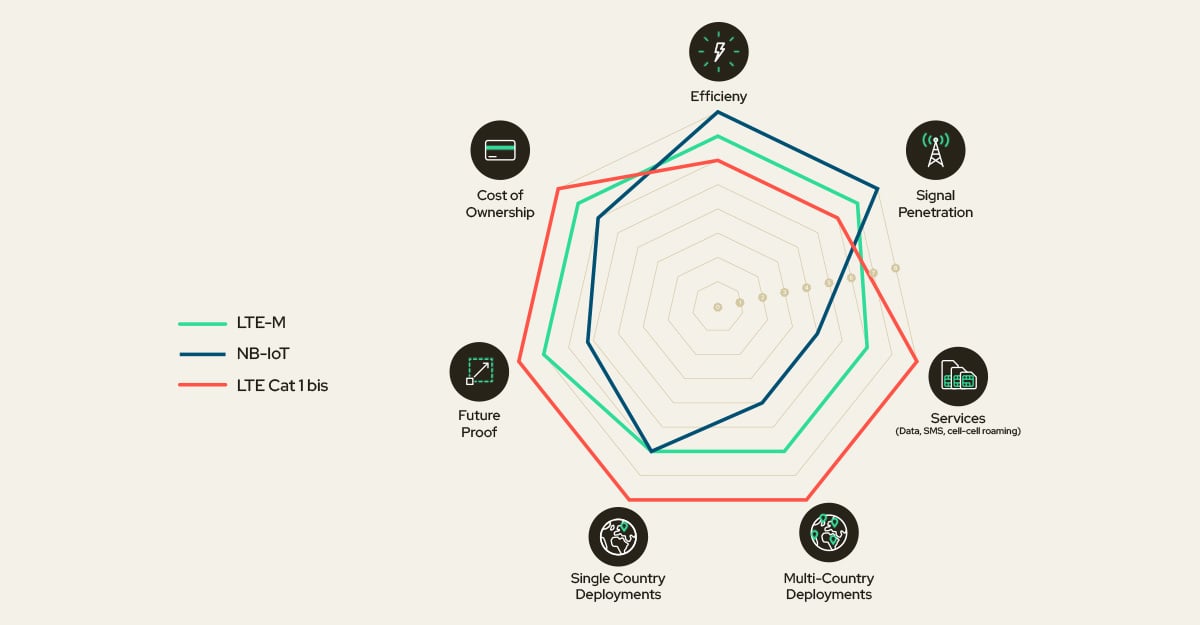
- LTE Cat 1: mid range performance, familiar LTE behaviour.
- LTE Cat 1bis: simpler Cat 1 variant for smaller, cheaper modules.
- LTE-M (eMTC): built for low power with mobility and voice support.
- NB-IoT: ultra low power and deep indoor coverage, but limited throughput.
Each one fits different use cases. Later sections explain where each is most useful.
LTE Cat 1 (LTE Category 1)
LTE Cat 1 was introduced around 2008 as part of 3GPP Release 8. It became one of the earliest LTE profiles suitable for IoT because it supports moderate data rates and works on almost all LTE networks worldwide. Many IoT devices still rely on Cat 1 as operators continue to support LTE while 2G networks are being shut down and 3G networks are being phased out.
Cat 1 is useful when a device needs more bandwidth than low power technologies. It fits use cases such as telematics, payment terminals, industrial equipment and remote monitoring. Devices can send images, logs or medium sized firmware files without major delays.
Key points:
- Typical downlink around 10 Mbps.
- Supports mobility and roaming.
- Broad network availability.
- Higher power use than LTE-M and NB-IoT.
LTE Cat 1bis (LTE Category 1 bis)
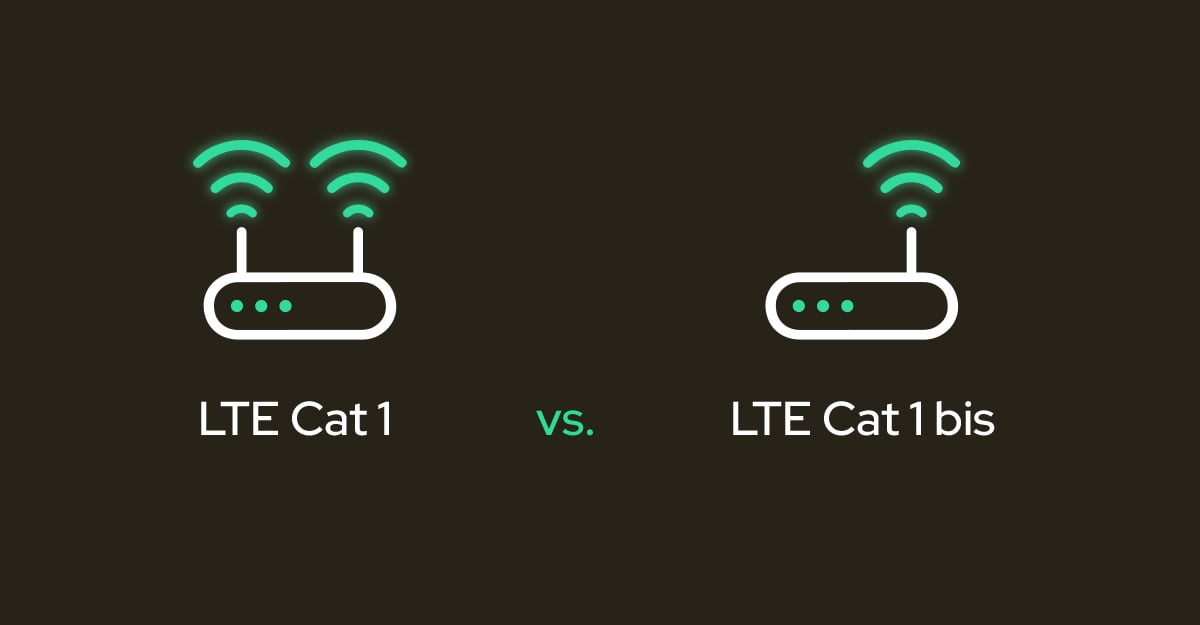
Cat 1bis was introduced in 2016 with 3GPP release 13 to address the need for simpler and lower cost LTE modules. It uses a single antenna rather than two, which reduces hardware complexity, size and cost. It keeps the general behaviour of Cat 1, but is better suited for compact products.
Cat 1bis is used in asset trackers, wearables, compact sensors and consumer IoT devices. It delivers enough performance for small and medium data transfers while keeping device design efficient.
Why it matters for IoT:
- Lower module cost for large scale deployments
- Smaller hardware footprint
- Suitable for long term LTE availability
To learn more about LTE Cat 1bis, check Com4’s detailed guide on LTE Cat-1 BIS.
LTE-M (LTE Category M1)
LTE-M, also known as LTE Cat M1, was standardised in 3GPP Release 13 for IoT. It was designed to reduce power consumption and support mobility, which makes it well suited for devices that move or need longer battery life.
LTE-M technology is used in asset tracking, wearables, medical devices and smart city sensors. It supports cell handovers and can handle use cases that require devices to stay online while moving. It also provides a balance between low power and moderate data rates.
Key points:
- Lower energy use than Cat 1
- Supports mobility and voice features
- Better indoor reach than standard LTE
- Higher throughput than NB-IoT
NB-IoT (Narrowband Internet of Things)
NB-IoT was also introduced in 3GPP Release 13 (in 2016) but follows a different approach from LTE-M. It uses very narrow bandwidth, allowing the signal to reach deep indoors, basements and underground installations. It focuses on extremely low power consumption and long device life.
NB-IoT fits stationary devices such as utility meters, environmental sensors, waste bins and building monitoring systems. These devices send small messages and can run for many years on a single battery.
Key points:
- Exceptional indoor and underground penetration
- Very low energy use
- Limited mobility
- Best for small, infrequent data transmissions
To learn more about NB-IoT, check Com4’s detailed guide on NB-IoT.
How to Choose the Right LTE Type for Your IoT Project
Choosing the right LTE profile becomes easier when you look at how your device will behave in real situations. The questions below help match the device needs with the most suitable LTE option. These are practical points that influence battery life, performance, cost and long term support.
|
Question to Ask |
What It Means |
Best LTE Options |
|
Will the device run on battery for long periods? |
Battery powered devices need low energy use. |
LTE-M or NB-IoT |
|
Will the device be used across different countries? |
Global projects need consistent network availability. |
Cat 1 or Cat 1bis |
|
Does the device need quick response times? |
Real time actions, alarms or alerts need lower latency. |
Cat 1 or LTE-M |
|
Will the device move between cell towers? |
Mobile assets need smooth handover between towers. |
Cat 1 or LTE-M |
|
Is hardware cost a priority? |
Large deployments benefit from smaller and affordable modules. |
Cat 1bis, LTE-M, NB-IoT |
|
Will the device be placed indoors or underground? |
Deep indoor areas need stronger signal reach. |
LTE-M or NB-IoT |
|
Do you need long term network support? |
Some LTE profiles continue into the 5G path. |
LTE-M and NB-IoT |
For a broader comparison, explore our guide on different IoT network options based on mobility, power use, data requirements and coverage.
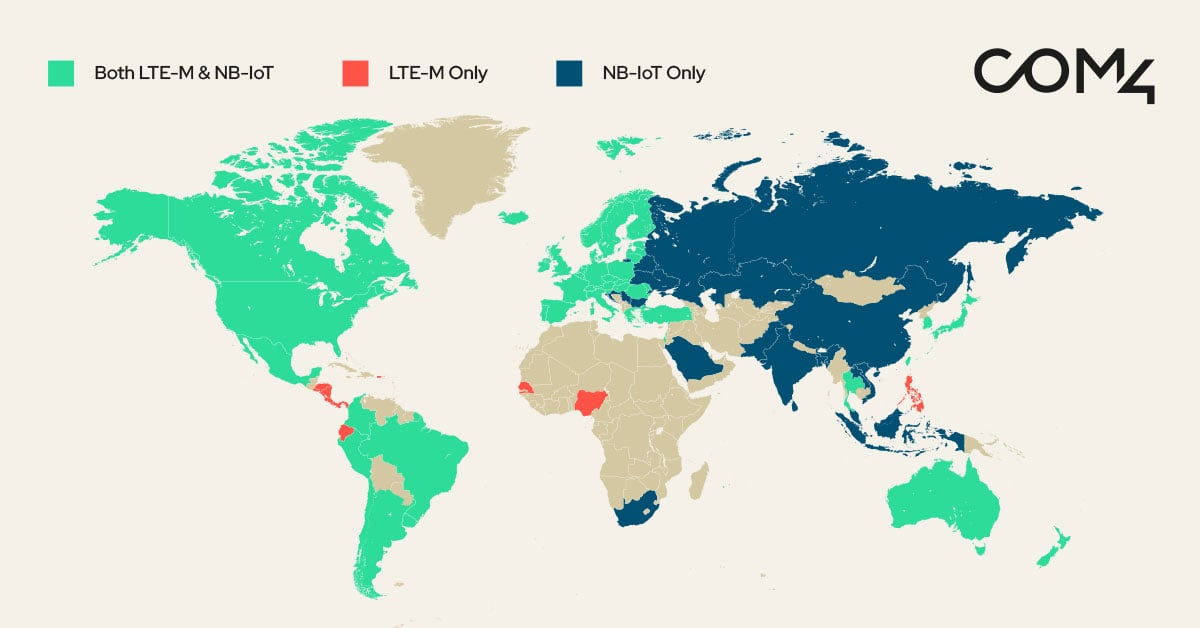
LTE-based IoT remains vital today. As of late 2024, there were over 4 billion cellular IoT connections, representing about 22% of all IoT connections worldwide (source: IoT Analytics. Additionally, 4G networks already cover about 92% of the global population, making LTE a dependable platform for IoT devices today and in the near future.
Choosing between Cat 1, Cat 1bis, LTE-M and NB-IoT comes down to how the device behaves, how much energy it can use and the coverage it needs. A reliable connectivity plan also depends on consistent roaming, secure SIM profiles and stable global network access. These are areas where Com4 has long term experience, helping organisations design IoT systems that stay online across regions and continue to perform as networks evolve.