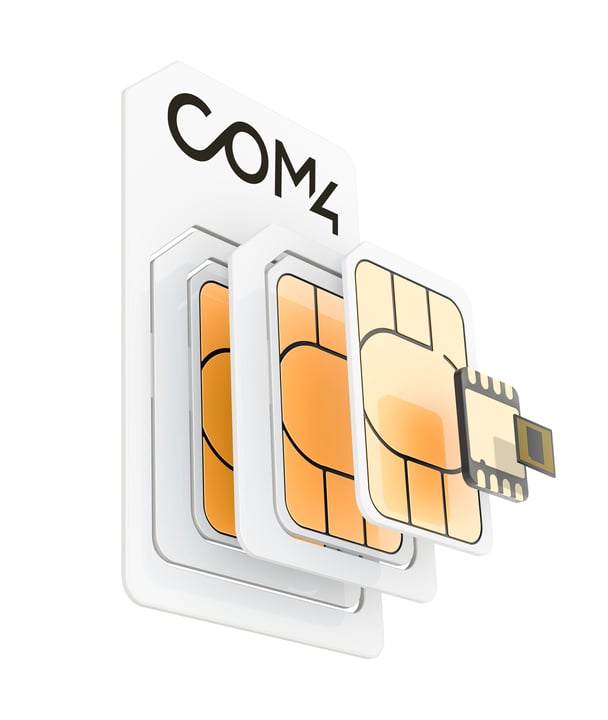
This guide covers the exact physical specifications of each IoT SIM card format, the GSMA eUICC and SGP.32 standards behind eSIM and iSIM, the power and cost tradeoffs between them, and how real Com4 customers have made this decision.
Key takeaways:
- Nano SIM (4FF) is the smallest of the traditional removable card formats, at 12.3 x 8.8 mm, and remains the default choice for serviceable IoT hardware.
- eSIM (MFF2) is a soldered chip, less than half the size of a Nano SIM, that supports GSMA-compliant remote SIM provisioning (RSP) and carrier switching without physical access to the device.
- iSIM goes a step further, integrating SIM functionality directly into the device's System on Chip (SoC), cutting standby power by up to 70% and footprint by up to 98% compared with a discrete eSIM.
- SGP.32 is the newest GSMA standard purpose-built for IoT eSIM provisioning at scale, with zero-touch activation and support for LTE-M, NB-IoT, 4G, 5G, and satellite.
- Real Com4 deployments, from a medical pillbox to Norwegian railway energy meters, show how form factor choice tracks directly to the device's environment, lifecycle, and security requirements.
What is a SIM card form factor, and why does it matter for IoT hardware design?
A SIM card form factor is the physical size and mounting method used to connect a device's cellular module to a mobile network subscription. For consumer phones, form factor is mostly a matter of which tray the SIM slides into. For IoT hardware, it is a design constraint that touches board space, enclosure sealing, environmental durability, serviceability, and unit cost, often before a single line of firmware is written.
Getting this decision wrong is expensive to fix. A device shipped with the wrong SIM form factor typically means a hardware respin, not a firmware patch, which is why IoT SIM card format should be locked down alongside the cellular module and antenna selection, not treated as an afterthought.
Types of SIM Card Form Factors
Nano SIM
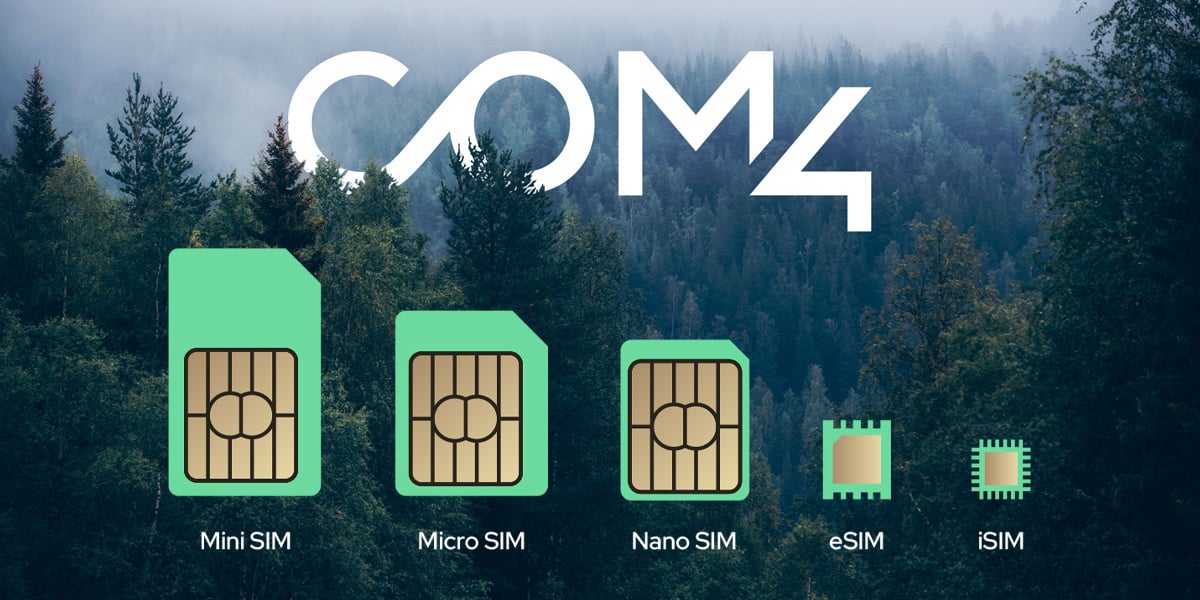
Nano SIM, or 4FF, measures 12.3 x 8.8 mm, the smallest of the traditional removable formats. Trackers and field-serviced sensors still default to nano SIM when a technician needs to swap the card by hand.
Micro SIM
Micro SIM, or 3FF, measures 15 x 12 mm, its size between Mini SIM and Nano SIM. ETSI defined the format in the early 2000s, and adoption spread from 2010. Most new IoT hardware has moved past it, but older trackers and legacy industrial equipment still run on it.
eSIM
eSIM, unlike nano or micro SIM cards, is not a removable SIM card. It's a chip in the MFF2 form factor, roughly 5 to 6 mm per side, soldered directly onto a device's circuit board. Built-in eUICC support lets operators load, switch, or update network profiles remotely under GSMA standards like SGP.02 and SGP.32.
iSIM
iSIM removes the separate chip entirely. SIM functionality lives inside a tamper-resistant element built into the device's SoC, adding close to zero incremental footprint. GSMA finalized the integrated eUICC standard in 2021, and the first compliant products reached market in 2023.
Nano SIM vs Micro SIM vs eSIM vs iSIM: Key Differences
|
Aspect |
Nano SIM |
Micro SIM |
eSIM |
iSIM |
|
Form factor designation |
4FF |
3FF |
MFF2 |
Integrated into SoC, no separate designation |
|
Physical dimensions |
12.3 x 8.8 x 0.67 mm |
15 x 12 x 0.76 mm |
Approx. 5-6 x 5-6 x 0.75-1 mm |
Effectively zero incremental footprint |
|
Physical nature |
Removable plastic card |
Removable plastic card |
Soldered chip, non-removable |
Integrated into SoC secure element |
|
Field serviceability |
Swappable by a technician |
Swappable by a technician |
Not swappable, remote profile change only |
Not swappable; remote profile change only |
|
Remote provisioning (RSP) |
Not built-in |
Not inherent |
Yes, via GSMA SGP.02 and SGP.32 |
Yes, same GSMA standards as eSIM |
|
Best-fit use case |
Compact consumer and industrial IoT devices needing a serviceable card |
Older tablets and legacy industrial devices |
Sealed, remote-managed, or long-lifecycle deployments |
Ultra-compact, power-constrained, high-volume IoT and wearables |
How to choose the right SIM form factor for your IoT device
Work through these questions before locking in hardware:
- Is the device physically accessible after deployment? If a technician can reach it easily, Nano SIM keeps servicing simple. If not, eSIM or iSIM avoids a maintenance visit just to swap a SIM.
- What is the device's expected lifespan? Long-lived industrial deployments, ten years or more, benefit from eSIM's or iSIM's durability and remote manageability over a card format that can corrode or work loose.
- How tight is the power budget? Devices that need years of battery life on a small cell should default toward iSIM's lower standby power draw, or eSIM if iSIM is not yet supported by the target module.
- How much board space is available? Compact wearables and small sensors favor eSIM or iSIM; devices with room to spare can use Nano SIM without a design penalty.
- Does the device need to operate across multiple countries or carriers? eSIM and iSIM with GSMA RSP, including SGP.32 for IoT-specific provisioning, allow profile switching without a hardware change, which matters for cross-border fleets.
- What is the security requirement? Regulated environments, such as healthcare or critical infrastructure, benefit from eSIM or iSIM's tamper-resistant design combined with a private APN and end-to-end encryption.
SGP.32: the GSMA standard built for IoT eSIM at scale
SGP.32 is the GSMA's newest eSIM specification, designed specifically for IoT rather than adapted from the consumer eSIM standard used in smartphones. Where earlier consumer-focused RSP standards assumed a user interface for accepting and switching profiles, SGP.32 is built for devices with no screen and no one physically present to approve a profile change.
SGP.32 brings three practical improvements for IoT connectivity:
- Zero-touch activation. Profiles can be provisioned and activated remotely without manual device interaction, which matters at fleet scale.
- Improved encryption and authentication. Provisioning and profile management are secured to a higher standard than earlier RSP implementations.
- Broad network compatibility. SGP.32-compliant eSIM works across LTE-M, NB-IoT, 4G, 5G, and satellite connectivity, so a single provisioning approach covers a device's full network options over its lifecycle.
Real-world SIM form factor decisions: Com4 customer examples
Dignio: a soldered SIM for a compact, secure medical device. Dignio's Pilly is a smart pillbox that prompts patients with sound and light cues and automatically notifies contacts when a dose is missed, targeting Norway's medication non-adherence problem, where only around half of prescribed medications are taken as intended. Pilly runs on Com4's SIM technology over a private network separate from the open mobile network, with private APNs, end-to-end encryption, and auditable connectivity logs supporting compliance with GDPR, MDR, and relevant IEC standards. The device is now deployed across more than 50 Norwegian counties and has expanded into Denmark. A compact, secure, tamper-resistant SIM form factor is exactly what a small, always-on medical device in a patient's home needs.
Bane NOR: SIM connectivity built for cross-border, industrial-grade reliability. Bane NOR needed a new generation of energy meters on Norwegian trains to communicate over IoT SIM cards, using a new CENELEC communication protocol. Because some routes cross into other European countries, the meters needed to hand off between different network operators mid-journey without losing connectivity. Com4 was the partner with the flexibility to support the new protocol across borders, underscoring why multi-network SIM capability and industrial-grade durability matter for infrastructure that has to keep working in motion, across jurisdictions, for years.
Soundsensing: a compact form factor for sensors installed in basements. Soundsensing's building-monitoring sensors are small and frequently installed below ground, where both size and signal penetration matter. Running on Com4's LTE-M connectivity, the compact SIM footprint fits the sensor's small enclosure while LTE-M's low-band frequency use maintains a reliable connection even in challenging indoor locations. Soundsensing now operates more than 1,500 sensors across 150 buildings, including sites for Statsbygg and Oslo City.
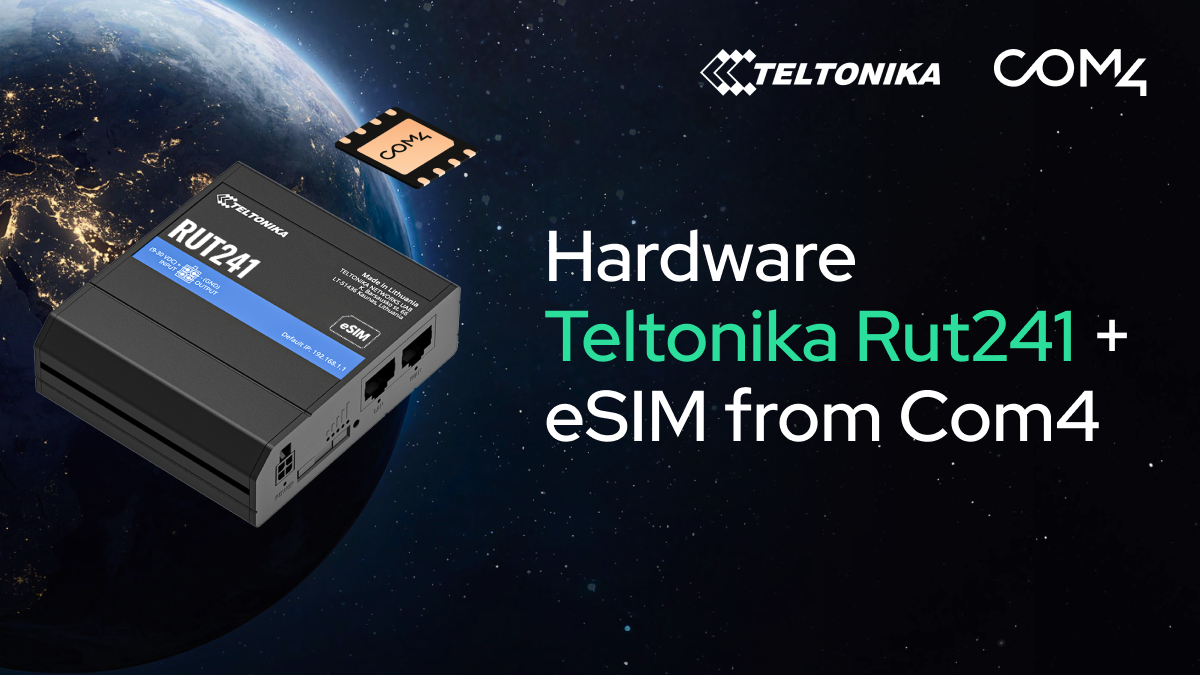
ZetaDisplay and the Teltonika RUT241: eSIM as a deployment accelerator. Com4 offers the Teltonika RUT241, an industrial 4G router preloaded with a Com4 eSIM profile, giving customers instant connectivity out of the box with no physical SIM to insert. ZetaDisplay's own digital signage deployment, running on industrial 4G modems and Com4 SIM connectivity across bus stops, the Oslo Airport Express Train, and Oslo Central Station, reflects the same underlying principle: pre-provisioned, remotely manageable connectivity removes a manual step from every unit shipped, which matters when a rollout spans hundreds of physical sites.
Getting your SIM strategy right from day one
Form factor is not a detail to finalize late in an IoT hardware project. It shapes board layout, environmental durability, servicing model, and total cost of ownership from the first design review. Com4 supports Nano SIM, eSIM, and iSIM connectivity, including SGP.32-compliant IoT eSIM provisioning, and can help match the right form factor to your device's deployment environment, lifecycle, and security requirements before hardware decisions are locked in. For a broader walkthrough of SIM types, durability grades, and security features, see Com4's complete guide to IoT SIM cards, eSIM and iSIM, or explore the eSIM and iSIM technology pages directly, including the iSIM Evaluation Kit for testing before you commit to a full deployment.



.jpg)