An M2M SIM card is built for machine-to-machine communication. It is placed inside a device such as a meter, tracker, or sensor. From there, it connects the device to a cellular network and can send data on its own.
Looking for M2M SIM cards for your devices? Com4’s global IoT and M2M SIM cards work on more than 750 networks in 190+ countries. Order a free test SIM to try them in your own device.
A typical M2M SIM stays in service for 10 to 17 years inside the same device, and its market is projected to grow more than USD 4.4 billion by 2032, as per Dataintelo’s findings. Their usage in everyday operations is the primary driver behind the increasing demand across different industries.
What is an M2M SIM Card?
An M2M SIM card (Machine to Machine SIM) is a special type of SIM card designed for communication between devices, not people.
While a regular SIM card is used in your phone to make calls or browse the internet, an M2M SIM is used inside machines, sensors, and devices to send data automatically.
For example, M2M SIM cards are used in things like:
-
Smart meters that send electricity readings.
-
Connected vending machines that report stock levels.
-
GPS trackers that share location data.
-
Security systems that send alerts.
These SIM cards are built to be more reliable and durable than consumer SIM cards. They can handle extreme temperatures, work in remote locations, and stay connected for years without manual updates.
How Do M2M SIM Cards Work
M2M SIM cards (Machine to Machine SIM cards) enable devices to communicate with each other without human involvement. They work by connecting machines to mobile networks, just like a phone SIM card, but are designed for data exchange between devices instead of voice calls or text messages.
The process is simple. A device or sensor collects information such as temperature, location, or usage data. The M2M SIM card then enables the device to use various IoT connectivity options such as 2G, 3G, 4G, 5G, LTE-M, or NB-IoT, depending on the coverage and needs of the application. The collected data is sent through the network to a central server or cloud platform, where it can be monitored, analyzed, or used to trigger automated actions.
M2M SIM cards can also be managed remotely. This allows businesses to monitor connectivity, change settings, or update software without physically accessing each device.
In simple terms, M2M SIM cards create a reliable and automated communication link between devices and systems, helping businesses collect real time data, improve efficiency, and reduce manual work.
Benefits of M2M SIM Cards
Remote SIM Card Management
One of the fundamental advantages of M2M SIM cards is the ability to manage them remotely. Unlike consumer SIM cards, which often require manual setup and activation, M2M SIM cards are managed through custom web platforms. These platforms simplify fleet management, allowing for quick activation, monitoring, and diagnostic tools, enhancing overall operational efficiency.
M2M Connectivity Solutions
M2M SIM cards cater to specific IoT and M2M projects. Instead of fixed pricing, M2M SIM cards offer flexible billing based on actual usage. This flexibility ensures that end-users pay only for the data they consume, making M2M SIM cards a cost-effective choice for industrial applications.
Custom and Permanent Roaming
M2M SIM cards provide the unique feature of custom roaming areas, ensuring uninterrupted connectivity. Unlike regular SIM cards, which may have time limits on roaming, M2M SIM cards offer permanent roaming, allowing them to stay connected to any existing cellular network for an unlimited duration.
Solutions Tailored to Industry Requirements
M2M SIM cards are built to withstand extreme conditions, making them suitable for use in various industrial projects. These rugged SIM cards can operate in high or low temperatures, withstand vibrations, and endure harsh environmental conditions, ensuring reliable connectivity in demanding scenarios.

Network Technologies Used in M2M Connectivity
M2M devices connect over a range of network types. 2G and 4G LTE carry basic traffic, while 5G is emerging for higher throughput needs.
3G network retirement creates a bigger problem for M2M than consumer devices. Many M2M SIMs are designed to operate for ten years or more. An early shutdown can force replacement long before the equipment reaches end of life.
LTE-M and NB-IoT address the problem differently. Both are low-power, wide-area technologies for IoT. They offer deep indoor coverage and power-saving modes that extend battery life for years. GSMA confirms active NB-IoT and LTE-M connections passed 1 billion by the end of 2025. That scale makes them the default for most new M2M deployments.
Differences Between M2M SIM Cards and Standard SIM Cards
M2M SIM cards are fundamentally different from consumer SIM cards used in mobile phones. While consumer SIM cards are designed for personal communication, M2M SIM cards are tailored for industrial applications. These specialized SIM cards are key players in connecting smart devices across various sectors, from healthcare to security and agriculture.
| Feature | Com4 M2M SIM Card | Regular SIM Card |
|---|---|---|
| Intended Use | Designed for machine to machine communication, IoT devices, and industrial automation | Made for phones, tablets, and personal communication |
| Durability | Built for long life in harsh environments and industrial conditions | Suitable for everyday consumer use |
| Connectivity | Multi-network access with global coverage and automatic network failover | Tied to a single operator with limited roaming options |
| Data Transmission | Optimized for continuous, small data transfers between devices | Primarily handles larger, less frequent data sessions |
| Security | Enhanced security and private APN options tailored for IoT applications | Standard consumer level security |
| Remote Management | Remote SIM activation, diagnostics, usage monitoring, and control at scale | Very limited or no remote management features |
| Reliability | Designed for always on connectivity and 24/7 uptime | Can experience interruptions, especially when roaming |
| Contract Flexibility | Scalable and cost efficient data plans with shared and pooled options | Fixed individual subscription plans |
M2M SIM Card Form Factors
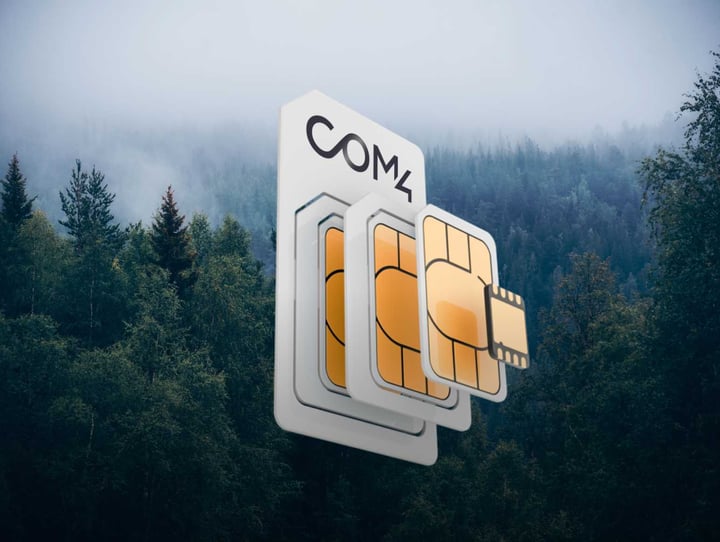
M2M SIM cards come in different formats to fit a wide range of devices and industrial environments. Each type varies in size, durability, and how it is integrated into industrial IoT hardware.
2FF (Mini SIM)
The 2FF SIM, also known as the Mini SIM, is the original and largest SIM card format. It is commonly used in industrial IoT gateways, routers, and older equipment that require a standard SIM slot.
Key Points:
-
Size: 25 x 15 mm
-
Easy to insert and replace
-
Suitable for routers, modems, and older IoT devices
-
Widely supported and reliable
3FF (Micro SIM)
The 3FF SIM, or Micro SIM, is smaller than the Mini SIM but still provides the same functionality. It is often used in compact devices that need a balance between size and easy handling.
Key Points:
-
Size: 15 x 12 mm
-
Common in smaller IoT devices and handheld units
-
Compatible with many industrial modems
-
Same electrical interface as larger SIMs
4FF (Nano SIM)
The 4FF SIM, known as the Nano SIM, is the smallest removable SIM card format. It is ideal for space-constrained IoT devices where compact design is a priority.
Key Points:
-
Size: 12.3 x 8.8 mm
-
Very compact and lightweight
-
Used in wearables, sensors, and mobile devices
-
More fragile than larger SIM formats
If you're unsure which SIM type is right for your device, our detailed comparison of Nano SIM vs Micro SIM explains the key differences.
MFF2 (Embedded eSIM)
The MFF2 SIM, often called an embedded SIM, is soldered directly onto the device’s circuit board. This format is built for long life, durability, and environments where vibration, moisture, or temperature changes make removable SIMs impractical.
Key Points:
-
Permanently embedded in the device
-
Size: 6 x 5 mm
-
Designed for harsh or remote environments
-
Ideal for long-term IoT deployments
-
Enables remote provisioning and management
M2M SIM Card Use Cases
M2M SIM cards power smart, connected operations across industries. They allow machines, vehicles, and sensors to communicate securely and efficiently, helping businesses automate processes and make better decisions.
Com4 provides reliable M2M connectivity designed for global IoT deployments and continuous uptime.
Logistics and Fleet Management
M2M SIM cards enable real time tracking of vehicles, assets, and goods. Fleet managers can monitor driver behavior, predict maintenance needs, and ensure deliveries stay on schedule.
Key benefits:
- Real time tracking and monitoring.
- Predictive maintenance.
- Global coverage and remote visibility.
Manufacturing
M2M SIM cards connect industrial machines to central monitoring systems, providing engineers with live data and performance insights. This supports predictive maintenance and reduces costly downtime.
Key benefits:
- Continuous machine monitoring.
- Early fault detection.
- Lower maintenance costs.
Security and Surveillance
M2M SIM cards keep security systems online even when WiFi fails by connecting directly to mobile networks. This ensures uninterrupted monitoring of cameras and alarms.
Key benefits:
- Reliable backup connectivity.
- 24/7 uptime.
- Secure data transmission.
Retail
Retailers use M2M SIM cards to monitor inventory levels in real time. Smart sensors send alerts when stock is low, improving efficiency and reducing waste.
Key benefits:
- Real time inventory control.
- Automated stock alerts.
- Better supply chain visibility.
Heavy Industry
M2M SIM cards are built for tough environments where WiFi is unreliable. They ensure stable communication despite heat, cold, or vibration.
Key benefits:
- Reliable under harsh conditions.
- Long lasting performance.
- Ideal for construction and energy sectors.
Healthcare
M2M SIM cards keep connected medical devices online, from patient monitors to insulin pumps. They support remote diagnostics and transmit data without gaps in coverage.
Key benefits:
-
Stays connected even during a carrier outage.
-
Enables remote patient monitoring.
-
Supports regulatory compliance needs.
Agriculture
M2M SIM cards connect soil sensors, weather stations, and livestock trackers across remote fields. This gives farmers real-time data to guide irrigation and crop decisions.
Key benefits:
-
Reliable coverage in remote areas.
-
Low data, low cost operation.
-
Up-to-date crop and soil insights.
Com4’s M2M SIM Cards: A Closer Look
The best M2M SIM for international projects is a multi-network SIM with remote provisioning (eUICC). Devices connect to local networks in each country, stay within permanent roaming rules and are managed from one platform. Com4’s global IoT SIMs cover 750+ networks in 190+ countries, support 2G to 5G, LTE-M and NB-IoT, and come in 2FF, 3FF, 4FF and MFF2.
Key Benefits:
-
Available in multiple form factors, including compact MFF2 chips and industrial grade plastic SIMs built to withstand extreme conditions.
-
Global multi network coverage for seamless connectivity across regions.
-
Support for remote SIM provisioning (eUICC, SGP.02 compliant) for easy management and activation.
-
Downloadable eSIM and iSIM profiles for flexible and secure IoT deployment.
-
Long data retention and high durability, even in harsh environments.
-
Fully compatible with industry standards and certified IoT modules.
The Backbone of IoT connectivity
M2M SIM cards are the backbone of IoT connectivity, offering a plethora of features to ensure seamless communication between devices. Com4's offerings, with their global coverage, support for multiple network types, and range of form factors, provide a versatile solution for IoT projects across various industries. Their commitment to quality and compliance ensures that your devices remain connected and reliable, even in the harshest environments. Whether you are embarking on a new IoT project or seeking to enhance an existing one, consider Com4's M2M SIM cards as a reliable and efficient connectivity solution.
Choose the right IoT Connectivity partner
To conclude on a positive note, let's take a look at the 11 essential offerings you should expect from an M2M provider.
A Comprehensive Checklist to Help You Select the Ideal M2M Provider:
✓ Maximize coverage and global presence with multiple operators.
✓ Ensure your devices always connect to the best network without interference.
✓ Safeguard your data flows with private APN and VPN for secure transport.
✓ Seamlessly manage your SIM card fleet with a comprehensive management platform.
✓ Enjoy the flexibility of offers without any commitment.
✓ Test SIM cards to ensure compatibility and functionality.
✓ Take full control of your usage by blocking data, SMS, or voice with barring.
✓ Choose from various card formats (2FF, 3FF, 4FF, and MFF2) to suit your needs.
✓ Opt for flexible pricing options based on your unique business model, whether it's metered or shared.
✓ Embrace LPWAN technologies like LTE-M or NB-IoT to meet your specific requirements.
✓ Access expert M2M customer service for prompt assistance in case of any issues.
This comprehensive checklist serves as a valuable tool for evaluating and selecting the ideal M2M provider from the multitude of options available in the market.
Now equipped with a wealth of knowledge, expert tips, and best practices, you have everything you need to accomplish your ultimate objective: transforming your IoT project into a resounding success.