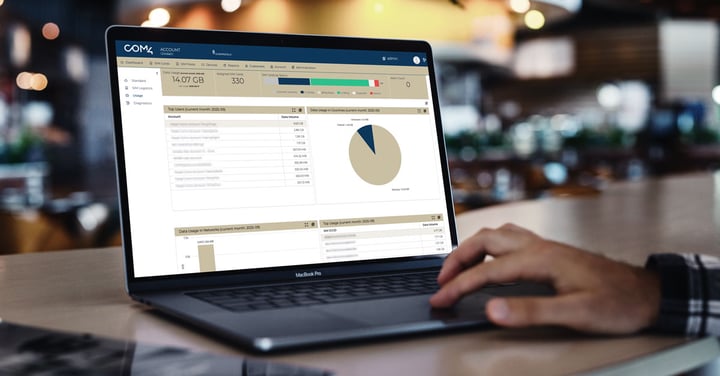
Short answer: Managed IoT connectivity is cellular connectivity for connected devices delivered as a complete service. It includes the SIMs and network access, a connectivity management platform, security, monitoring and alerts, billing control and expert support, all from one provider. It solves the problems that appear after a device is deployed: coverage gaps, manual SIM administration, runaway data costs, security exposure and roaming rules. Com4 delivers managed IoT connectivity with multi-network SIMs on 750+ networks in 190+ countries, its own Nokia 5G SA-based mobile core and the Polaris connectivity management platform, for 1000+ customers and 20M+ connections.
Most connected products start with a handful of SIM cards in a lab. That part is easy. The hard part comes two years later, when 8,000 devices are spread across six countries, a firmware release doubles data use overnight, one operator drops a roaming agreement, and nobody on your team has time to log in to three different carrier portals to work out why 140 chargers went quiet.
That is the gap managed IoT connectivity fills. This guide explains what it includes, what it solves, and what to ask before you choose a provider.
Managed IoT connectivity vs. buying IoT SIM cards
An IoT SIM subscription gives a device permission to use a mobile network. Managed connectivity covers everything that has to happen around that permission for the whole life of the device, which for most IoT hardware means five to ten years.
| SIM cards only | Managed IoT connectivity | |
| Network access | Usually one operator plus roaming | Several networks per country, with automatic fallback |
| SIM administration | Spreadsheets, emails, carrier portals | One platform and API for the whole fleet |
| Costs | Discovered on the invoice | Pooled plans, usage caps and alerts |
| Security | Devices on the public internet | Private APN, VPN, fixed IP, traffic rules |
| When something breaks | You find out from customers | Alerts, diagnostics and a support team that owns the problem |
What managed IoT connectivity includes
1. SIMs and multi-network access
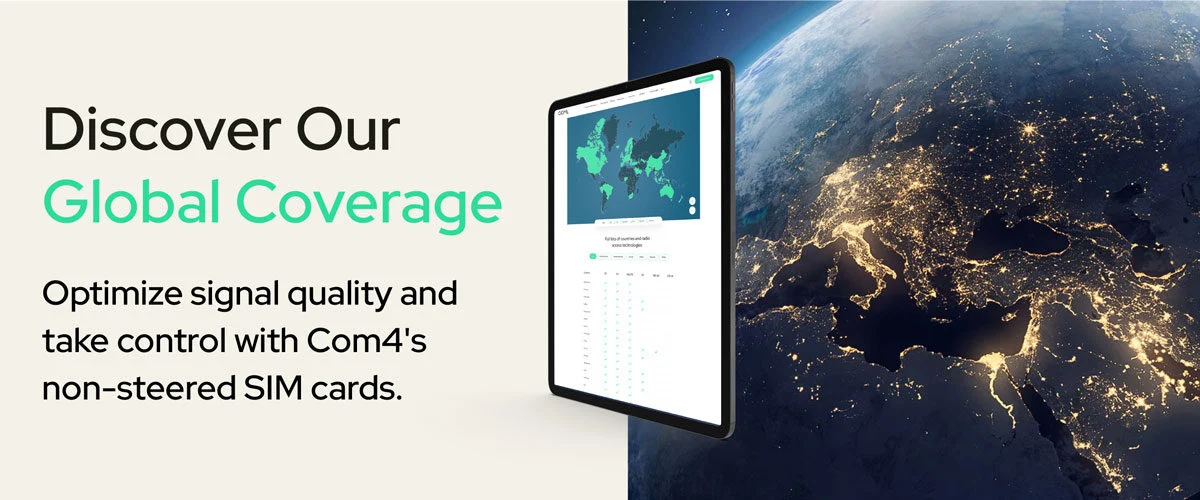
The base layer is the SIM and the networks it can reach. A managed service should give each device more than one network option in every market, through multi-IMSI SIMs, eUICC and SGP.32 eSIM, or both. It should also cover the radio technologies your devices use: LTE-M, NB-IoT, 4G and 5G, plus a plan for the 2G and 3G shutdowns. Industrial SIM form factors that survive heat, cold and vibration belong here too.
2. A connectivity management platform
A connectivity management platform (CMP) is where you activate, suspend and move SIMs, see usage and network events per device, and connect to your own systems through an API. Without one, every operational question becomes a support ticket.
3. Security built into the connection
Devices that sit on the open internet are an easy target. Managed connectivity should offer a private APN, VPN tunnels to your back end, fixed IP addresses where needed, and controls that stop a stolen SIM being used in another device. See Com4's IoT security services.
4. Monitoring, alerts and automation
Rules that flag a device that has stopped reporting, a SIM using ten times its normal data, or a device that has moved to an unexpected country, and that act on it automatically when you want them to.
5. Cost control and billing
Pooled data plans, per-group bundles, overage caps and one consolidated invoice instead of one per operator and country.
6. Compliance with local rules
Some markets restrict permanent roaming or require local registration. A managed provider should know where your devices are going and have a local profile or partner ready before the device arrives. Read more about IoT SIM regulations.
7. Coverage beyond cellular
Ships, offshore sites, remote farms and mountain infrastructure often sit outside cellular coverage. A managed service can add satellite backup, such as Com4's satellite NTN service or Starlink as a managed service, under the same contract.
8. People who own the problem
A named team that knows your deployment, can read network logs and will work through an attach failure with your firmware engineers. Com4's support team works from 08:00 to 16:00 on all business days.
What problems managed IoT connectivity solves
- Coverage gaps and single-operator risk. If one network fails or ends a roaming agreement, the device moves to another instead of going offline.
- Manual SIM work that doesn't scale. Activations, suspensions and plan changes for thousands of SIMs happen in one place or through an API.
- Unpredictable costs. Alerts and caps catch a runaway device before the invoice does.
- Security exposure. Traffic stays on a private network instead of crossing the public internet.
- Lock-in. With eUICC and SGP.32, operator profiles can be changed over the air instead of replacing SIMs in the field.
- Slow troubleshooting. Network events per SIM show whether a problem is in the device, the radio network or your platform.
Who needs managed IoT connectivity
Managed connectivity pays off when devices are spread across many sites or countries, when they stay in the field for years, and when downtime costs money or safety. Typical examples are EV chargers, smart meters, fleet and asset trackers, personal alarms and lone worker devices, digital signage, and remote patient monitoring. Com4 works with leading Nordic EV charging companies such as Easee and with some of Norway's largest smart metering companies, including Valider.
If you have 20 devices in one building on Wi-Fi, you probably don't need it yet. If you are planning a product that will be sold across Europe, you need it before the first production batch, because connectivity choices get locked into hardware and firmware early.
How to compare managed IoT connectivity providers
- How many networks can the SIM use in each of your target countries, and how does fallback work?
- Does the provider run its own mobile core, or resell another operator's?
- Is eUICC with SGP.32 available, so you can change operator profiles later without replacing SIMs?
- What can you do yourself in the platform and API, and what needs a support ticket?
- Which security options are included: private APN, VPN, fixed IP, SIM-to-device locking?
- How does the provider handle permanent-roaming markets in your roadmap?
- Can satellite backup be added under the same contract?
- Who answers when something breaks, and during which hours?
- Can you test with real SIMs at your own sites before you commit?
The short version
Buying SIM cards gets a device online. Managed IoT connectivity keeps a whole fleet online, secure and affordable for the ten years it spends in the field, with one provider responsible for all of it.
The value of managed connectivity shows up on the worst day of your deployment, not the first.
If you want to see what managed connectivity would look like for your devices and markets, talk to Com4. We'll go through your coverage, security and cost needs and give you a straight answer, including when you don't need it.