
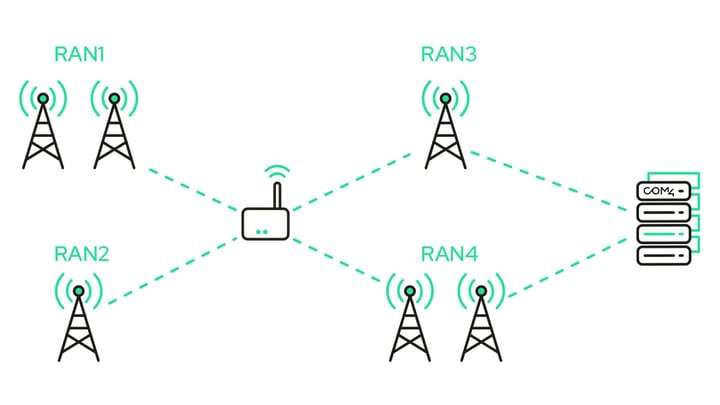
However, with the advancement of the Remote SIM Provisioning (RSP), IoT providers can now streamline global deployments by using a single SIM that adheres to regional and regulatory stipulations, ensuring secure and compliant connectivity.
Table of Contents
-
How Does IoT Roaming Work?
-
Understanding Permanent Roaming and Its Impact on IoT
-
The Cost Per Megabyte Is the Least Important Number
-
Challenges of IoT Deployment in a Permanently Roaming World
-
Technology Choice Shapes Roaming Feasibility
-
Global Permanent Roaming Restrictions by Country
-
Achieving Global IoT Compliance with Remote SIM Provisioning (RSP) Technology
-
Designing a Sustainable Global IoT Roaming Strategy
-
How Com4 Supports IoT Deployments with Global Connectivity Solutions
How Does IoT Roaming Work?
A SIM is tied to a home network, either an MVNO (Mobile Virtual Network Operator) or an MNO (Mobile Network Operator). When a device is outside its home network's coverage, it connects to a local network instead, through a roaming agreement between the home operator and that local MNO.
The device authenticates onto the visited network using credentials stored on its SIM. Once granted access, its data traffic is either routed back through the home network or handled locally by the visited network, depending on how the connection is configured. This affects latency, cost, and compliance with local data sovereignty rules.
For IoT devices, this connection is not occasional. Devices are deployed once and operate unattended for years, without anyone present to reconnect or troubleshoot them. This is what turns ordinary roaming into permanent roaming, and it is why permanent roaming faces a different level of regulatory scrutiny than the short-term roaming used by a traveler's phone.
Understanding Permanent Roaming and Its Impact on IoT
Traditional SIM cards enable devices to connect to different networks when in foreign countries via roaming agreements between an MVNO (Mobile Virtual Network Operator) or MNO (Mobile Network Operator) and local MNOs. Roaming is categorized as either transient or permanent. While transient roaming is suitable for short-term visits (like a business trip), permanent roaming applies to IoT devices deployed long-term in various countries.
Permanent roaming restrictions can impact IoT deployments significantly. In many cases, local MNOs are required or permitted to terminate connections that have been active for over 90 days, affecting IoT asset tracking, narrowband IoT (NB-IoT), and other critical services. These restrictions often arise due to national cybersecurity concerns, economic policies, and the growing need for secure IoT solutions across global networks.
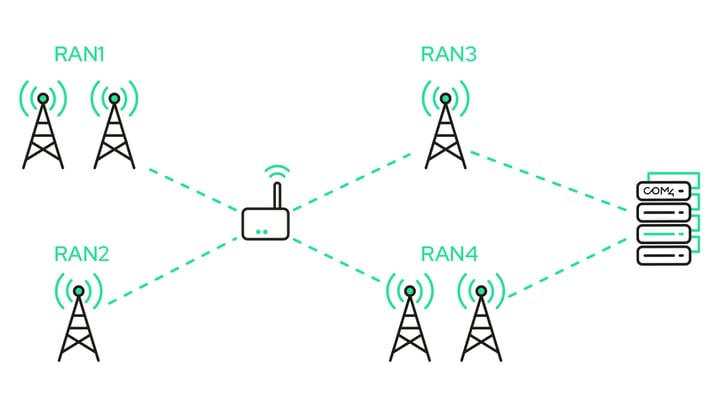 Com4 is fully integrated with more than 750 networks worldwide, offering extensive global connectivity.
The Cost Per Megabyte Is the Least Important Number
In most procurement discussions, roaming is evaluated based on price per MB, SIM cost, and the number of roaming agreements. These are visible costs. They are easy to compare. They fit neatly into spreadsheets.
The real cost drivers in IoT are indirect and cumulative. When roaming is not engineered correctly, devices may perform additional network scans, experience failed attach attempts, retry data sessions repeatedly, remain attached longer due to latency, and consume more battery power per transmission.
In many tracking or metering use cases, the battery accounts for up to 70 per cent of the device’s bill of materials. A reduction in battery life from eight years to five years does not merely increase maintenance costs. It can invalidate the entire business model.
Total cost of ownership in IoT is driven by radio efficiency and operational stability, not just tariff structures.
Challenges of IoT Deployment in a Permanently Roaming World
IoT solutions often require long-term operational devices, making them particularly vulnerable to permanent roaming restrictions. To comply, companies face two options: using local SIMs with direct roaming agreements or utilizing SIM cards that can be remotely reprogrammed over-the-air (OTA) through Remote SIM Provisioning (RSP). The former involves significant costs and operational complexity, especially when deploying IoT solutions across multiple countries with varying regulations.
By leveraging RSP-enabled SIM cards, companies can use a single SIM for all their products, regardless of the country. These SIMs switch between preloaded or downloaded profiles to localize connectivity, ensuring compliance with regional IoT platform pricing, regulatory requirements, and network policies.
Technology Choice Shapes Roaming Feasibility
The underlying radio technology determines how realistic global roaming truly is. Legacy 2G networks once provided near-universal coverage for IoT. However, many regions are actively shutting down 2G and 3G networks, reducing their viability for new long-term deployments.
LTE-Cat 1 and LTE-Cat1 bis operate on established LTE infrastructure with broad global coverage. For many industrial use cases, they provide a balance between coverage, latency, bandwidth, and power consumption.
LTE-M and NB-IoT were designed specifically for low-power applications. However, global roaming support remains inconsistent, and configuration of power saving modes such as PSM and eDRX varies significantly between operators. Misalignment in these settings can eliminate the expected power savings.
5G holds long-term promise, but global roaming frameworks and service level expectations for IoT remain immature in many regions. Technology selection is therefore not simply about module cost or theoretical efficiency. It is about realistic roaming availability across all intended markets.
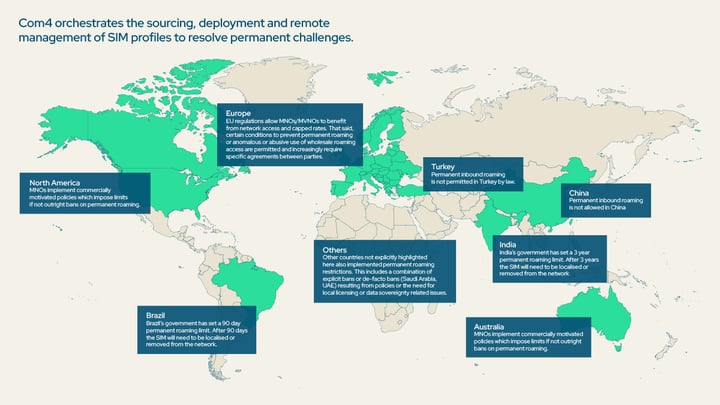
Global Permanent Roaming Restrictions by Country
| Country | Roaming Restriction |
| Australia | MNOs enforce commercially driven restrictions on permanent roaming, often resulting in bans or strict limitations. |
| Brazil | Permanent roaming is limited to 90 days. After that, the SIM must be localized or disconnected to comply with regulations. |
| China | Permanent inbound roaming is prohibited, preventing long-term use of foreign SIMs. |
| Egypt | Strict local data laws and regulations prevent long-term inbound roaming. |
| Europe | EU regulations allow roaming under capped wholesale rates, but measures to prevent permanent roaming abuse are increasing. Provider-specific agreements are often required. |
| India | Permanent roaming is allowed for up to three years. After that, the SIM must be localized or removed from the network. |
| Indonesia | Permanent roaming is restricted due to local licensing requirements and data sovereignty laws. |
| Japan | MNO policies make permanent roaming difficult and generally favor localized SIM solutions. |
| Malaysia | Permanent roaming is limited by MNO policies and local regulatory requirements. |
| Mexico | Permanent roaming is not explicitly banned, but MNOs commonly restrict long-term use through commercial policies. |
| Nigeria | Local telecommunications laws require compliance through partnerships with local MNOs, making permanent roaming difficult. |
| North America | MNOs have policies that limit or prohibit permanent roaming, mainly for commercial reasons. |
| Russia | Strict data localization laws and local partnership requirements limit permanent roaming. |
| Saudi Arabia | Data sovereignty laws and local licensing requirements effectively create a de facto ban on permanent roaming. |
| South Korea | Strict MNO policies and local compliance requirements make permanent roaming difficult. |
| Thailand | MNO policies often require SIM localization for long-term connectivity. |
| Turkey | Permanent inbound roaming is prohibited by law. SIMs must be localized for continued service. |
| UAE (United Arab Emirates) | Local licensing laws and data sovereignty requirements restrict permanent roaming. |
| Vietnam | Local regulations and licensing requirements make long-term permanent inbound roaming challenging. |
Achieving Global IoT Compliance with RSP Technology
Remote SIM Provisioning (RSP) enables seamless global IoT deployments using eSIM, iSIM, and multi-IMSI solutions. This approach helps companies avoid the complexity of managing individual SIM contracts with local operators while ensuring compliance with local regulations. IoT deployments that rely on permanent roaming must ensure that their devices connect to networks that fully comply with the specific regulations in each region.
Countries often demand various levels of localization:
- Soft localization requires a local IMSI (International Mobile Subscriber Identity) from a local operator, but allows connection to other mobile core networks.
- Full localization mandates that both the SIM profile and network connection must be fully local.
- IP localization is focused on reducing latency for better IoT performance and ensuring data sovereignty by keeping data within regional boundaries.
Designing a Sustainable Global IoT Roaming Strategy
Enterprises planning international IoT deployments should evaluate roaming through several lenses.
-
Understand the connectivity provider’s position in the value chain. Core ownership affects routing flexibility, latency optimization, and policy control.
-
Validate power-saving behaviour in real environments, not only in laboratory conditions. Basement installations, industrial interference, and cross border behavior often reveal issues that controlled tests do not.
-
Assess regulatory exposure in each target market, including permanent roaming limitations and data localization requirements.
- Design for change. Network sunsets, operator consolidation, and evolving standards are inevitable over a ten-year device lifecycle.
How Com4 Supports IoT Deployments with Global Connectivity Solutions
Com4's extensive partnerships with MNOs and its ability to provide eSIM, iSIM, and IMSI solutions make it a leading provider of IoT connectivity. By offering a single SIM solution for global IoT deployments, Com4 helps companies navigate the complex landscape of permanent roaming restrictions and regulatory compliance. With IoT asset tracking, narrowband IoT, and other critical services at stake, it’s crucial to have a reliable connectivity provider that understands the nuances of regional regulations and IoT network requirements.




.webp)
.jpg)