
.jpg?width=720&height=720&name=IoT-in-telecom-hero-2%20(1).jpg)
For enterprise teams running IoT fleets across multiple countries, the connectivity layer is either invisible because it works, or very visible because it doesn't. Below are ten signs that your current IoT connectivity provider has coverage gaps that will eventually surface, and what to check for in a genuinely global, carrier agnostic connectivity partner instead.
1. Devices go quiet the moment they cross a border
If a device that worked perfectly at home suddenly stops reporting after shipping to a new country, that's not a hardware problem. It's a sign your provider's network coverage doesn't actually extend where your customers are, or that the roaming agreements underpinning it are thin, temporary, or missing in that market entirely.
2. Coverage depends on a single underlying network operator
Many "global" IoT SIMs are really one mobile network operator's SIM with a roaming agreement layered on top. That works fine until that one operator has an outage, gets deprioritized in a country, or simply never had strong coverage there. A carrier agnostic provider routes each device to the strongest available network in a given location rather than locking the whole fleet to one operator's footprint.
3. The coverage map looks impressive until you ask about a specific country
Global coverage maps are easy to draw and hard to verify. The real test is asking a provider to name the specific network partners and agreements they hold in the two or three countries that matter most to your roadmap. If the answer is vague, the coverage claim probably is too.
4. Costs spike unpredictably when devices roam
Permanent roaming, where a device operates long-term on a foreign network rather than just visiting, is priced very differently by different providers. If your bill swings sharply whenever a batch of devices ships internationally, your provider likely doesn't have proper permanent roaming agreements in place, and is instead passing through premium visitor-roaming rates.

5. You can't get local breakout where compliance requires it
Some markets, and some customer contracts, require that device traffic exit onto the local internet within the country rather than being routed back through a home network. If your provider can only offer one global breakout point, you'll hit a wall the moment a deal requires in-country data handling.
6. Regulatory requirements block expansion into new markets
Telecom regulation varies enormously by country: permanent roaming restrictions, local registration requirements, data residency rules. A provider without in-house regulatory and compliance expertise across your target markets will turn every new country launch into a slow, manual legal exercise instead of a configuration change.
7. Nobody can clearly explain how permanent roaming is handled
Ask directly: "If I deploy 10,000 devices in this country and leave them there for five years, how is that connectivity licensed and priced?" A provider with genuine global infrastructure has a straightforward answer. A provider reselling someone else's roaming SIMs usually doesn't.
8. There's no single dashboard showing every device, in every country
If checking device status in one country means logging into a different portal than device status in another, that's a strong sign your "global" connectivity is actually several regional contracts stitched together after the fact rather than one managed connectivity service.

9. Support can't keep up with your fleet's time zones
A fleet spread across continents needs support that's actually available when something breaks, not just during one region's business hours. If escalations sit unanswered overnight in the markets where your devices operate, coverage gaps become downtime gaps.
10. Every new country is a new contract and a new onboarding project
The whole point of a proper global IoT connectivity provider is that expansion is a configuration change, not a procurement cycle. If launching in a new market always means renegotiating terms, sourcing a new local SIM, and re-testing the integration from scratch, the underlying network was never really global to begin with.
What genuine global IoT coverage looks like
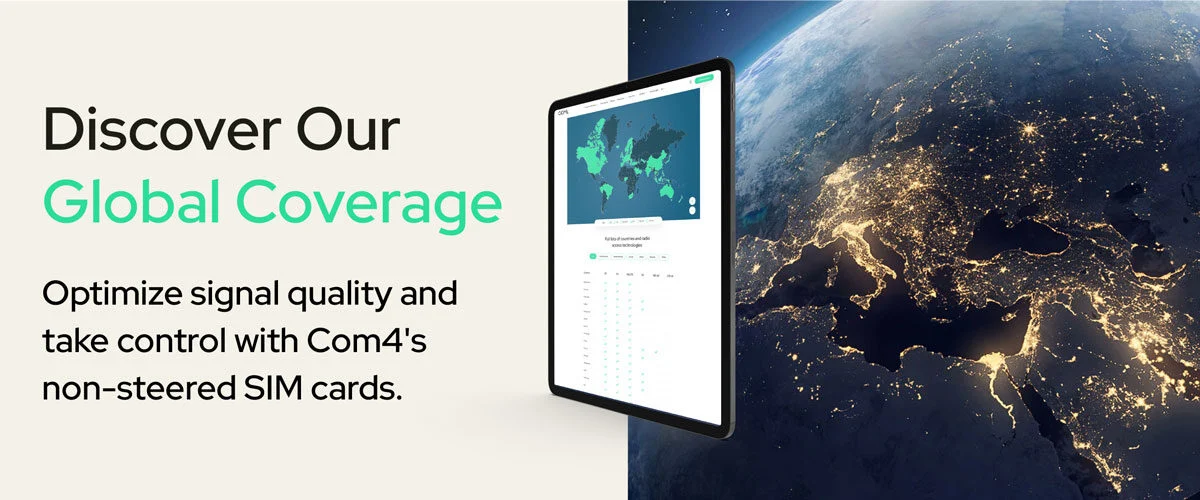
A connectivity provider built for multi-country fleets should be able to show, not just claim, three things: a carrier agnostic network with named operator partnerships in your target markets, proper permanent roaming agreements rather than premium visitor rates, and a single connectivity management platform giving one view of every device regardless of country.
This is the model Com4 has built its global IoT connectivity around. When Gomero, a Swedish predictive maintenance platform, needed to scale its sensor network past 6,000 monitored assets across 9 countries, the connectivity requirement wasn't just coverage on a map. It was consistent global terms, predictable pricing as the fleet grew, and compliance with local regulatory requirements in each new market Gomero entered. That combination is what let Gomero treat expansion into a new country as a rollout, not a renegotiation.
Questions to ask your current IoT connectivity provider
Before assuming your coverage is solid, it's worth asking your provider directly: which specific network operators do you have live agreements with in our top five target markets? How is permanent roaming priced in each of those markets? Can we see device status across every country from a single platform? And what does onboarding a new country actually involve, in practice, not in the sales deck?
The answers will usually tell you within a few minutes whether you're working with a genuinely global IoT connectivity provider, or a single-network SIM with a roaming agreement doing its best impression of one.