
-1.jpg?width=720&height=720&name=big-data-hero-4%20(1)-1.jpg)
Whether you're rolling out connected medical equipment, smart meters, or industrial sensors, the connectivity approach you select today determines your uptime, compliance risk, and operational costs across multiple countries. Com4 helps enterprise IoT teams connect devices to 750+ networks across Europe and beyond using multi-network IoT SIMs.
This guide walks you through every factor you need to weigh when evaluating multi-network IoT SIMs against single-carrier roaming SIMs. By the end, you'll understand how each approach affects coverage, resilience, regulatory compliance, security, and fleet management for Europe-wide deployments.
Key Takeaways: How to Compare IoT SIMs for Europe in 2026
- Multi-network IoT SIMs connect to the strongest available signal automatically, reducing downtime across European markets.
- Single-carrier roaming SIMs rely on one home network's roaming agreements, creating single points of failure.
- Permanent roaming regulations in several European countries add compliance risk to single-carrier approaches.
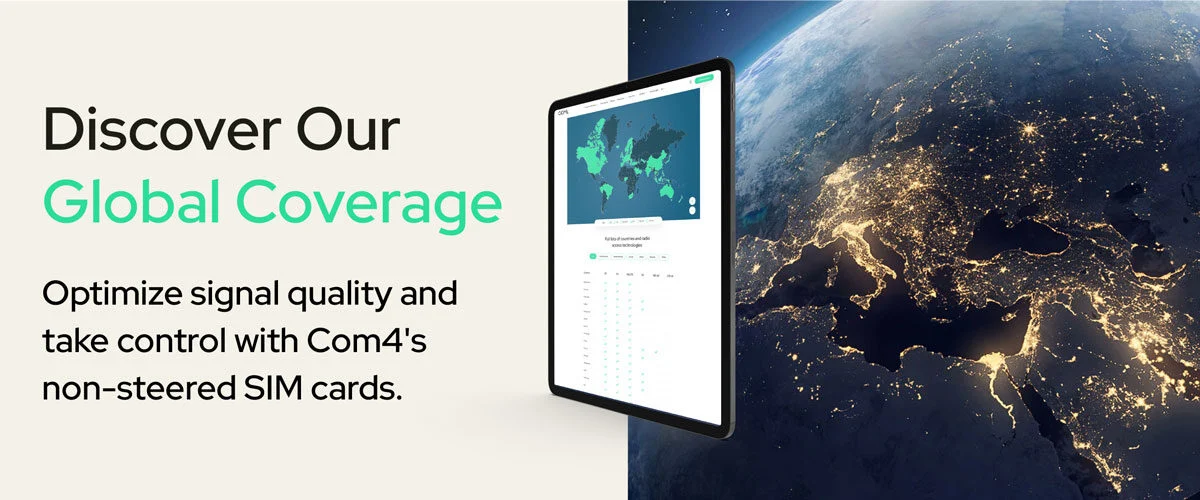
- Com4's carrier-agnostic SIMs access 750+ networks worldwide, giving you multi-operator coverage per country.
- Evaluate SIM providers on network diversity, remote provisioning capabilities, security features, and lifecycle management.
What Is a Multi-Network IoT SIM?
A multi-network IoT SIM stores multiple subscriber identities or profiles, allowing your device to connect to whichever network offers the strongest signal at any given location. Rather than being tied to one carrier's coverage footprint, your devices can switch between operators automatically.
This approach is sometimes called multi-IMSI technology. The SIM holds several International Mobile Subscriber Identity numbers, each linked to a different network operator. When your device powers on or loses signal, it scans available networks and connects to the one with optimal conditions.
For Europe-wide IoT deployments, this means your devices aren't dependent on any single operator's infrastructure. If one network experiences congestion or maintenance, your device switches to another without manual intervention.
How Do Single-Carrier Roaming SIMs Work?
A single-carrier roaming SIM is registered to one home network. When your device operates outside that network's direct coverage, it roams onto partner networks through bilateral roaming agreements. The home network negotiates these agreements with foreign operators, and your traffic routes back through the home network before reaching its destination.
This architecture creates a dependency chain. Your device relies on the home network maintaining active agreements with operators in every country where you deploy. If the home network has weak roaming partnerships in a particular region, your devices experience coverage gaps.
Additionally, roaming traffic follows a longer path. Data generated on your device travels back to the SIM's home network first, then routes to its destination. This home-routed traffic adds latency and increases data transit costs compared to locally-routed connections.
Why Does Network Resilience Matter for European IoT Deployments?
Network outages happen. Towers go down for maintenance. Natural events disrupt infrastructure. When your IoT deployment depends on a single operator per country, any disruption to that operator directly impacts your devices.
Multi-network SIMs reduce this risk by giving each device access to multiple operators. If Network A experiences issues in Germany, your device connects to Network B or C instead. This redundancy is particularly valuable for critical applications like medical device connectivity, where downtime can affect patient care.
Single-carrier SIMs offer no such fallback. When your home network's roaming partner in a particular country experiences problems, your devices stay offline until service resumes. For deployments spanning multiple European countries, this creates unacceptable risk.
What Coverage Differences Should You Expect Across Europe?
Network coverage varies significantly between European countries and even within regions of the same country. Urban areas typically have dense 4G and 5G coverage from multiple operators. Rural regions may have limited options, sometimes with only one carrier offering reliable service.
Multi-network SIMs give your devices the flexibility to connect to whichever operator provides the strongest signal in each location. In a country like Germany, where multiple operators have built extensive networks, your devices benefit from operator diversity. In countries with more concentrated markets, having access to all available networks ensures you're using the most reliable option.
Single-carrier approaches lock you into your home network's roaming partners. These partners may not always be the operators with the strongest coverage in every area where your devices operate. The result is inconsistent performance across your deployment footprint.
How Do Permanent Roaming Regulations Affect Your SIM Choice?
Permanent roaming occurs when a device uses a SIM registered to a foreign network for its entire operational life without returning to the SIM's home country. Regulatory frameworks in a growing number of countries restrict or prohibit this practice.
Within Europe, permanent roaming is generally permitted under EU roaming regulations. However, operators can apply fair use policies that limit extended roaming. Outside the EU, countries like Turkey have implemented strict requirements that essentially mandate local operator involvement for devices operating permanently within their borders.
For organizations deploying IoT across diverse European markets, understanding these regulations is critical. Multi-network SIMs with eUICC capabilities can address regulatory requirements by allowing remote profile switching. If a market requires local provisioning, you can update the device's operator profile over the air without physical intervention.
What Is eUICC and Why Does It Matter for Europe-Wide Deployments?
eUICC stands for embedded Universal Integrated Circuit Card. This technology enables a SIM to store multiple operator profiles and switch between them remotely. Unlike traditional SIMs with fixed profiles, an eUICC-enabled SIM can be reprovisioned over the air.
For European deployments, eUICC solves several problems simultaneously. You can ship devices with a single SIM SKU and provision the appropriate operator profile based on where the device is installed. If regulations change or you need to switch operators, you update profiles remotely rather than dispatching technicians to replace SIMs.
Com4 was the first IoT operator in Europe to implement GSMA-compliant eUICC eSIM subscription management. This capability enables remote SIM provisioning and lifecycle management, reducing operational complexity for large-scale deployments.
How Should You Evaluate Security Across SIM Approaches?
Security considerations differ between multi-network and single-carrier SIM approaches. Both can support security features like private APNs, VPNs, and encrypted connections. The differences lie in control and network-level protection.
With single-carrier roaming, your data routes through multiple operator networks and the home network's core before reaching its destination. Each hop represents a potential exposure point. You're also dependent on your home operator's security practices and those of every roaming partner.
Multi-network SIMs from operators with their own core network offer more direct control. Com4 operates its own mobile core network, enabling consistent security policies across all connected devices regardless of which underlying radio network they use. Features like private APN, VPN, and IPsec can be configured and managed centrally.
For sensitive applications, this control matters. Medical devices transmitting patient data, industrial sensors monitoring critical infrastructure, and smart meters handling utility information all benefit from consistent, centrally managed security.
What Management Capabilities Should You Prioritize?
Managing thousands of SIMs across multiple European countries requires visibility and control. The management platform your SIM provider offers directly impacts your operational efficiency.
Key capabilities to evaluate include real-time connectivity status monitoring, data usage analytics, remote SIM lifecycle management, and automated alerts. You should be able to activate, suspend, and modify SIMs from a single dashboard. Usage policies should be configurable to prevent unexpected costs.
Multi-network SIM providers with dedicated IoT platforms typically offer more granular control than traditional carriers. Look for platforms that show current connectivity status rather than data that's 24-48 hours old. When a device goes offline, you need to know immediately rather than the next day.
How Does Data Pricing Differ Between Multi-Network and Single-Carrier Approaches?
Pricing models vary significantly between providers and SIM types. Single-carrier roaming SIMs often involve complex roaming surcharges that vary by country and partner network. Predicting costs for a deployment spanning multiple countries becomes challenging.
Multi-network providers typically offer simpler pricing structures. Data pooling allows all your devices to draw from a shared allocation rather than having individual caps per SIM. This prevents stranded data on low-usage devices and overage charges on high-usage ones.
Transparent pricing with no hidden roaming fees simplifies budgeting. When evaluating providers, ask for detailed breakdowns of how costs scale as you add devices and countries to your deployment.
What Technical Considerations Apply to Medical Device Deployments?
Medical devices and remote patient monitoring equipment have specific connectivity requirements. Reliability is non-negotiable because connectivity failures can directly impact patient outcomes. Regulatory compliance adds additional layers of complexity.
For medical device IoT connectivity, multi-network SIMs offer inherent advantages. If a patient's monitoring device loses connection to one network, it can automatically switch to another without interrupting data transmission. This redundancy supports continuous care even during network maintenance or outages.
Security and compliance requirements for medical devices are stringent. The connectivity infrastructure must support HIPAA, GDPR, and other relevant regulations depending on where devices are deployed and where data is processed. Ensure your SIM provider can support the encryption, access controls, and audit trails your compliance framework requires.
How Should You Approach Vendor Evaluation for Europe-Wide IoT SIM Providers?
When evaluating SIM providers for European deployments, structure your assessment around coverage, technology, security, management, and support.
Coverage evaluation should go beyond counting the number of networks. Ask which operators the provider works with in each country where you plan to deploy. Verify whether multi-operator coverage is available in each market or if certain countries have single-partner coverage.
Technology assessment should examine SIM formats supported, eUICC capabilities, and network technologies available. Ensure the provider supports the radio technologies your devices require, whether that's LTE-M, NB-IoT, 4G, or 5G.
Security review should examine the provider's core network architecture, available security features, and compliance certifications. Ask about private APN options, VPN support, and how security policies are managed across multi-network connections.
Management platform evaluation should include hands-on testing if possible. Verify that the platform provides the visibility and control you need for your deployment scale.
Support assessment should examine the provider's technical support capabilities. For critical deployments, you need access to IoT engineers who understand cellular connectivity, not just generic call center support.
What Questions Should You Ask IoT SIM Providers?
Prepare specific questions that differentiate providers based on your requirements.
Ask whether the SIM uses multi-IMSI technology or relies on a single home network with roaming agreements. Multi-IMSI means the SIM presents a local identity in each market rather than roaming.
Ask whether eUICC is available and whether it supports over-the-air profile switching for headless devices. Remote profile switching without physical access is essential for deployed fleets.
Ask which markets require local profiles and whether the provider has operator agreements in those markets. Coverage claims tell you where the SIM connects, not where local provisioning is available.
Ask whether data is pooled globally or whether each SIM has individual caps. Individual caps create operational inefficiencies and cost unpredictability.
Ask how current the management platform data is. Delayed visibility into connectivity status limits your ability to respond to issues promptly.
How Do You Plan for Long-Term IoT SIM Lifecycle Management?
IoT devices often remain deployed for five to fifteen years. The SIM you choose today needs to support your devices throughout their operational life.
Industrial-grade SIMs are designed for extended lifecycles. They offer wider operating temperature ranges, greater durability, and higher data retention than consumer SIM cards. For devices deployed in harsh environments or inaccessible locations, these specifications matter.
Remote lifecycle management becomes increasingly important over time. The ability to suspend, reactivate, and modify SIMs without physical intervention reduces operational costs. eUICC capabilities allow profile changes as network technologies evolve or as your operational requirements change.
Technology evolution also factors into long-term planning. Networks are continuously upgrading, and older technologies are being sunset. Ensure your SIM provider has a roadmap that aligns with how network technologies are evolving in your deployment markets.
In Conclusion: Choosing the Right IoT SIM Approach for European Deployments
The choice between multi-network IoT SIMs and single-carrier roaming SIMs shapes your deployment's reliability, compliance posture, and operational costs across Europe. Multi-network approaches offer redundancy, flexibility, and reduced regulatory risk. Single-carrier approaches may simplify vendor relationships but introduce dependencies and potential coverage gaps.
For critical applications spanning multiple European countries, multi-network SIMs with eUICC capabilities provide the most flexibility. They allow your devices to connect to the strongest available network, adapt to regulatory requirements through remote profile switching, and benefit from centralized management and security.
Evaluate providers based on the specific requirements of your deployment. Consider coverage depth in your target countries, security and compliance capabilities, management platform functionality, and long-term support. The SIM decision you make today will affect your devices for years to come.
FAQs About Multi-Network IoT SIMs vs Single-Carrier Roaming SIMs for Europe
What is the main difference between multi-network and single-carrier IoT SIMs?
Multi-network IoT SIMs store multiple operator identities and connect to whichever network offers the strongest signal. Single-carrier SIMs are registered to one home network and roam onto partner networks when outside direct coverage. Com4's multi-IMSI SIMs access 750+ networks, giving your devices automatic failover capabilities.
Do multi-network SIMs cost more than single-carrier SIMs?
Pricing varies by provider and deployment scale. Multi-network SIMs often offer simpler pricing through data pooling, which can reduce costs by eliminating stranded data and overage charges. Com4's transparent pricing model means you pay only for active SIMs and actual data usage.
How do permanent roaming regulations affect IoT SIM selection in Europe?
EU regulations generally permit permanent roaming with fair use policies. Some non-EU European countries have stricter requirements. Multi-network SIMs with eUICC capabilities allow remote profile switching to address regulatory requirements without physical SIM replacement.
What is eUICC and why is it important for IoT deployments?
eUICC enables a SIM to store multiple operator profiles and switch between them remotely. For IoT deployments, this means you can provision devices with appropriate profiles based on deployment location and update them over the air. Com4 supports GSMA-compliant eUICC for remote provisioning.
Which SIM approach is better for medical device connectivity?
Multi-network SIMs offer advantages for medical devices because they provide automatic network failover, reducing the risk of connectivity interruptions. Com4's healthcare IoT solutions deliver reliable connectivity with enterprise-grade security for remote patient monitoring and connected medical equipment.
How do I evaluate IoT SIM providers for European deployments?
Assess providers based on network coverage depth in your target countries, eUICC and multi-IMSI capabilities, security features, management platform functionality, and technical support quality. Request hands-on platform access and verify coverage claims for specific deployment locations.
What SIM form factors are available for IoT devices?
IoT SIMs come in standard plug-in formats (2FF, 3FF, 4FF) and embedded MFF2 chips for industrial applications. Com4 offers industrial-grade SIMs designed for harsh environments with operating temperatures from -40°C to +105°C and data retention periods up to 15 years.
How does multi-network connectivity improve IoT device reliability?
When one network experiences issues, multi-network SIMs automatically switch to another available operator. This redundancy reduces downtime compared to single-carrier SIMs that depend on one network's availability. Com4's non-steered SIMs prioritize signal quality to maintain consistent connectivity.



-1.webp)