
The Internet of Things connects physical devices such as sensors, machines, and equipment to digital networks, generating real-time operational data. Big Data Analytics provides the tools and methods needed to collect, organize, and analyze this data to support better decision-making and business results.
The Internet of Things (IoT) has changed how organizations collect data. It connects physical devices like sensors, machines, and equipment to digital networks. These devices send constant data streams. They show how systems work in real time. Big Data Analytics includes the tools and methods that organizations use. They collect, organize, and analyze large amounts of data. This helps them gain insights, make better decisions, and improve business results.
Today, businesses in many sectors are putting money into IoT analytics. They want to boost efficiency, lower costs, and find new value in their connected assets. The global IoT analytics market is growing fast. According to Grand View Research, it is expected to expand by more than 24 percent each year until 2030. This shows how important it is to turn connected data into strategic intelligence.
Why Big Data Analytics Matters for IoT
Connectivity alone does not deliver business value. The true value of IoT investments lies in how organizations use the data generated by their devices.
At scale, IoT analytics helps organisations:
- Improve operational efficiency by identifying underperforming assets and process bottlenecks.
- Reduce costs through predictive maintenance, energy optimisation, and better resource utilisation.
- Reduce risk by detecting anomalies and failures before they cause downtime or safety incidents.
- Support better decisions by replacing assumptions with evidence from real operational data.
Infrastructure and industrial companies are using more sensor data. This helps them shift from reactive maintenance to predictive strategies. This scenario is common in Com4 customer deployments like Soundsensing and Gomero. Data from connected devices helps teams respond quickly. It also improves long-term planning.
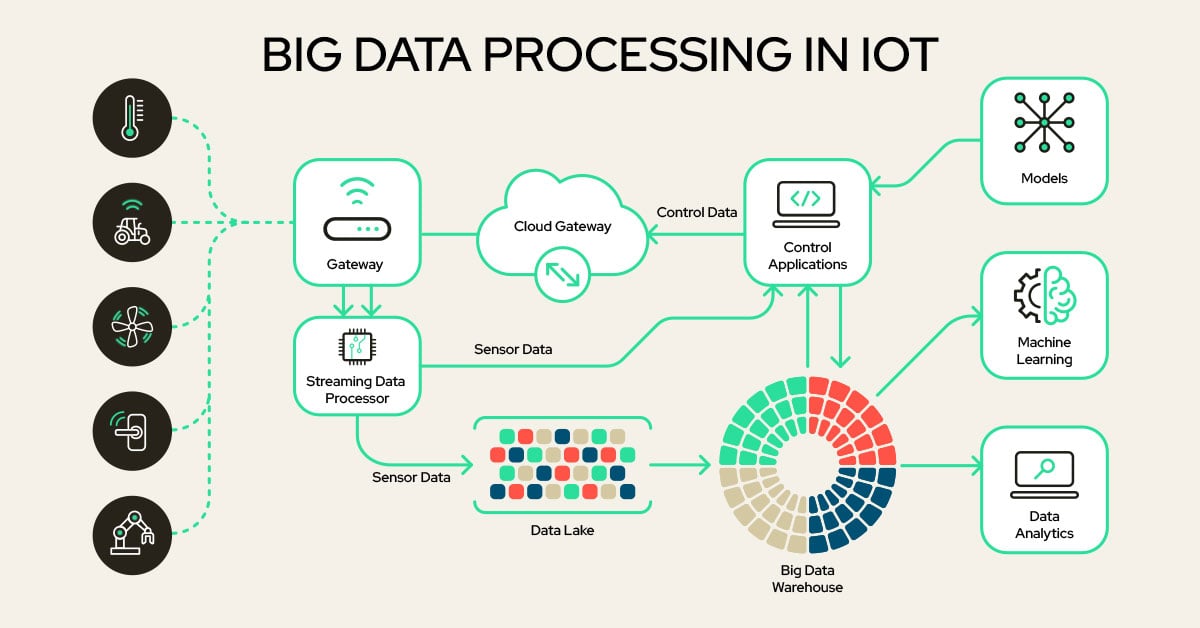
Key Components of an IoT Big Data Analytics Architecture
An IoT big data analytics architecture typically consists of the following key components.
- Data collection and ingestion: Sensors, machines, and devices generate data continuously or at defined intervals, which is securely transmitted to backend systems for processing.
- Connectivity and network layers: Cellular, satellite, and hybrid networks enable reliable data transfer across regions and borders. At Com4, we manage global IoT connectivity across multiple networks so device data is transmitted consistently and securely, without customers needing to handle telecom complexity themselves.
- Data storage and data lakes: Scalable cloud storage, data lakes, and time-series databases store high volumes of structured and unstructured IoT data over time.
- Processing and analytics engines: Data is cleaned, enriched, and analyzed using real-time stream processing, historical analysis, and advanced analytics models.
- Visualization and business intelligence tools: Dashboards, alerts, and reports translate analytics into actionable insights for operational and business teams.
Types of Analytics Used in IoT (From Descriptive to Prescriptive)
IoT analytics typically evolves across four levels, with each level answering a different operational or business question:
- Descriptive analytics (What happened?): Summarizes historical IoT data into dashboards and reports, such as tracking fuel consumption, equipment usage, or downtime trends.
- Diagnostic analytics (Why did it happen?): Examines data patterns to identify root causes, linking issues to operating conditions, usage behavior, or maintenance history.
- Predictive analytics (What is likely to happen?): Uses statistical models and machine learning to forecast outcomes, commonly applied to predictive maintenance and failure prevention.
- Prescriptive analytics (What should we do next?): Recommends or automates actions based on predictions, such as adjusting schedules, rerouting assets, or optimizing operating parameters.
As organizations mature their IoT capabilities, value increasingly shifts toward predictive and prescriptive analytics.
Real-World Use Cases Across Industries
IoT big data analytics is showing clear results in many industries. While the specific use cases differ, the underlying pattern is the same: continuous data from connected devices is analysed to improve reliability, efficiency, safety, and cost control. The table below summarises some of the most common and high-impact applications.
|
Industry / Sector |
Typical IoT Data Used |
Analytics Use Case |
Business Outcome |
|
Manufacturing and industrial infrastructure |
Vibration, temperature, machine usage, fault codes |
Predictive maintenance and failure detection |
Reduced unplanned downtime, longer asset life, lower maintenance costs. Examples include infrastructure and condition monitoring solutions such as Soundsensing and Gomero. |
|
Logistics and transportation |
GPS location, fuel consumption, vehicle health, cargo condition |
Route optimisation and fleet performance analysis |
Better on-time delivery, lower fuel costs, improved asset utilisation. |
|
Smart buildings and energy management |
Occupancy, temperature, energy consumption, air quality |
Energy optimisation and automated building control |
Lower energy bills, improved comfort, reduced environmental impact. |
|
Healthcare and remote monitoring |
Vital signs, device status, patient activity data |
Real-time alerts and trend analysis |
Faster intervention, fewer hospital visits, more efficient care delivery. This is seen in our solutions like Dignio and MedThings. |
|
Smart cities and public infrastructure |
Traffic flow, environmental data, infrastructure status |
Traffic optimisation and infrastructure monitoring |
Improved public safety, reduced congestion, better long-term planning. |
In all these scenarios, reliable connectivity ensures data is available, but it is analytics that turns this data into operational and financial impact.
Key Technologies and Tools for IoT Big Data Analytics
A modern IoT analytics stack usually combines several specialised technology categories:
- Storage and data lakes: Cloud object storage, Hadoop ecosystems, NoSQL databases, and time-series databases are commonly used to store high-volume device data efficiently.
- Stream processing and real-time analytics: Technologies like Apache Kafka and other streaming platforms allow real-time data intake and processing. This is useful for tasks such as anomaly detection and live monitoring.
- Machine learning platforms: These help create predictive and prescriptive models. For example, they can predict failures, forecast demand, or optimize performance.
- Visualisation and dashboarding: Business intelligence tools turn complex data into easy-to-understand views. They create management dashboards and automated reports.
The toolset changes based on scale and use case. However, the architecture needs to grow with the number of devices and the amount of data.
Challenges in IoT Big Data Analytics and How to Overcome Them
- Data volume and velocity: IoT systems produce a lot of data, and they produce it very fast. Traditional systems can't scale well. Teams need cloud platforms, data filtering, and sometimes edge processing.
- Data quality and reliability: Sensor data is often incomplete or noisy. If the data is poor, the insights will be poor too, so strong checks and monitoring are needed from the start.
- Security and data protection: IoT data needs protection while it is moving and stored. It's even more important when devices work across different countries and networks. This makes secure connections and access control essential, particularly when using private APNs or VPN-based IoT connectivity.
- Scalability of Infrastructure: Most IoT projects start with a few devices, but they can expand rapidly. If the platform cannot scale easily, it will slow down the project and increase costs.
- Integration with existing systems: IoT analytics usually needs to connect with business systems such as maintenance or operations platforms. If these systems do not work well together, much of the business value is lost.
- Cost control and operational complexity: Storing and processing large amounts of data costs money and takes effort to manage. Using managed services helps teams spend more time on insights and less time on infrastructure.
Future Trends in IoT Big Data Analytics
IoT analytics is evolving rapidly as device numbers and data volumes increase. The focus is shifting from centralized cloud processing to edge analytics, where data is analyzed closer to its source. This reduces latency, lowers bandwidth usage, and enables faster responses, particularly in industrial and critical infrastructure environments.
AI and machine learning are becoming core components of IoT analytics, allowing systems to detect anomalies, predict failures, and optimize operations automatically. At the same time, privacy-focused approaches such as federated learning help organizations extract insights without moving sensitive data.
Augmented analytics is further simplifying decision-making by automating analysis and surfacing key insights, reducing reliance on specialized data teams.
IoT Analytics Trends Snapshot:
|
Aspect |
Past / Current |
Future Direction |
|
Data Processing Location |
Mostly centralised cloud analytics |
Increased edge and distributed analytics for speed and efficiency |
|
AI Integration |
Early use of machine learning for basic predictions |
Deep learning and autonomous analytic workflows |
|
Privacy Handling |
Data aggregated centrally, raising privacy concerns |
Distributed techniques such as federated learning |
|
User Experience |
Specialist-driven dashboards and queries |
Augmented analytics with automated insights |
|
Device Growth |
~18.5bn connected devices (2024) |
~39bn devices by 2030, requiring scalable analytics (IoT Analytics) |
Strategic Considerations
IoT delivers value only when data is transformed into insight and action. As connected devices continue to scale, analytics becomes the foundation for improving reliability, controlling costs, and supporting smarter operational decisions. Organisations that treat analytics as a core capability, rather than an add-on, are better positioned to realise long-term returns from their IoT investments.
A successful approach requires thinking end to end, from connectivity and data flow to analytics, governance, and an integrated IoT security platform. With secure, scalable connectivity in place, providers like Com4 support this foundation by ensuring IoT data is consistently available for analysis across regions and deployments. This allows organisations to focus on extracting insight and driving outcomes, rather than managing infrastructure.



.jpg)