
.jpg?width=720&height=720&name=IoT-in-telecom-hero-3%20(2).jpg)
MarketsandMarkets reports that the global Industry 4.0 market was valued at USD 52.17 billion in 2023. It’s expected to grow to USD 182.01 billion by 2028, with a CAGR of 28.4%. This quick growth shows how much manufacturers, energy providers, and infrastructure operators are investing in digitalization. They aim to boost efficiency, resilience, and competitiveness. At the core of this transformation is the ability to collect, move, and use operational data at scale.
The Internet of Things (IoT) is the practical foundation that makes this possible. IoT links machines, sensors, and industrial assets to software. This turns physical operations into ongoing data streams. These streams can be monitored, analyzed, and automated. This supports predictive maintenance, tracks performance in real time, and improves decision-making. It affects factories, supply chains, and essential infrastructure. In real-world use, reliable and secure connectivity is crucial. This is especially true when assets are spread across different sites or countries. In this way, Industry 4.0 and IoT are not separate concepts. Together, they define how modern industrial operations are built, scaled, and optimized today.
Understanding IoT and Industrial IoT (IIoT)
To avoid confusion, it’s important to separate general IoT from Industrial IoT (IIoT). IoT means all connected devices. This includes smart home thermostats, wearables, connected cars, and city infrastructure. IIoT focuses on IoT applications in industrial settings. This includes factories, power grids, transport networks, and heavy equipment.
Think of it this way:
- General IoT focuses on consumer and commercial uses, such as smart homes and offices. Here, convenience and scale are important.
- IIoT focuses on industrial uses. It prioritizes reliability, security, long device lifecycles, and stable connectivity.
IIoT plays a vital role in Industry 4.0. Smart factories and connected operations rely on a steady stream of data from machines and tools. Without IIoT, real-time visibility and large-scale automation are hard to achieve.
.jpg?width=1200&height=628&name=IoT-in-food-2%20(1).jpg)
Common IIoT devices are:
- Vibration sensors for machines
- Temperature sensors for machines
- Smart meters in energy systems
- Controllers on production lines
- Tracking devices for assets and vehicles
These devices form the backbone of Industry 4.0.
The Evolution of Industrial Revolutions: From 1.0 to Present
Every industrial revolution has introduced technologies that changed how goods are produced. Industry 4.0 is the latest stage in this journey, but to understand it fully, we must look at the earlier phases.
|
Industry Phase |
Time Period |
Main Technology |
Key Changes |
Impact |
|
Industry 1.0 |
Late 18th century |
Steam power, mechanisation |
Manual labor replaced by machines |
Birth of factories, growth in textiles & mining, large-scale production |
|
Industry 2.0 |
Early 20th century |
Electricity, assembly lines |
Mass production and organised factories |
Lower costs, higher output, affordable goods, rise of steel & railways |
|
Industry 3.0 |
1970s onwards |
Computers, PLCs, digital systems |
Automation and digital control of machines |
Faster production, reduced human intervention, globalised manufacturing |
|
Industry 4.0 |
Present |
IoT, AI, cloud, big data |
Smart, connected, data-driven systems |
Real-time communication, intelligent decision-making, smart factories |
The Role of IoT in Industry 4.0
IoT is key to Industry 4.0. It connects devices, gathers data, and allows real-time communication in industrial settings.
At their core, IoT hardware such as sensors and actuators are found on machines, tools, and infrastructure. Sensors collect data such as temperature, pressure, vibration, location, or energy consumption. Actuators help systems take action. They can adjust a machine setting or stop a process when specific thresholds are met.
The data goes through connected systems to software platforms. There, it can be monitored, analyzed, and used to automate decisions. The result forms an ongoing feedback loop connecting the physical world and digital systems.
In practical terms, this means:
- Production managers can see what is happening on the factory floor in real time.
- Maintenance teams can detect early signs of equipment failure before breakdowns occur.
- Operations can be optimized based on actual performance data rather than assumptions.
This communication between machines and systems transforms traditional factories into smart, connected operations. Reliable connectivity is a critical part of this picture. In many industrial setups, cellular IoT connectivity is key. This is where Com4’s Global IoT SIM Cards becomes especially valuable, particularly when assets are spread across multiple sites or countries.
.jpg?width=1200&height=675&name=iot-maintenance-4%20(1).jpg)
Core Technologies Enabling Industry 4.0
Cyber-Physical Systems (CPS)
CPS connects physical machines to digital control systems. This setup lets us monitor and adjust processes automatically using real-time data.
Big Data and Analytics
Industrial systems generate large volumes of data. Analytics platforms convert this data into useful insights. These insights help with optimization, quality control, and maintenance planning.
Cloud and Edge Computing
Edge computing processes data quickly near the machines. Cloud platforms, on the other hand, provide large-scale storage, advanced analysis, and a broad view of systems.
Artificial Intelligence and Machine Learning
AI and machine learning help find patterns, predict failures, and automate decisions. They are especially useful in quality inspection and predictive maintenance.
Industrial Connectivity (4G, 5G, NB-IoT, and Satellite)
Reliable connectivity is the backbone of Industry 4.0. This includes cellular technologies and satellite communication. It usually involves solutions like Fixed Wireless Access or Global Satellite connectivity. This choice depends on the specific use case.
Groups like the World Economic Forum say that Industry 4.0 is defined by the mix of these technologies.
.jpg?width=1200&height=628&name=IoT-in-food-1%20(1).jpg)
Benefits of IoT in Industry 4.0
The business value of IoT in Industry 4.0 is very practical and measurable.
One of the strongest value drivers is reduced downtime. Predictive maintenance alone can save large costs by avoiding unexpected production stops.
Other important benefits include:
- Higher productivity because machines are used more efficiently.
- Lower operating costs due to better energy management and fewer emergency repairs.
- Better product quality thanks to continuous monitoring and automated checks.
- Faster and better decisions because managers see what is happening in real time.
In construction and waste management, Sensorita uses connected sensors. They track waste containers at various sites. This helps with logistics planning and cuts down on extra pickups. So, it saves time and money.
Use Cases of IIoT in Industry 4.0
IIoT is already delivering results across many industries. Here are some of its most meaningful use cases:
Manufacturing
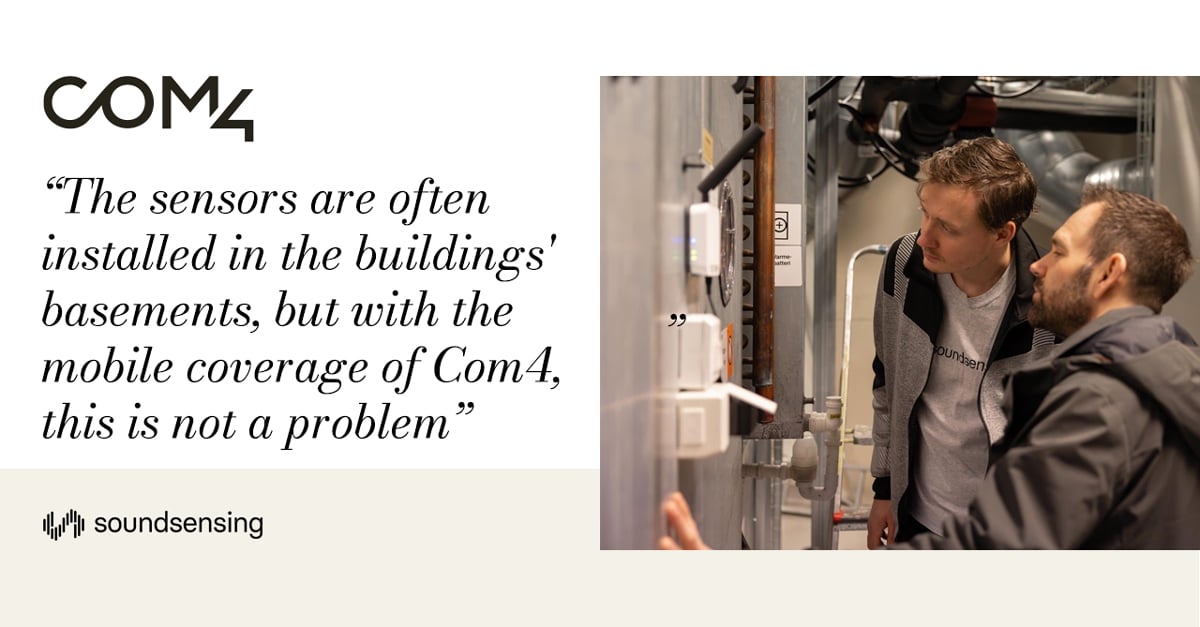
- Predictive maintenance using vibration and sound sensors, as seen in the Soundsensing case.
- Real-time production monitoring to detect bottlenecks early.
- Automated quality inspection using connected cameras and sensors.
Logistics and supply chain
- Asset and fleet tracking to know where goods are and in what condition.
- Cold chain monitoring for food and pharmaceuticals.
- Smarter route and inventory planning based on live data.
Energy and infrastructure
- Remote monitoring of grid components, tunnels, bridges, or pipelines, as in the Gomero case.
- Faster fault detection and more efficient maintenance planning.
Food delivery and field operations
- In the Just Eat Norway case, connected systems help run large, distributed operations. Here, uptime and reliability are key.
Com4 offers Connectivity Packages as well as Add-on IoT Products, like private APNs and VPNs. These tools ensure devices and platforms communicate securely and reliably.
Challenges and Practical Considerations
Despite the clear benefits, adopting IoT in Industry 4.0 is not without challenges.
- Security and data protection must be addressed from the start. Every connected device is a potential entry point if not properly secured.
- Integration with existing systems is often more difficult than expected. Many factories still rely on older machines that were never designed to be connected.
- Data management becomes more complex as the number of devices grows. Clear rules are needed for data access, storage, and usage.
- People and processes are just as important as technology. Teams need new skills, and organizations need to adapt how decisions are made.
Successful companies often begin with a clear use case. They prove its value and then scale gradually.
The Future of IoT and Industry 4.0
The next phase of Industry 4.0 will go even further. Digital twins can simulate entire factories or systems. This helps us test changes before applying them in the real world. More AI will move closer to the machines through edge computing. Private 5G networks and advanced cellular solutions will power apps that need low latency and high reliability. We will see more use of iSIM and eSIM technologies.
The direction is clear. Industrial systems will become more autonomous, more connected, and more data-driven.
Industry 4.0 and IoT are changing how industrial companies work, compete, and add value. IoT and IIoT provide the data and connectivity foundation. Cloud computing, analytics, and AI transform data into insights and actions.
The key value drivers are clear: higher efficiency, lower costs, better quality, and more resilient operations. Success also needs a practical approach. It should consider security, integration, and how ready the organization is.
For business leaders, the strategic actionables are to:
- Start with high-impact, well-defined use cases.
- Build a scalable and secure connectivity and data foundation.
- Treat Industry 4.0 as a long-term transformation, not a one-off project.
For organizations scaling IoT initiatives, partnering with experienced providers like Com4 is key. We help ensure the infrastructure is reliable and secure. This support is crucial for global, industrial-grade deployments.



.webp)
.jpg)