None of these fleets are exceptional. What they share is the same underlying shift: connectivity has quietly become the thing that decides whether a fleet runs well or runs into trouble. Vehicles, cargo and drivers now generate a constant stream of data, and IoT is what turns that stream into fewer breakdowns, lower fuel bills, safer driving and a fleet that a manager can actually see, instead of guess at.
This guide is written for fleet management companies: logistics and transport operators, construction and heavy-equipment fleets, shared-mobility providers, and the telematics vendors building for them. It covers what IoT fleet management actually is, the components that make it work, the use cases delivering the most value in 2026, the challenges that trip up most implementations, and why connectivity, more than any single piece of hardware, is what determines whether a fleet IoT project succeeds
What Is IoT Fleet Management?
IoT fleet management is the use of connected devices, telematics, and sensors to collect real-time data from vehicles, drivers, and cargo, and to transmit that data over a network so it can be monitored, analysed and acted on. In practice, it means a fleet manager can see where every vehicle is, how it's being driven, what condition it's in, and whether its cargo is safe, all from one dashboard, without a single phone call.
The market reflects how central this has become to modern logistics and transport. The global IoT fleet management market is projected to reach USD 20.61 billion by 2030, growing at roughly 17% a year, according to Grand View Research. That growth is being driven by fleets of every size looking for the same things: lower operating costs, fewer accidents, and less time spent reacting to problems after they've already cost money.
Most conversations about IoT fleet management focus on the devices: the trackers, the sensors, the dash cams. Those matter. But every one of them is only as good as the network underneath it. A tracker that drops signal at the border, a sensor that can't reach the cloud from a rural depot, or a SIM that only works reliably in one country isn't a fleet management tool, it's a liability with a dashboard attached. This is where Com4 focuses: building the connectivity layer that lets every other component in a fleet IoT system actually do its job.
The Building Blocks of an IoT Fleet Management System
A working fleet IoT setup is really a stack of components, each one dependent on the layer below it.
Telematics devices
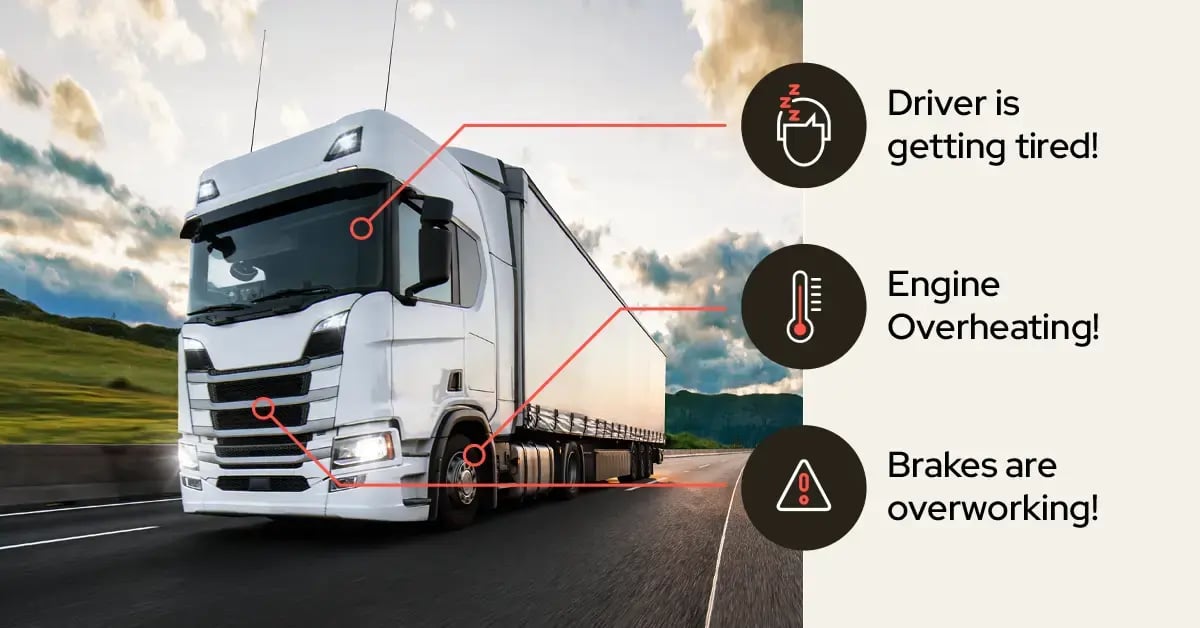
Telematics units, typically connected through a vehicle's OBD-II port or CAN bus, are the core data source for most fleets. They report GPS location and route, engine diagnostics like fuel level and battery health, driver behaviour such as harsh braking or speeding, and fuel consumption patterns that flag waste before it adds up.
Sensors
Beyond the vehicle itself, sensors monitor the things a telematics unit can't see directly: tyre pressure, cargo temperature and humidity for refrigerated goods, engine oil and coolant levels, and shock or vibration for fragile or high-value freight. For fleets carrying pharmaceuticals, food, or electronics, these sensors are often the difference between a delivery and a write-off.
Dash cameras
Dash cams add a visual record to the data record. They capture incidents for insurance and liability purposes, help coach driver behaviour, and act as a deterrent against theft or tampering.
Connectivity: the layer that decides whether any of this works
This is the part of the stack that's easiest to underestimate and the one Com4 exists to get right. Every telematics device, sensor and camera needs a reliable way to get its data off the vehicle and into the cloud, and the right network choice depends on where the fleet operates and how much data it moves.
- Cellular connectivity (4G/5G, LTE-M, NB-IoT) carries the bulk of fleet data. High-bandwidth applications like live video from dash cams or AI-powered in-vehicle systems need standard 4G or 5G. Battery-powered trackers on trailers or low-value assets, which might report location only a few times a day, are better served by LTE-M or NB-IoT, which trade speed for years of battery life on a single charge.
- Satellite and NTN connectivity picks up where cellular coverage runs out: long-haul routes through the Norwegian mountains, cross-border corridors, or fleets operating in genuinely remote territory. Com4 offers satellite connectivity, including Starlink-based and Non-Terrestrial Network (NTN) solutions, so a route losing cellular signal doesn't also mean losing visibility of the vehicle.
- Multi-network, carrier-agnostic SIMs solve the problem of a fleet operating across several countries, or even just several regions within one. Rather than betting on a single mobile operator, a Com4 SIM automatically connects to the strongest available network among 750+ operators across 190+ countries.
- eSIM, eUICC and Multi-IMSI technology let a fleet management company provision, reconfigure or switch a device's network profile remotely, over the air, without a technician physically swapping a SIM card in every vehicle. For a fleet of any real size, this alone can turn a multi-week rollout into a same-day one.
Cloud platforms
Everything the devices and sensors collect needs somewhere to land, get processed and turn into something a fleet manager can act on. A good cloud platform stores and analyses the incoming data in real time, flags anomalies (an overheating engine, a temperature excursion in a reefer trailer), and integrates with the other systems a business already runs, dispatch, accounting, CRM, so fleet data doesn't sit in its own silo.
Mobile and web applications
The dashboard is where all of this becomes usable day to day: live vehicle tracking, maintenance alerts, geofencing notifications, driver scorecards, and custom reporting, accessible from an office desktop or a manager's phone in the field.
Top IoT Fleet Management Use Cases in 2026
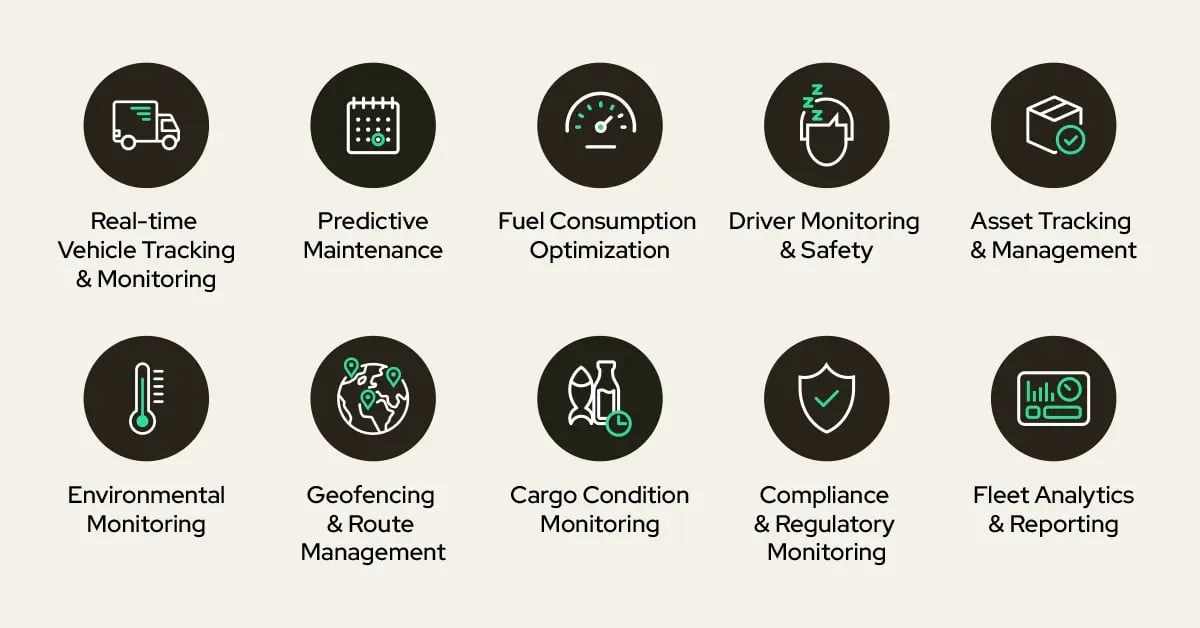
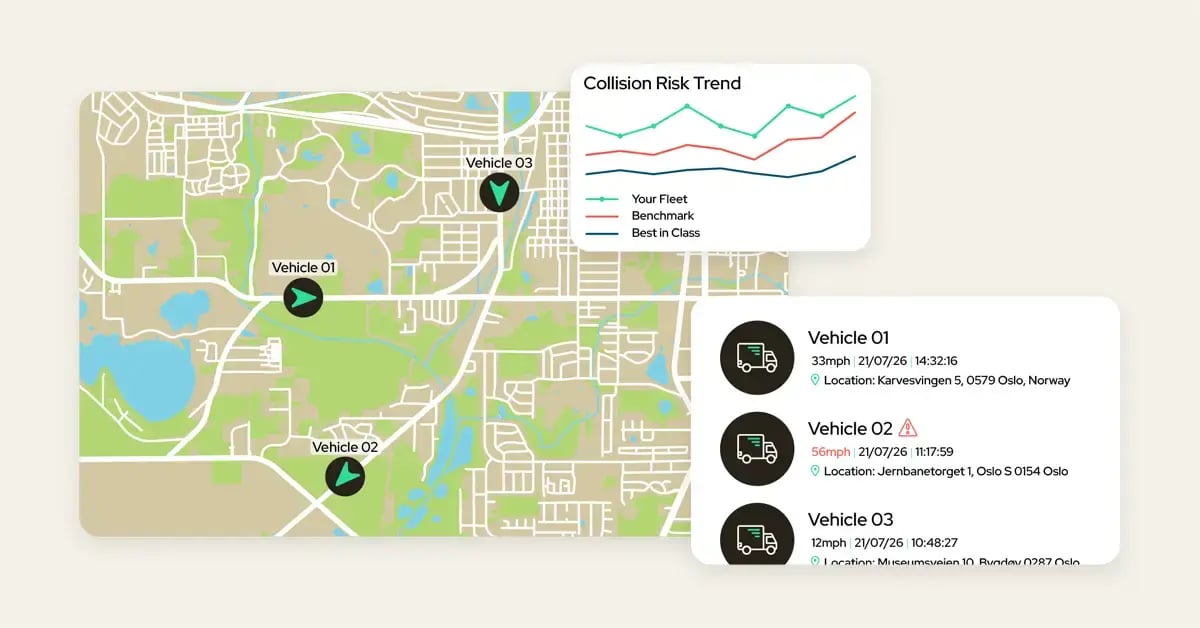
- Real-time vehicle tracking. Live location, speed and route data lets fleet managers reroute around traffic, give customers accurate delivery windows, and know exactly where every vehicle is without a phone call. Stavanger-based Soolo built its fuel-tank monitoring platform on Com4 connectivity and, by giving operators real-time visibility of every tank, cut transport costs in half simply by removing the guesswork from restocking routes.
- Predictive maintenance. Continuous monitoring of engine health, tyre pressure and vibration flags problems before they become breakdowns, extending vehicle life and cutting unplanned downtime.
- Fuel consumption optimisation. Telematics data on idling, harsh acceleration and route inefficiency turns fuel, often a fleet's single largest cost, into something measurable and manageable rather than an end-of-month surprise.
- Driver safety monitoring. Speeding, harsh braking and fatigue indicators let fleet managers coach drivers with real data instead of guesswork, which tends to reduce both accidents and insurance premiums over time.
- Asset and cargo tracking. Trailers, containers and high-value equipment can be tracked independently of the vehicle hauling them, which matters the moment a trailer gets left behind or a container goes missing at a port.
- Environmental and cargo condition monitoring. For temperature-sensitive goods, continuous monitoring with instant alerts on deviation prevents spoilage and keeps a fleet compliant with cold-chain regulations, rather than finding out about a problem after the delivery has already failed.
- Geofencing and route compliance. Virtual boundaries flag unauthorised stops, route deviations or entry into restricted zones, useful for both security and simple operational discipline.
- Connectivity for mixed and off-road fleets. Fleet management isn't limited to trucks on a highway. Holte, a leading Norwegian provider of digital solutions for the construction sector, manages hundreds of vehicles and pieces of heavy machinery across the country, much of it in rural or mountainous terrain with patchy coverage. Running on Com4's IoT SIM and eSIM solutions, Holte gets seamless data transmission, real-time monitoring, predictive maintenance and equipment tracking, in exactly the conditions where a single-operator SIM tends to drop out.
- AI-powered in-vehicle video for shared and connected fleets. Swipp, a Scandinavian car-sharing company, runs its connected vehicles on Com4's high-throughput IoT connectivity to power onboard AI video and telematics. That gives Swipp real-time driving-behaviour analysis, safety alerts and live vehicle monitoring across its shared fleet, the kind of bandwidth-heavy, always-on application that needs dependable 4G/5G underneath it, not just a tracker pinging every few minutes.
- Fleet analytics and reporting. Aggregated data across the fleet, not just per vehicle, reveals which routes consistently run late, which vehicles cost the most to maintain, and where the next efficiency gain is actually hiding.
How an IoT Fleet Management System Works
The process is the same regardless of fleet size, only the scale changes.
- Collection. Telematics devices and sensors gather location, diagnostic, behavioural and environmental data continuously from every vehicle.
- Transmission. That data moves off the vehicle over cellular, satellite or a combination of both, depending on where the vehicle is and how urgent the data is. Location and safety alerts go in real time; routine diagnostics can batch.
- Processing. A cloud platform aggregates data across the entire fleet, applies analytics to spot patterns and anomalies, and increasingly uses machine learning to predict maintenance needs or safety risks before they materialise.
- Action. Fleet managers see the results on a dashboard, alerts, live maps, reports, and act: reroute a vehicle, schedule maintenance, coach a driver, resolve a compliance gap.
- Improvement. Over time, the accumulated data feeds longer-term decisions: which routes to redesign, which vehicles to retire, where training is actually needed.
At Com4, this whole chain sits on Polaris CMP, our connectivity management platform. It gives fleet management companies one place to provision SIMs, monitor usage and connection status per vehicle, set alerts and thresholds, and manage the entire SIM estate globally through APIs that plug into existing fleet software, rather than forcing a rebuild of systems that already work.
NTN and Satellite Failover: Coverage Where Cellular Can't Reach
Fleet routes don't stop at the edge of cellular coverage, but historically, visibility did. A truck through a Norwegian mountain pass, a construction fleet like Holte's working rural or mountainous terrain, a logistics route that runs along a coastline between ports: these all pass through zones where even a strong multi-network SIM eventually runs out of towers. This is where Non-Terrestrial Networks (NTN) and satellite failover close the gap.
NTN connects a device directly to a satellite instead of a ground-based tower. Until recently, that meant proprietary hardware, a separate SIM, and a completely separate system to manage alongside the rest of a fleet. That's changed. Under the 3GPP Release 17 standard, NTN now works with standard NB-IoT devices and SIMs, the same technology already running in a large share of IoT trackers. In practice, that means a single SIM can authenticate on a terrestrial cellular network when one is available and automatically fail over to satellite the moment it isn't, with no separate hardware and nothing for a fleet manager to configure mid-route.
Com4 delivers this hybrid cellular-and-satellite connectivity through two partnerships: Sateliot, a leading 5G NTN satellite operator built on the 3GPP Release 17 standard, and Starlink, where Com4 is an official SpaceX partner. Both run through the same Polaris CMP dashboard as every terrestrial SIM in a fleet, so a vehicle that drops off cellular coverage on a remote stretch doesn't disappear from the fleet map, it just switches connection paths, automatically, on the same SIM.
For fleet management companies, this failover matters most on: long-haul routes through mountainous or rural terrain, cross-border corridors with gaps between national operators, construction and heavy-equipment fleets working remote sites, and logistics routes that run along coastlines or between ports where terrestrial coverage thins out.
It's worth being direct about the tradeoff. NTN connectivity currently costs more per device than terrestrial cellular, and for most fleet routes within reliable coverage, standard cellular remains the right and more cost-effective choice. NTN and satellite failover earn their place as a fallback layer for the specific routes where a coverage gap creates real operational risk, a missed maintenance alert, a lost asset, a break in a cold chain, not as a default for an entire fleet.
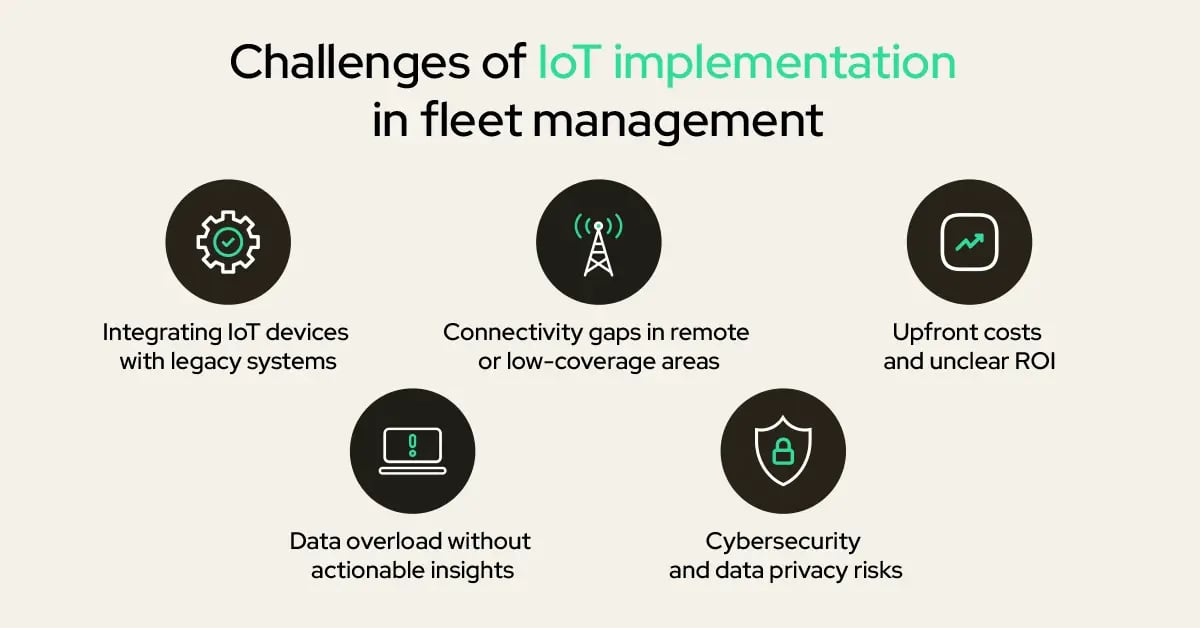
Common Implementation Challenges
Com4 isn't a fleet management software vendor. We're the connectivity layer underneath the fleet management platforms, telematics devices and sensors that fleets already use or are evaluating, which means the strengths that matter here are specifically about keeping a moving vehicle reliably online, wherever it goes.
- Coverage gaps in remote or cross-border areas. A single-operator SIM works until a vehicle crosses into an area that operator doesn't cover well, and fleet management companies running international or rural routes hit this constantly. Com4's multi-network SIMs draw on 750+ operators across 190+ countries, automatically switching to the strongest available signal, with satellite and NTN connectivity available where cellular simply doesn't reach.
- Battery life on tracked assets. Trailers, containers and low-value equipment can't be recharged like a cab-mounted unit. LTE-M and NB-IoT, both supported across Com4's network, are built specifically for devices that need to report occasionally over months or years on a single battery.
- Fragmented connectivity contracts as fleets scale internationally. Negotiating separate operator contracts per country doesn't scale past a handful of markets. One Com4 SIM, one contract, one invoice, and one platform (Polaris CMP) covers a fleet management company expanding from one country to fifteen without a new procurement cycle each time.
- Slow, hands-on device provisioning. Physically swapping SIMs across a large or distributed fleet is expensive and slow. eSIM, eUICC and Multi-IMSI technology let Com4 customers provision and reconfigure devices remotely, over the air.
- Security and compliance. Fleet data includes location history, driver behaviour and sometimes cargo details that are commercially sensitive. Com4 supports VPN and private APN-based secure connections, keeping fleet traffic isolated from the public internet, alongside GDPR-aligned data handling.
- Unclear ROI on the first rollout. Full fleet-wide IoT deployments carry real upfront cost. Com4's flexible, pay-as-you-go pricing (from as little as €0.001/MB, with no minimum contract duration) makes it realistic for a fleet management company to start with a pilot fleet, prove the cost savings, and scale from there.
Why Fleet Management Companies Choose Com4
Com4 isn't a fleet management software vendor. We're the connectivity layer underneath the fleet management platforms, telematics devices and sensors that fleet management companies already use or are evaluating, which means the strengths that matter here are specifically about keeping a moving vehicle reliably online, wherever it goes.
- Reach: 750+ mobile networks across 190+ countries, with multiple operators available per country for resilience, not just one fallback option.
- Flexibility: carrier-agnostic multi-network SIMs, eSIM/eUICC and Multi-IMSI support, and SGP.32-ready hardware, so a fleet isn't locked into a single operator or SIM form factor as it grows.
- Full technology range: 2G, 3G, 4G/5G, LTE-M and NB-IoT, plus satellite and NTN connectivity including Starlink, matched to whatever a given device or route actually needs.
- One platform: Polaris CMP gives fleet management companies real-time visibility, automation and control over every SIM and connection, globally, from a single dashboard.
- Proven hardware partnerships: Com4 eSIM ships preloaded on the Teltonika RUT241 industrial router, giving fleets a ready-to-deploy connectivity option without separate SIM provisioning.
- Scale and backing: Com4 is part of the Wireless Logic Group, one of Europe's largest IoT connectivity specialists, a GSMA industry member, and already supports more than 20 million SIMs in IoT deployments worldwide.
- A track record with fleet management companies specifically: from Soolo's fuel-tank monitoring, to Holte's construction fleet and heavy-machinery connectivity, to Swipp's AI-powered car-sharing video, to Bane NOR's rail infrastructure, Com4 connectivity is already running inside fleets and transport operators across the Nordics and beyond.
Case Studies: Two Norwegian Fleet Management Companies
Holte: Connectivity for a Construction Fleet in Rural and Mountainous Terrain
Challenge: Holte, a leading Norwegian provider of digital solutions for the construction sector, manages hundreds of vehicles and pieces of heavy machinery across the country. Much of that fleet works rural or mountainous sites, exactly the terrain where a single-operator SIM tends to lose signal, undermining real-time monitoring, predictive maintenance, and equipment tracking.
Solution: Holte runs its fleet and equipment connectivity on Com4's IoT SIM and eSIM solutions, giving it access to multiple mobile networks rather than being locked into one operator's coverage map.
Result: Seamless data transmission, greater operational visibility across the fleet, and reduced downtime, even on sites where terrestrial coverage is patchy.
Swipp: AI-Powered In-Vehicle Video for a Car-Sharing Fleet
Challenge: Swipp, a Scandinavian car-sharing company, needed its connected vehicles to support onboard AI video and telematics, a bandwidth-heavy, always-on application that standard low-power IoT connectivity isn't built for.
Solution: Swipp runs its shared fleet on Com4's high-throughput IoT connectivity, giving its AI video systems the consistent 4G/5G bandwidth they need across every vehicle in the fleet.
Result: Real-time driving-behaviour analysis, safety alerts, and live vehicle monitoring across the fleet, supporting a smoother, more transparent car-sharing experience for both Swipp and its customers.
Where IoT Fleet Management Is Headed
A few shifts are already visible heading into the rest of 2026 and beyond. AI-driven analytics are moving from reporting what happened to predicting what's about to happen, catching a likely breakdown or a risky driving pattern before it becomes an incident, the same shift already visible in AI-powered in-vehicle video systems like Swipp's. Edge computing, processing data on the device itself rather than waiting on a round trip to the cloud, is starting to show up in fleet hardware, cutting the delay between a sensor detecting a problem and a driver being alerted. Electric fleets are adding their own connectivity demands: battery health monitoring and charging optimisation on top of the tracking and maintenance data fleets already collect. And satellite-cellular hybrid connectivity, once a niche requirement for maritime or mining, is becoming a standard consideration for any fleet management company with genuinely remote routes, including construction fleets like Holte's operating in rural or mountainous terrain.
None of these trends change the fundamentals. They all still depend on a connectivity layer that stays up regardless of where the vehicle is, which is the problem Com4 was built to solve.