
NTN in 2026: Transforming Global IoT Connectivity

For years, the promise of truly global IoT connectivity has run into the same wall: terrestrial networks simply do not cover everywhere. The oceans, the mountains, the pipelines, the farmland, the remote infrastructure that industries depend on most — these are precisely the places where traditional cellular networks run out. Non-Terrestrial Networks, or NTN, exist to solve exactly that problem. And in 2026, the technology has moved decisively from concept to reality.

Satellite / Industrial IoT Connectivity Solutions / NTN (Non-Terrestrial Networks) | 1 July 2026
Nighttime view of Earth from space showing Europe, the Middle East, and North Africa illuminated with city lights, encircled by a network of satellite connection lines representing global coverage via Non-Terrestrial Network (NTN) technology.
At Com4, we are not just watching this shift from the sidelines. We have partnered with Sateliot, one of the world's leading NTN satellite operators, as we work to make seamless hybrid cellular and satellite IoT a standard part of what we offer our customers.

What Are Non-Terrestrial Networks (NTN) and How Do They Work?

NTN stands for Non-Terrestrial Networks. Rather than connecting a device to a ground-based tower, NTN connects devices directly to satellites or other airborne platforms. The critical development in recent years is that this is no longer a proprietary, niche technology requiring special hardware. Thanks to the 3GPP Release 17 standard, NTN now works with standard NB-IoT devices, the same low-power, wide-area technology that millions of IoT deployments already run on.

This is the breakthrough that matters. It means that a device can connect to a terrestrial network when one is available, and automatically switch to satellite when it is not, using the same SIM, the same platform, and the same management tools. No proprietary hardware. No separate system to manage. Just coverage, everywhere.

Why 2026 Is the Tipping Point for NTN and Satellite IoT

The ecosystem has reached a tipping point in 2026. Sateliot has raised €100 million to accelerate the deployment of its constellation, with backing from institutional investors including the European Investment Bank. Their network is built around 3GPP Release 17 5G Non-Terrestrial Network specifications, which extend cellular standards to satellite connectivity, meaning devices can connect to the satellite network without modifications, custom antennas, or special firmware, provided those devices support the relevant 3GPP release.

On the device side, the chipset ecosystem is catching up fast. Few modem vendors support NTN-ready modules today, and the chipsets that do exist are cutting-edge technology. The prime example is Nordic Semiconductor's brand new nRF9151 that supports NTN connectivity. The nRF9151 has already achieved successful chip-to-cloud communication via Sateliot's NTN satellites, marking a pivotal advance in satellite communications and verifying the potential of low-power cellular IoT technology for applications in smart agriculture, asset tracking, and smart metering.

Global satellite network illustration showing digital Earth map with connected satellites orbiting over Europe — global connectivity and communication technology

How Com4 and Sateliot Are Delivering Hybrid Cellular and Satellite IoT Connectivity

Com4 has entered into a partnership with Sateliot, a leading 5G NTN satellite operator, to bring seamless hybrid cellular and satellite IoT connectivity to our customers. This partnership is a direct expression of our commitment to ensuring that IoT devices stay connected wherever they operate, whether in a city centre or in the middle of the ocean.

Our goal is straightforward: to extend the same reliable, managed IoT connectivity we provide across 190 countries and 750 networks into every corner of the planet, including the places where no cell tower will ever exist. Through our partnership with Sateliot, customers can now plan deployments with true global coverage in mind, backed by 3GPP standards, automatic cellular-to-satellite switchover, and management through our Polaris connectivity platform. One SIM, one platform, one bill.
As a full member of AIOTI, the Alliance for AI, IoT and Edge Continuum Innovation, Com4 is also contributing to the European-level standardisation and policy work that will shape how NTN is deployed responsibly and interoperably across the continent. European IoT sovereignty means more than choosing European providers. It means building on open standards, and NTN built on 3GPP is exactly that.

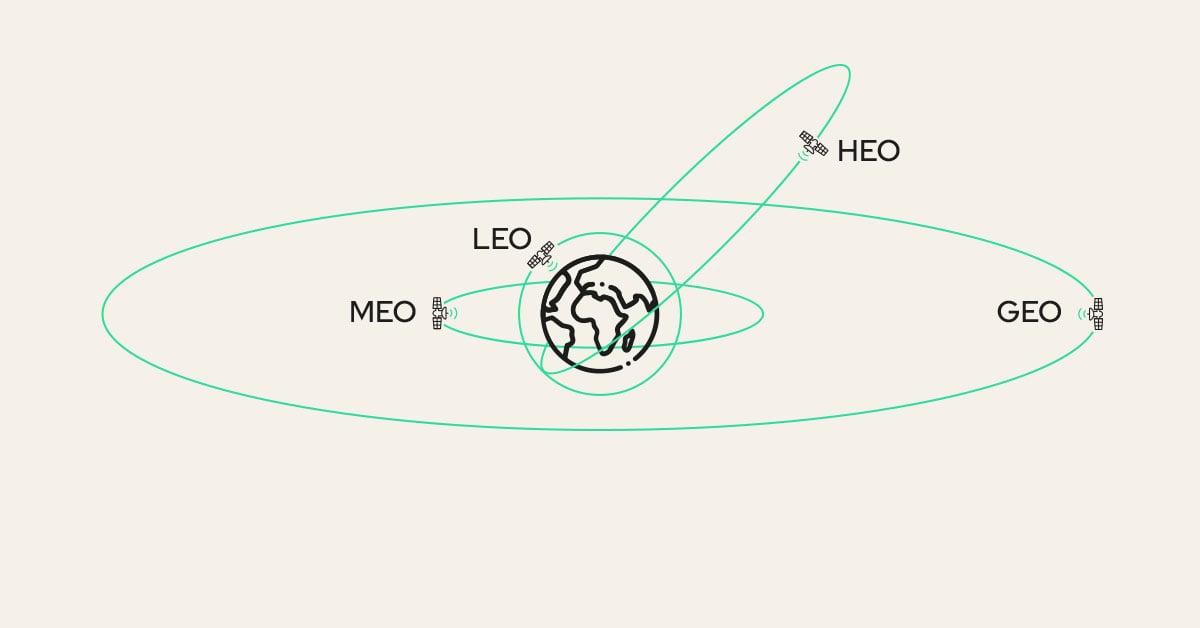
Diagram of Earth orbit types showing satellites at four altitudes: LEO (Low Earth Orbit) closest to Earth, MEO (Medium Earth Orbit) in a wider circular path, GEO (Geostationary Orbit) in the widest circular path, and HEO (Highly Elliptical Orbit) shown as an elongated oval path extending far from Earth.

The Best IoT Use Cases for NTN Connectivity Today

NTN is not a replacement for cellular connectivity. In 2026, the honest assessment is that terrestrial networks remain the right choice for the vast majority of IoT deployments. But for the use cases where connectivity genuinely cannot be guaranteed on cellular alone, NTN is no longer theoretical. Maritime tracking, remote energy infrastructure, agriculture in rural areas, logistics routes that cross coverage gaps, environmental monitoring in the wilderness — these are real, deployable use cases today.

The key is designing connectivity strategies that treat cellular and satellite as complementary layers, not competing choices. That is the architecture Com4 is building toward, and it is why our partnership with Sateliot is a significant step in that direction.

The Future of NTN: What IoT Businesses Need to Know

If you are designing IoT deployments that need to go beyond the reach of terrestrial networks, or if you want to future-proof your connectivity architecture with satellite fallback, we would love to talk.

The era of truly global IoT connectivity is arriving. We are helping to build it.


Frequently Asked Questions About NTN and Satellite IoT

What does NTN stand for?

NTN stands for Non-Terrestrial Networks. It is the 3GPP-standardised framework for connecting IoT devices via satellite or other airborne platforms, extending connectivity beyond the reach of traditional ground-based cellular towers.

How is NTN different from regular satellite IoT connectivity?

Traditional satellite IoT often required proprietary hardware, dedicated terminals, and separate management systems. NTN, standardised under 3GPP Release 17, works with standard NB-IoT devices and SIMs, meaning it integrates into existing cellular IoT architectures rather than requiring a completely separate stack.

Does my existing IoT device support NTN?

Not automatically. NTN requires devices with chipsets that support 3GPP Release 17 or later. The most notable example today is Nordic Semiconductor's nRF9151 module. If you are designing new deployments, it is worth specifying NTN-compatible modules from the outset. Com4 can advise on compatible hardware for your use case.

Do I need a special SIM card for NTN satellite connectivity?

No. A single SIM, eSIM, or iSIM can authenticate across both terrestrial cellular networks and NTN satellite networks. This means your devices can be managed through one platform, with automatic switchover between cellular and satellite based on coverage availability.

What are the strongest IoT use cases for NTN in 2026?

NTN delivers the most value where terrestrial coverage cannot be guaranteed. The strongest use cases include maritime tracking, remote energy and pipeline monitoring, agriculture in rural areas, logistics across coverage gaps, environmental monitoring, and emergency communications infrastructure.

Is NTN more expensive than standard cellular IoT?

Yes, NTN connectivity currently carries a higher cost per device than terrestrial cellular. For most IoT deployments within reliable cellular coverage, terrestrial networks remain the more cost-effective choice. NTN is best evaluated as a fallback or complement for specific use cases where coverage gaps create operational or business risk that outweighs the cost difference.

What is Com4's NTN connectivity offering?

Com4 has partnered with Sateliot, a leading 5G NTN satellite operator, to offer hybrid cellular and satellite IoT connectivity. Through Com4's Polaris connectivity management platform, customers can manage both terrestrial and NTN connections in one place, with automatic switchover, real-time monitoring, and a single SIM across both network types. Get in touch with our team to discuss your specific connectivity needs.

Northern-light-sky
START YOUR JOURNEY TODAY

Stay up to date with the latest news and developments in Com4 and IoT industry