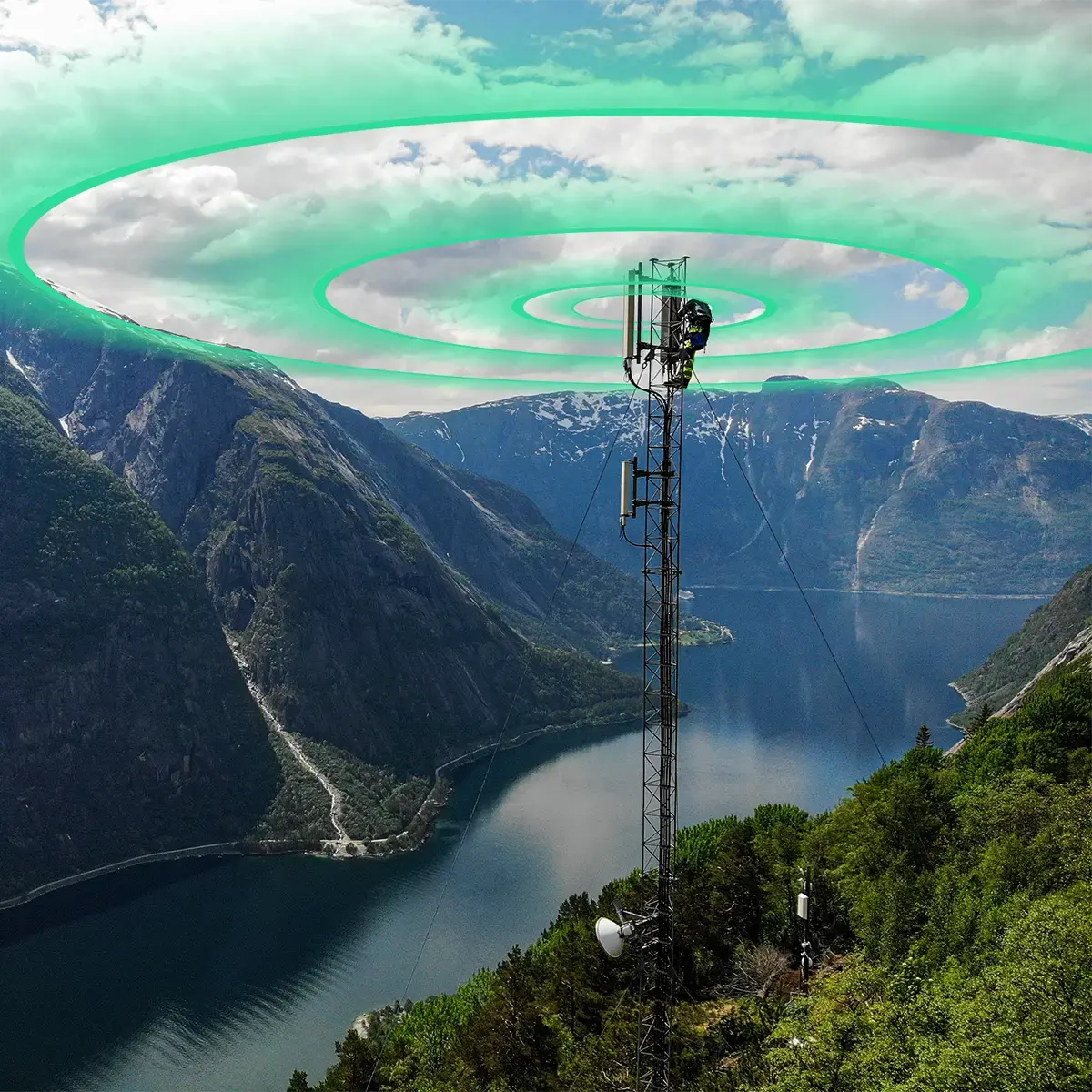
.jpg?width=720&height=720&name=satellite-image-hero%20(1).jpg)
Most large organizations have invested significantly in robust networks, redundant data centers, and cybersecurity. Yet we often see that one risk continues to be underestimated: the loss of the very connection to the outside world.
After all, what happens if the fiber-optic cable is cut? What if the cellular network becomes unavailable? And what do you do when facilities are located in areas where cellular coverage has never been good enough? Many have already experienced this firsthand; others ask these questions during emergency preparedness drills.
In such discussions, satellite technology is coming up more and more often—especially Starlink. Not as a replacement for fiber or cellular. But as an independent layer of preparedness. This year, Starlink’s capacity is going from already good to twice as good.
Connectivity has become a critical infrastructure
Just a few years ago, a company could, in practice, continue to operate locally if the internet went down. Today, most operations come to a halt immediately:
-
ERP systems and cloud services
-
Payment solutions
-
Logistics and warehouse systems
-
Production and OT environments
-
Video conferencing and remote support
- Monitoring and sensor data
Network outages thus quickly have direct financial consequences. Added to this are the ripple effects, referred to in international analyses as “the million-dollar hour.”
This costly domino effect has sparked renewed interest in better contingency planning to ensure uptime—whether the person asking has learned from past mistakes or is simply being proactive. The internet connection has become part of their disaster recovery architecture, on par with power supply and data centers.
The Problem with Traditional Redundancy
The classic model for redundancy is simple:
-
Fiber as the primary connection
-
Two independent lines for those with the highest requirements
-
4G or 5G as a backup
This works well in most scenarios. But there’s a weakness that many overlook: All solutions still rely on the same ground-based infrastructure.
Fiber can be cut during excavation work. Cell towers can lose power or capacity. Extreme weather
can affect both at the same time.
In such situations, both the primary and backup lines can go down at the same time. We won’t dwell
on these vulnerabilities any further, but rather point out that the standard of “in most scenarios” could easily raised several notches.
When backup is moved from the ground to space
This is where LEO (Low Earth Orbit) satellites come into the picture. Starlink consists of thousands of satellites in low Earth orbit, about 550 kilometers above the ground. This provides much lower latency than traditional satellite systems, along with the capacity needed to use the solution for standard business applications.
The most important aspect in an emergency preparedness context, however, is something else: The connection is completely independent of local infrastructure. When a business incorporates Starlink as a third connection in its WAN architecture, the backup line is moved away from the ground.
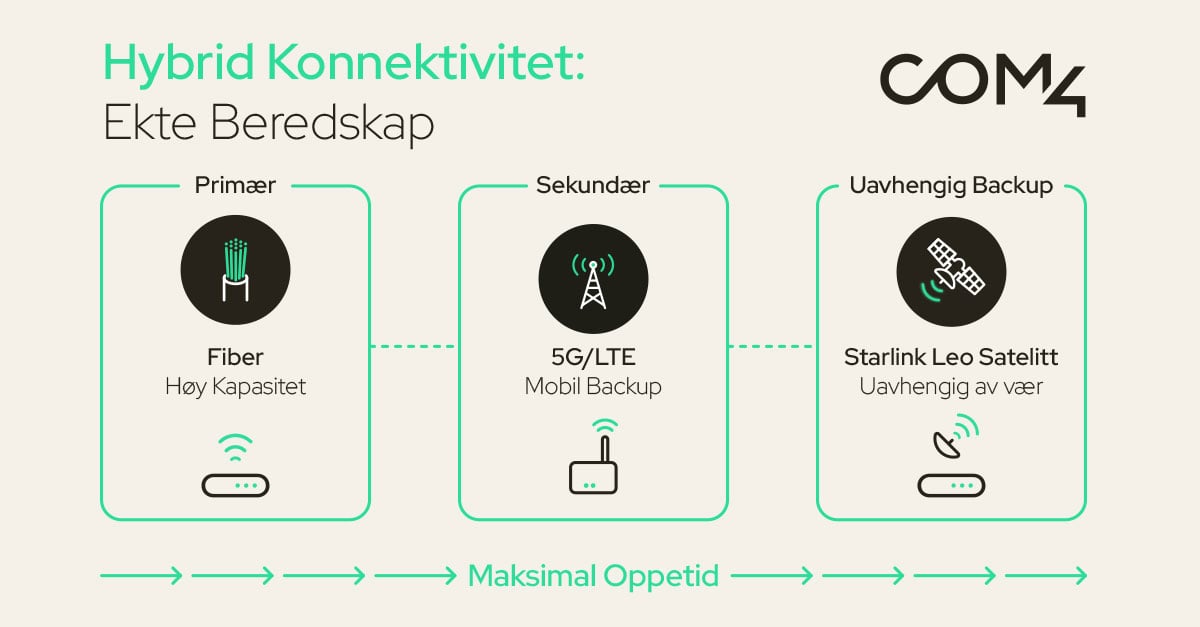
This means that even if fiber or mobile networks fail locally, traffic can still be routed via satellite. In practice, we often see solutions like this:
-
Fiber as the primary line
-
5G/LTE as the secondary line
-
Starlink as an independent backup
Together, this provides hybrid connectivity where three completely different technologies support one another.
The extreme case in Antarctica is similar to conditions in Norway
The NORSAR Research Foundation is building a seismic measuring station at the Norwegian research station Troll. The installation is located in an area with an extreme climate and limited access, and must operate autonomously through eight months of polar night.
The station can only store data for about 100 days. If communication is interrupted, researchers risk losing irreplaceable data series.
That is why NORSAR has chosen Starlink, provided and operated by Com4, as a backup connection to its primary 5G line. The solution ensures that data continues to be transmitted even if the main connection fails.
It’s an extreme environment, but the principle is the same as what many Norwegian businesses face. These are organizations operating in areas where cell service is limited or unstable:
-
Power plants and energy facilities
-
Fish farms
-
Industrial areas
-
Construction sites
-
Research stations
-
Mountain and coastal installations
Here, satellite can serve as the primary means of connectivity, not just a backup.
Why this is happening now
Several developments are unfolding simultaneously in the satellite market. Starlink has already demonstrated that satellites can deliver hundreds of megabits per second with relatively low latency. And new generations of satellites are set to launch (very soon) that will be able to deliver significantly higher capacity in the future.
At the same time, we’re seeing a clear trend in enterprise networks: Many companies are moving away from closed MPLS networks and toward internet-based WAN architectures combined with SD-WAN, which seamlessly switches between fiber, 5G, and—if you have Starlink—satellite.
As the Internet becomes the transport layer for an increasing number of critical systems, SD-WAN becomes more effective the more independent alternatives it has to choose from. Satellite fits naturally into that model.
By 2026, Starlink will be up and running with 1 GB of capacity. Add a robust battery, and the company’s uptime will truly approach 100 percent.
Three questions more businesses should ask themselves
When we talk to IT and network managers, we usually start with three simple questions:
1. What is the actual cost of one hour of downtime?
2. Is the backup connection truly independent of the primary line?
3. Do you have locations in Norway where you operate without reliable IoT coverage?
If the answer to any of these questions is unsettling, it may be worth taking a closer look at how satellite can be incorporated into your contingency plan. Not because satellite replaces fiber or cellular. But because robust networks almost always consist of multiple technologies that complement each other. And what is our role in all of this? An important lesson from such projects is that a satellite connection is rarely “plug-and-play” in an enterprise architecture. It must be integrated into:
-
Routing and WAN design
-
Security architecture
-
Monitoring
-
Failover mechanisms
This is where providers like Com4 and Blue Wireless typically come into the picture. The latter provides global connectivity based on Starlink, while Com4 builds and operates the solutions in the Nordic region.
In practice, this involves integrating satellite technology into the company’s overall network architecture—not just installing a single antenna on the roof. The goal isn’t to sell a box. The goal is to ensure that the network continues to function when other systems fail.



-1.webp)
.webp)