LoRaWAN and NB-IoT are low-power wide-area network (LPWAN) technologies. Both connect devices that send small amounts of data and run for years on a battery. However, neither of them is built to replace Wi-Fi, 4G, or 5G broadband.
In the case of LoRaWAN, the business usually installs and owns its gateways, which run on unlicensed spectrum. In the case of NB-IoT, each device uses a SIM to connect to a mobile operator's base stations over licensed spectrum.
Range and battery life vary with the site, the reporting interval, and how deep indoors the device sits. So the right choice depends on site ownership, existing cellular coverage, payload size, and device mobility.
This article covers how LoRaWAN and NB-IoT work, their key differences, industry use cases, how to choose between them, and when a hybrid setup is recommended.
What Is LoRaWAN?
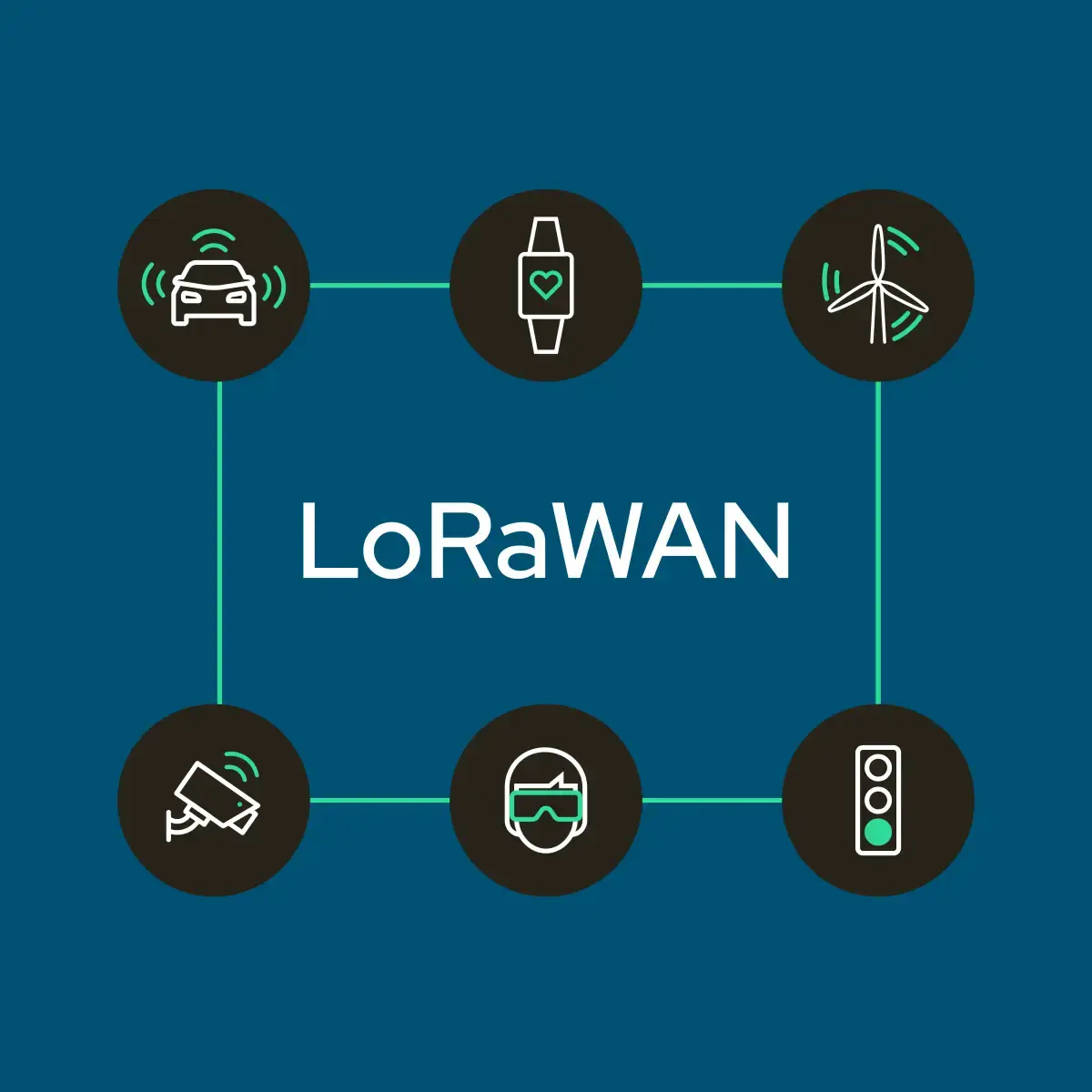
LoRaWAN is an open network protocol that provides long-range IoT connectivity for battery-powered devices on unlicensed spectrum. The LoRa Alliance maintains the specification, and its members reported 150 million LoRaWAN devices deployed globally in September 2026. The protocol runs on LoRa, a radio modulation developed by Semtech.
A LoRaWAN network has three main parts. Sensors send data to nearby gateways, and the gateways forward it to a network server over Ethernet, cellular, or satellite. The server then removes duplicate messages and passes the data to the application.
Spectrum rules also differ by region. For example, Europe sets a 1% airtime limit on most channels, while North America allows higher transmit power. So a device configured for Europe cannot ship unchanged to the US.
Benefits of LoRaWAN
-
No per-device airtime fee: A private network needs no SIMs, so the main cost is the gateways.
-
Low energy per message: A sensor transmits briefly at low power and sleeps between readings.
-
Wide coverage from one gateway: A rooftop gateway covers 2 to 5 km in dense urban areas and 5 to 15 km in rural areas.
- Open device ecosystem: More than 695 certified devices are available from multiple vendors.
Limitations of LoRaWAN
-
Low throughput: Data rates on a standard channel run from about 0.25 to 5.5 kbit/s, which rules out images and large firmware updates.
-
Coverage only where gateways exist: Wide-area coverage needs a public LoRaWAN operator or a large private build.
-
No guaranteed service quality: Other devices share the unlicensed band, so interference can occur.
-
Limited downlink: Most devices can only receive a command right after they send data.
What Is NB-IoT?
NB-IoT (Narrowband IoT) is a cellular LPWAN technology that 3GPP standardized in LTE Release 13 in June 2016. It runs on licensed spectrum inside existing mobile networks. Each device connects to the operator's base stations through a SIM, eSIM, or iSIM, so the business does not install any gateways of its own.
NB-IoT uses a narrow 180 kHz channel that operators place inside or alongside an LTE carrier. 3GPP designed it for a maximum coupling loss of 164 dB, which is about 20 dB more than GSM. This extra signal margin keeps meters in basements, pits, and underground chambers connected.
The GSMA counted 140 commercial NB-IoT networks in November 2025. Coverage is strong in Europe and China but uneven in the Americas, where several operators focus on LTE-M instead. So NB-IoT availability must be checked in each target country before rollout.
Benefits of NB-IoT
-
No gateways to install: Devices connect to existing operator sites wherever NB-IoT is enabled.
-
Deep indoor coverage: The 164 dB design target suits meter cupboards, basements, and utility pits.
-
Licensed spectrum: The operator controls network access, so devices do not compete with unrelated traffic.
-
Larger payloads: A message can carry hundreds of bytes, while LoRaWAN carries 51 to 222 bytes in Europe.
-
Long battery life: Power Saving Mode (PSM) and extended discontinuous reception (eDRX) let devices sleep for hours or days between reports. 3GPP targets more than 10 years on a 5 Wh battery for one 200-byte message per day.
-
SIM-based fleet control: SIM identity, roaming, and remote eSIM provisioning suit products shipped to many countries.
Com4's Polaris CMP lets teams activate, monitor, and suspend every NB-IoT SIM in a fleet from one platform.
Limitations of NB-IoT
-
Higher energy per message: Each session involves syncing with the network and transmitting at up to 23 dBm. As a result, it uses more energy than a LoRaWAN message in good coverage.
-
Latency of seconds: Typical latency is about 1.6 to 10 seconds, which rules out real-time control.
-
No handover between cells: A device that moves during a session must reconnect through the new cell.
-
Recurring connectivity cost: Each device needs a data plan, which adds a monthly cost per device.
LoRaWAN vs NB-IoT: Key Differences
LoRaWAN and NB-IoT differ in network ownership, spectrum, indoor coverage, and cost model. The table below compares them on the factors that affect a deployment:
| Factor | LoRaWAN | NB-IoT |
| Standard body | LoRa Alliance | 3GPP |
| Spectrum | Unlicensed sub-GHz bands | Licensed LTE bands |
| Network owner | The business or a public LoRaWAN operator | The mobile operator |
| SIM required | No | Yes (SIM, eSIM, or iSIM) |
| Data rate | About 0.25 to 5.5 kbit/s, up to 50 kbit/s in faster modes | Tens of kbit/s, up to about 127 kbit/s downlink on Cat-NB2 |
| Payload per message | 51 to 222 bytes in Europe | Hundreds of bytes |
| Outdoor range | 2 to 5 km urban, 5 to 15 km rural | Follows the LTE cell, about 1 km urban to 10 km rural |
| Indoor and underground | Good when a gateway is nearby | Designed for deep indoor coverage at 164 dB |
| Latency | Seconds, plus duty-cycle waits in Europe | About 1.6 to 10 seconds |
| Downlink | Class A devices receive only after sending; Class C devices listen almost continuously | Through eDRX paging; unreachable while in PSM |
| Battery life | Often 5 to 10+ years, with lower energy per message | 10-year 3GPP target, with higher energy per session |
| Mobility | No handover; any gateway in range receives the message | No handover during an active connection |
| Service quality | Best effort in a shared band | Operator-managed in licensed spectrum |
| Cost model | Gateway purchase and maintenance | Monthly data plan per SIM |
| Module cost | Lower | A few USD higher than LoRaWAN |
In the case of LoRaWAN, the business is responsible for fixing the link when it fails, whereas in the case of NB-IoT, the mobile operator handles it. For vehicles and other assets in constant motion, LTE-M is the better cellular option because it supports handover between cells.
How Do LoRaWAN & NB-IoT Work?
LoRaWAN and NB-IoT both deliver small sensor readings to an application, but each one uses a different network path.
How LoRaWAN Works
A LoRaWAN sensor stays in a low-power state between readings. When a reading is due, the sensor encrypts the data with AES-128 and transmits it on a permitted channel. Every gateway within range receives the message and forwards it to the network server, but the gateways cannot decrypt the payload.
The network server checks that the message has not been altered or replayed and then forwards it to the application server for decryption. When the signal is strong, the server uses adaptive data rate (ADR) to switch the device to a faster data rate, which shortens each transmission and reduces battery use.
Downlink commands reach the device only during its receive windows, and the device class sets when those windows open:
-
Class A: The device opens two short receive windows after each uplink, so a command waits until the next report.
-
Class B: The device adds receive windows at scheduled intervals, which makes command delivery more predictable.
-
Class C: The device keeps its receiver open almost continuously, so it usually needs mains power.
How NB-IoT Works
An NB-IoT device first scans the operator's licensed bands, selects an NB-IoT cell, and attaches to it. During attachment, the SIM authenticates the device with the operator's core network. The device then opens a short connection with the base station, transmits its reading, and releases the connection.
Between reports, the device switches to one of two power-saving modes:
-
PSM (Power Saving Mode): The device stays registered with the network but switches its receiver off, so it cannot receive commands until its next report.
-
eDRX (extended discontinuous reception): The device checks for paging messages at fixed intervals, so a command arrives at the next check instead of the next report.
When the device is installed in a basement or pit, the network repeats each transmission several times. The message still arrives, but delivery takes longer and uses more battery.
Battery life on both networks depends on how often the device reports, how often it receives commands, and how strong its signal is.
LoRaWAN vs NB-IoT: Industry Use Cases
Many industries use both technologies, and the choice at each site depends on who owns the network and where the devices are installed.
Water and Gas Metering
Utilities that run private or city-wide network use LoRaWAN, as Asker municipality in Norway does for over 20,000 water meters. Others use NB-IoT for meters in street pits and basements to avoid owning gateways.
Smart Buildings
Air quality, leak, and occupancy sensors inside a building suit LoRaWAN because one private gateway covers the site without a SIM fee per sensor. Dutch construction firm Heijmans, for example, runs over 20,000 LoRaWAN sensors across client buildings in the Netherlands.
Agriculture
Soil probes and tank sensors on a single farm use LoRaWAN through a solar-powered gateway, even where cellular coverage is weak. On a durian estate of over 80 hectares in Malaysia, LoRaWAN soil sensors replaced two hours of manual tree checks every day. Sensors spread across many farms use NB-IoT because each site needs no gateway.
Smart Cities
Cities that already run LoRaWAN gateways use them for parking and waste-bin sensors. In India, Tata Communications connects over 360,000 streetlights over LoRaWAN and has cut their energy use by 27%. Water meters and roadside cabinets spread across the city use NB-IoT because the existing cellular network already covers them.
Electricity Grids
When a grid operator monitors one large site, sensors inside the substation fence use LoRaWAN because a single gateway covers it. Operators with substations spread across regions use NB-IoT over the public cellular network instead. Gomero, for example, monitors over 6,000 transformer bunds in nine countries over Com4’s cellular network.
Logistics
Warehouse and yard sensors use LoRaWAN because the business controls the site and its gateways. Containers parked at depots and remote fuel tanks use NB-IoT. Soolo’s tank sensors, for example, connect over NB-IoT and help fuel distributors cut transport costs by up to 50%. Trackers on moving vehicles need LTE-M because it supports handover between cells.
How to Choose Between LoRaWAN & NB-IoT?
The matrix below shows which technology suits each deployment condition:
| Factor | Choose LoRaWAN when | Choose NB-IoT when |
| Network ownership | The business owns the site and has staff to maintain gateways | The business has no in-house team to run radio infrastructure |
| Device spread | Devices are on one site, campus, or farm | Devices are spread across a country or shipped abroad |
| Indoor placement | A gateway can be installed near the devices | Devices are in basements or pits with no gateway nearby |
| Message size and frequency | Messages are a few dozen bytes, sent a few times a day | Messages are hundreds of bytes, sent hourly |
| Command delivery | Commands can wait until the device reports | Commands must arrive within minutes |
| Service quality | Best-effort delivery in a shared band is acceptable | The deployment needs operator accountability and licensed spectrum |
| Cost at scale | Many sensors share one site and its gateways | Devices are spread across many sites, where a gateway at each site costs more than a SIM plan |
For products sold in several countries, a global IoT SIM connects each device to NB-IoT wherever operators have enabled it. Neither technology suits vehicles in motion nor devices that send images, video, or voice. Moving assets need LTE-M, whereas high-bandwidth devices need a different IoT network such as LTE Cat-1, 4G, or 5G.
Is Hybrid LoRaWAN + NB-IoT Deployment Possible?
Yes, and the most common setup combines LoRaWAN sensors with a cellular gateway. The sensors have no SIM, while the gateway uses a cellular SIM to send aggregated data over LTE, LTE-M, or NB-IoT.
Another setup splits one fleet across both networks. For example, a utility can connect street meters over NB-IoT and on-site sensors over LoRaWAN, and one application receives data from both. Dual-radio devices also exist, but extra power use, board space, and certification make them uncommon.
For sites beyond terrestrial coverage, Com4's satellite IoT connectivity extends NB-IoT devices to 3GPP Release 17 satellite networks and switches them back to cellular when coverage returns.
Conclusion
The choice between LoRaWAN and NB-IoT sets who owns the network, how deployment costs scale, and who maintains the connection over the life of the product. It also determines whether devices in basements and pits stay connected.
Start with the site, the coverage available there, the message pattern, and whether devices move. LoRaWAN suits sites the business controls, whereas NB-IoT suits devices spread across public networks or installed deep indoors.
Com4's free IoT test kit includes up to five SIMs with NB-IoT and LTE-M support on one card for testing coverage at real sites before rollout. Talk with our experts to plan connectivity for your deployment.
FAQ
Does NB-IoT Use 4G?
Can I Build a Private Network with LoRaWAN or NB-IoT?
Can I Use LoRa Without LoRaWAN?
Which Has Better Battery Life, LoRaWAN or NB-IoT?
Can LoRa Penetrate Walls?
Is LoRaWAN Still Used?