.jpg?width=720&height=720&name=enterprise-hero-1%20(2).jpg)
None of these problems are solved by faster networks. They're solved by networks built around a different set of priorities entirely: power efficiency, deep signal penetration, and the ability to keep tens of thousands of devices online for a decade without anyone touching them. That's the specific job Low Power Wide Area (LPWA) technology does, and it's why LPWA has become the connectivity layer underneath most of what the industry calls Industrial IoT, or IIoT.
This guide covers what LPWA actually is, how it works at a technical level, how the main LPWA technologies compare, and where LPWA is already running in industrial deployments today, grounded in real projects rather than theoretical use cases.
What Is LPWA IoT?
LPWA (Low Power Wide Area) is not a single technology. It's a category of wireless network technologies designed around one core trade-off: sacrificing data speed and throughput in exchange for much lower power consumption, longer range, and better signal penetration than technologies like Wi-Fi, Bluetooth, or standard 4G/5G were ever designed to provide.
Most connectivity technologies in wide use today, Wi-Fi, Bluetooth, Ethernet, standard cellular, were built for phones, computers, or consumer electronics: devices with a plug, a daily charge cycle, or a person nearby to operate them. Industrial IoT devices are usually none of those things. A vibration sensor bolted to a pump in a substation, a level sensor on an underground waste container, or a smart meter installed a decade ago and never touched since, all need to run unattended, on a small battery, often in a location a normal radio signal struggles to reach.
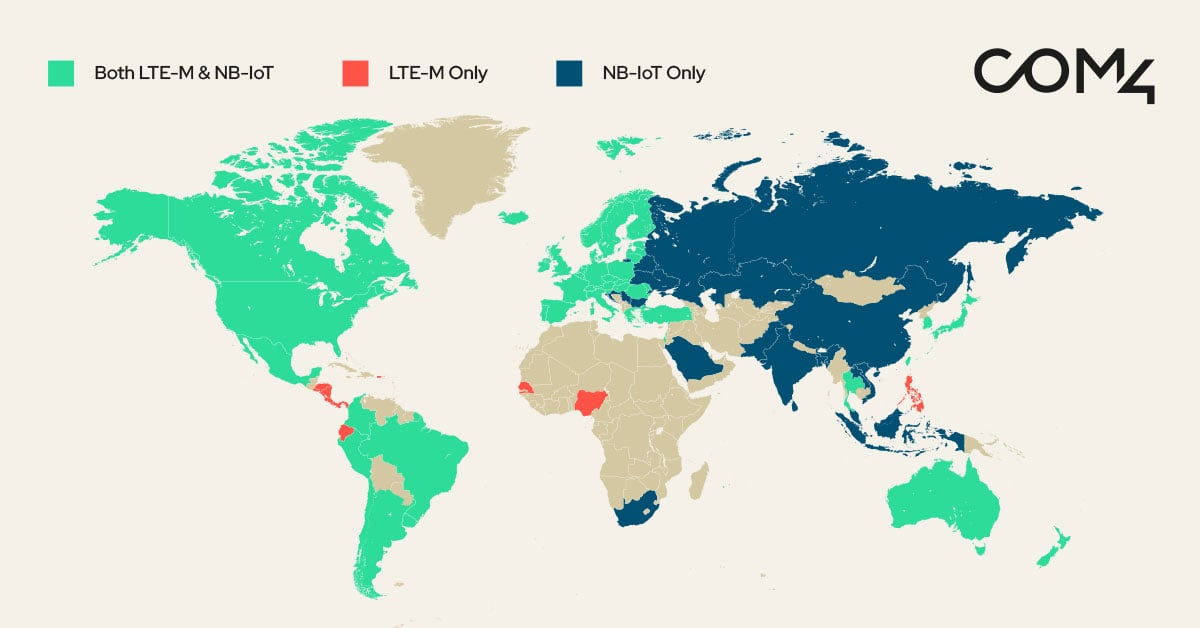
LPWA closes that gap. According to the GSMA's Mobile IoT Deployment Map, there were 269 commercial Mobile IoT network launches globally as of November 2025, 129 running LTE-M and 140 running NB-IoT, with especially strong coverage across Europe and the Nordics. This is no longer an emerging technology category; it's the standard connectivity layer for a large share of new industrial deployments.
The Two Technical Principles Behind LPWA's Efficiency
LPWA networks achieve their long range and low power draw through two deliberate engineering choices:
Narrowband transmission. Most LPWA technologies transmit over a much narrower slice of spectrum than a standard cellular or Wi-Fi signal. A narrower channel means less noise for the receiver to filter out, which allows for extremely high receiver sensitivity, commonly in the range of -120 to -130 dBm. That sensitivity is what lets a device transmit for kilometres on a signal measured in milliwatts.
Low, intentional data rates. LPWA networks are not trying to move large amounts of data quickly. By keeping data rates low and payloads small, a device spends less time with its radio active, which is the single biggest driver of battery drain in any wireless device. Combined with modern coding techniques that improve the link budget, this is how a battery-powered NB-IoT sensor can transmit from underground and still run for years.
Cellular vs Non-Cellular LPWA
LPWA technologies split into two broad families, and the choice between them is usually the first real architectural decision in an industrial IoT deployment.
Non-Cellular LPWA (LoRaWAN, Sigfox)
Non-cellular LPWA networks run on unlicensed spectrum, independent of mobile operator infrastructure. LoRaWAN is the best-known example: organisations can deploy their own private network (their own gateways, their own coverage footprint) or connect to a public LoRaWAN network operated by a third party.
This gives an organisation direct control over coverage and infrastructure, which suits contained deployments: a single industrial site, a campus, a farm. The tradeoff is that ownership brings operational responsibility: gateway maintenance, network planning, interference management, and the fact that expanding coverage beyond the initial footprint means installing more infrastructure yourself. Security is also generally lighter than cellular alternatives; LoRaWAN relies on AES-128 encryption rather than the full 3GPP security architecture.
Cellular LPWA (NB-IoT, LTE-M)
Cellular LPWA technologies, principally NB-IoT and LTE-M, are standardised by 3GPP and run on licensed spectrum through existing mobile network infrastructure. Rather than building a private network, a device simply connects to a mobile operator's towers, the same way a phone does.
This is what makes cellular LPWA the technology of choice for most industrial and enterprise deployments: coverage is already there, provided by operators who have spent decades building and maintaining that infrastructure, and it comes with full 3GPP-grade security, device management, and global roaming, none of which an organisation has to build or maintain itself. The cost is a subscription to network connectivity, typically through SIM cards, rather than a one-time infrastructure investment.
For deployments that need to scale across sites, countries, or both, without taking on the operational burden of running private radio infrastructure, cellular LPWA is generally the more practical starting point. This is where Com4 focuses: multi-network, carrier-agnostic SIM cards connecting to 750+ networks across 190+ countries, so a device connects to whichever network is strongest in a given location rather than depending on one operator's coverage map.
.jpg?width=1200&height=628&name=LoRaWAN-Chart%20(1).jpg)
LTE-M vs NB-IoT: A Technical Comparison
Within cellular LPWA, the two standards, LTE-M and NB-IoT, solve different problems. Choosing between them is one of the most consequential decisions in an industrial IoT deployment, because it's typically locked in at the hardware design stage and difficult to change afterward.
|
Feature |
LTE-M |
NB-IoT |
|
Data rate |
Up to ~1 Mbps downlink |
Up to ~200 kbps downlink |
|
Latency |
10 to 100 ms |
1.6 to 10+ seconds |
|
Mobility |
Full seamless cell handover |
Cell reselection only, no handover |
|
Coverage depth (MCL) |
~156 dB, good indoor reach |
~164 dB, superior deep-indoor/underground reach |
|
Battery life |
5 to 10+ years with PSM and eDRX |
10+ years with PSM and eDRX |
|
Voice (VoLTE) |
Supported |
Not supported |
|
Module cost |
Approx. $5–$15 per module |
Often under $10 per module |
|
Firmware updates |
Fast, reliable OTA delivery |
Large OTA updates slow and power-intensive |
|
Best for |
Mobile devices, moderate data needs |
Static sensors, minimal data needs |
In practical terms: LTE-M is the right choice when a device moves (a tracked vehicle, a piece of mobile equipment), needs lower latency, or needs frequent, reliable firmware and security updates delivered over the air. NB-IoT is the right choice when a device stays in one place, transmits small amounts of data infrequently, and needs to survive as long as possible on a single battery, especially when that device sits somewhere hard to reach, underground, inside a concrete structure, or in a remote substation.
Both are part of the 3GPP standard, both will continue to coexist alongside 5G, and neither is being phased out. The 2G and 3G shutdowns already underway across parts of Europe are, if anything, accelerating migration toward LTE-M and NB-IoT rather than away from them.
.jpg?width=1200&height=628&name=Benefits-of-NB-IoT-LTE-VS%20(1).jpg) Power-Saving Modes: How LPWA Devices Achieve Multi-Year Battery Life
Power-Saving Modes: How LPWA Devices Achieve Multi-Year Battery Life
The comparison table above only tells half the story. Battery life in the field depends heavily on how a device is configured to sleep, not just which network it runs on.
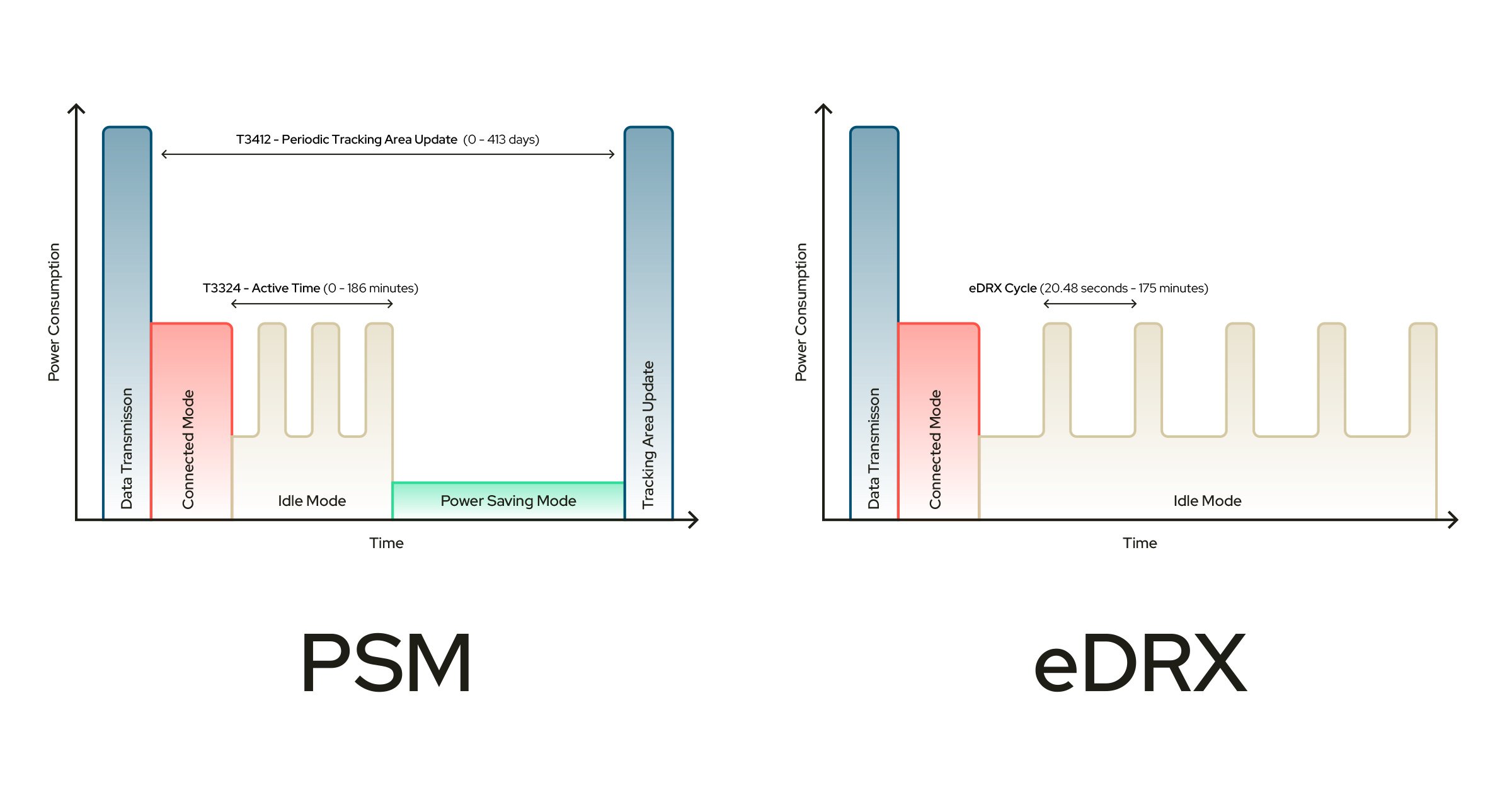
PSM (Power Saving Mode) lets a device drop into deep sleep while remaining registered on the network. The radio effectively switches off, waking only at scheduled intervals to transmit or check for messages. It's the deepest and most efficient sleep state available, at the cost of the device being unreachable between wake-ups; any downlink command has to wait.
eDRX (Extended Discontinuous Reception) is the lighter-touch alternative: the device sleeps for shorter, more frequent intervals, trading some power efficiency for the ability to still receive commands with moderate latency.
A device that only ever reports outward, a level sensor pinging once a day, belongs on PSM. A device that occasionally needs a command pushed to it needs eDRX's better reachability, and the extra power draw that comes with it. Getting this configuration right, on top of choosing the right underlying network, is what separates a sensor that needs a battery change every two years from one that runs for ten.
Why Industrial IoT (IIoT) Specifically Needs LPWA
It's worth being precise about the distinction between general IoT and Industrial IoT. General IoT covers consumer and commercial applications: smart home devices, wearables, connected offices, where convenience and scale matter most. IIoT covers industrial applications: factories, power grids, transport networks, and heavy equipment, where reliability, security, long device lifecycles, and stable connectivity across possibly thousands of assets matter more than anything else.
Industry 4.0, the current phase of industrial evolution following mechanisation (1.0), electrification and mass production (2.0), and digital automation (3.0), is defined by connected, data-driven operations: machines, sensors, and software working together to optimise production and maintenance in real time. The global Industry 4.0 market was valued at USD 52.17 billion in 2023 and is projected to reach USD 182.01 billion by 2028, according to MarketsandMarkets, a scale of investment that reflects how central connected operations have become across manufacturing, energy, and infrastructure.
IIoT is the connectivity and data layer that makes this possible, and LPWA is very often the specific technology underneath it, for a simple reason: most industrial sensors, vibration monitors, smart meters, pressure and level sensors, don't need to move fast amounts of data. They need to run reliably, for years, often in locations, basements, substations, remote pipelines, that a normal signal struggles to reach.
Common Industrial LPWA Devices
-
Vibration and acoustic sensors monitoring machine health
-
Temperature and pressure sensors on industrial equipment and tanks
-
Smart meters across energy and utility networks
-
Level and fill sensors on waste, fuel, or storage containers
-
Asset and equipment tracking devices
-
Grid and substation monitoring equipment
Real-World Industrial IoT Deployments Running on LPWA
Theory is easy; production deployments are where LPWA choices get tested. These are real projects running on Com4 connectivity today.
Predictive Maintenance: Soundsensing
Soundsensing builds sensors and software that monitor mechanical equipment, ventilation systems, HVAC, pumps, in commercial buildings. The sensors learn the normal sound signature of a given motor, and machine learning flags irregular sounds before they become a breakdown. Running on Com4's LTE-M connectivity, more than 1,500 Soundsensing sensors are now operational across 150 buildings, including for clients like Statsbygg and Oslo City, many of them installed in building basements where mobile coverage is typically weakest. Building owners get smoother operations and lower maintenance costs; Soundsensing gets full visibility into device performance and data usage through Com4's platform, letting them maintain service quality and control costs at scale.
Grid Maintenance: Gomero
Gomero Group, based in Gothenburg and market leader in Sweden, provides electrical grid companies with remote, real-time monitoring of critical substation assets, including transformer bunds, for customers including Ellevio, Vattenfall, Fingrid, Deutsche Bahn, and SA Power Networks. Running on Com4's cellular IoT connectivity across nine countries, Gomero's SIPP platform has secured over 6,000 transformer bunds for more than 100 customers, collecting over 76 million data points, preventing more than 6,300 oil spills, avoiding over 6,700 unnecessary site visits, and reducing CO2 emissions by more than 56 tonnes. As Gomero's Head of Technology put it: "Com4 enables a reliable and efficient connection at all our customers' stations. It is of the utmost importance for us to have a supplier who can guarantee that our communication works smoothly and reliably in all nine countries where we operate."
Construction Site Waste Management: Sensorita
Sensorita solves a specific, unglamorous industrial problem: knowing when a waste container on a construction site is actually full. Using Com4's LTE-M connectivity, sensors report real-time fill levels, feeding into AI-driven logistics planning that cuts unnecessary pickup trips and reduces cost.
Railway Infrastructure: Bane NOR
Com4 and Bane NOR, the operator of Norway's national railway infrastructure, have integrated IoT connectivity into core systems within the Norwegian rail network, an example of LPWA and cellular IoT operating in one of the most safety-critical industrial environments there is.
Choosing the Right LPWA Technology: A Practical Framework
Selecting an LPWA technology comes down to how a device actually behaves, not how much bandwidth it could theoretically use.
|
Requirement |
Better Option |
|
Devices move (vehicles, mobile equipment) |
LTE-M |
|
Deep indoor or underground coverage |
NB-IoT |
|
Higher data volume or richer payloads |
LTE-M |
|
Maximum battery life on static devices |
NB-IoT |
|
Voice support needed |
LTE-M |
|
Lowest-cost modules at high volume |
NB-IoT |
|
Frequent, real-time data |
LTE-M |
|
Fully contained site, want to own the infrastructure |
LoRaWAN (private network) |
|
Multi-country deployment, need operator-grade security and support |
Cellular LPWA (NB-IoT/LTE-M) |
Some devices increasingly support both LTE-M and NB-IoT in a single dual-mode module, allowing dynamic network selection based on coverage, though switching technologies after a device is already designed and deployed is rarely straightforward; it generally requires compatible hardware and firmware changes, not just a configuration update.

Common Challenges in Industrial LPWA Deployments
Even mature LPWA technologies come with deployment realities that are easy to underestimate:
Fleet-scale device and SIM management. A handful of sensors can be managed by hand. A few thousand, spread across countries, cannot. This is where a connectivity management platform stops being a nice-to-have and becomes the thing that determines whether an IIoT rollout is operationally sustainable.
Roaming and coverage variability. NB-IoT roaming remains more limited than LTE-M in some regions, and coverage varies by operator spectrum strategy. A multi-network SIM that automatically connects to the strongest available operator removes most of this risk, but it's worth confirming coverage for the specific regions a deployment will actually run in.
Legacy system integration. Many industrial sites run equipment that predates any concept of connectivity. Retrofitting older machines with sensors and getting that data into existing operational software is often more work than the connectivity layer itself.
Real-world battery performance. Lab-estimated battery life assumes good signal conditions. In practice, poor coverage forces a device to transmit longer and more often to get a signal through, which can meaningfully shorten real-world battery life compared to the spec sheet.
Security from day one. Every connected device is a potential entry point. Cellular LPWA benefits from full 3GPP security architecture as a baseline, but private APNs, VPNs, and proper device authentication still need to be designed in from the start, not added after a deployment is already live.
2G/3G sunset migration. As legacy networks shut down across parts of Europe, including Norway and Sweden, devices still running on older cellular standards need a migration path to LTE-M or NB-IoT well before the deadline, not after.
How Com4 Supports Industrial LPWA Deployments
Com4 provides the connectivity layer underneath IIoT deployments like the ones above: carrier-agnostic IoT SIM cards connecting to 750+ networks across 190+ countries, supporting NB-IoT, LTE-M, 4G, 5G, and satellite connectivity from a single managed platform, Polaris CMP. Rather than juggling separate contracts and dashboards per country or per technology, an organisation manages its entire device and SIM estate, provisioning, usage monitoring, alerts, and connectivity switching, from one place.
eSIM and iSIM support means a device's network profile can be provisioned or updated remotely, without a technician physically swapping a SIM card in a substation, a basement, or a site nine countries away. For deployments the scale of Gomero's or Soundsensing's, that's not a convenience feature, it's what makes global scale operationally realistic in the first place.
Com4's connectivity has already enabled more than 20 million IoT connections across over 1,000 customers, spanning energy, manufacturing, construction, logistics, and healthcare, with the same underlying priority running through all of it: industrial-grade reliability, wherever the device happens to be.
Ready to Build Your Industrial IoT Deployment?
Whether it's grid infrastructure, predictive maintenance, or asset monitoring across borders, the right LPWA foundation determines whether a pilot becomes a fleet-wide rollout. Talk to a Com4 IoT expert about which LPWA technology fits your deployment.