
The Internet of Aquatic Things
Aquaculture is one of the world's fastest-growing food sectors, and it is becoming one of the most data-intensive. Sensors watch water quality around the clock. Cameras observe fish behaviour in real time.
Algorithms analyse feeding patterns, predict disease outbreaks, and model harvest timing for maximum return. The convergence of artificial intelligence and the Internet of Things, which researchers are calling AIoT, is fundamentally changing how farms operate.
But none of it works without connectivity. Every sensor reading, every camera feed, every firmware update and remote diagnostic depends on a stable, fast, and secure wireless connection between the farm and the cloud. For aquaculture operations spanning remote coastlines, offshore cages, and rural inland ponds, that connectivity challenge is significant.
This is where Com4 comes in.
What connected aquaculture actually looks like
The applications of IoT in fish and shrimp farming are broad, and they are maturing quickly. Across the industry, three use cases have become foundational:
1. Water quality monitoring
pH, temperature, dissolved oxygen, and salinity are the vital signs of any aquaculture operation. IoT sensors track these parameters continuously, sending alerts the moment conditions move outside safe ranges. What once required manual testing several times a day now happens automatically, with data flowing to farm managers via mobile apps wherever they are
2. Feeding automation
Feed accounts for a large proportion of operating costs in aquaculture, and both underfeeding and overfeeding have serious consequences: poor fish health, reduced growth rates, and degraded water quality. Smart feeding systems use vibration, acoustic signals, and behavioural data to dispense feed at precisely the right time and in the right quantity. Farms using these systems have reported harvest cycles reduced by up to ten days and significant improvements in feed conversion ratios
3. Aeration and energy management
Dissolved oxygen is critical for fish survival, and paddle wheel aerators are essential equipment on many farms. IoT-connected aeration systems activate automatically when oxygen levels drop, rather than running on fixed schedules. The result: farms cutting energy costs by up to 30 percent while maintaining healthier pond conditions.
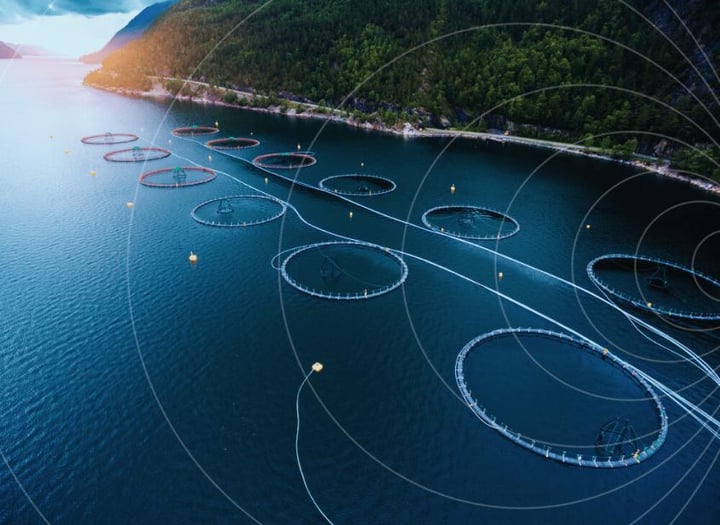
Rapid and stable connectivity between the cages and the operations centre is fundamental for the advancement of artificial intelligence.
Connectivity as the critical enabler
The technology itself is advancing rapidly. But the single most consistent barrier to adoption across aquaculture markets is connectivity. In coastal and rural environments, this challenge is acute.
Many aquaculture facilities sit beyond the reach of stable broadband infrastructure. Offshore net pens, remote inland ponds, and farms in developing coastal regions may have limited or intermittent mobile signal, unreliable power, and no fixed-line internet at all. Without reliable connectivity, even the most sophisticated IoT sensors produce data that never reaches the people who need it.
A hybrid connectivity approach has emerged as the solution the industry needs. Cellular networks including 4G, 5G, LTE-M, and NB-IoT provide fast, high-capacity connections for farms within mobile coverage. Satellite connectivity extends that coverage to the most remote operations. Together, they ensure that connectivity failures do not become operational failures.
Com4's Fixed Wireless Access (FWA) solution, for example, delivers 4G and 5G connectivity at speeds up to 500 Mbit/s with data capacity up to 3TB per month, giving aquaculture operations the bandwidth to transmit live video feeds, high-resolution sensor data, and real-time diagnostics continuously from any location with a mobile signal.
In practice: Remora Robotics and Com4
Remora Robotics, based in Stavanger, Norway, offers a clear illustration of what reliable IoT connectivity makes possible in aquaculture.
The company has developed an autonomous underwater robot that cleans the net pens used in salmon farming. Net pen cleaning is essential: fouled nets restrict oxygen flow and compromise fish health, but traditional diesel-powered manual cleaning is costly, emissions-heavy, and disruptive to the animals. Remora's robot performs the same task gently, continuously, and without direct emissions.
The robot connects to a unit mounted on the pen fence above water via cable, and that surface unit transmits live video and sensor data back to Remora's operations centre in Stavanger over Com4's 4G and 5G network. From there, a small team monitors every deployed robot in real time, troubleshooting issues as they arise and feeding operational data back into the AI algorithms that power the robot's cleaning behaviour.
The model depends entirely on connectivity. Without a fast, stable, high-capacity link between the pen and the operations centre, the remote monitoring that makes the business model viable would not be possible. The AI that makes the robot smarter with every job would have no data to learn from.
Remora's deployments have more than doubled year on year since adopting Com4's connectivity infrastructure. The Stavanger operations centre now oversees a growing fleet of robots across Norwegian aquaculture facilities, all connected through a single, managed network.
The broader picture: IoT in global aquaculture
The Remora story is one example of a much larger trend. Across the world, aquaculture producers are adopting IoT at pace, and the scale of impact is becoming clearer.
Indonesia: IoT in shrimp farming
Indonesia is the world's second-largest shrimp exporter, with aquaculture contributing over USD 2.2 billion to the national economy. Research conducted across four Indonesian provinces found that feeding automation and smart aeration are delivering measurable results: harvest cycles shortened by up to ten days, electricity costs cut by up to 30 percent, and healthier animals across intensive and semi-intensive farms.
The research also identified connectivity as the critical barrier for traditional farmers, who operate in remote coastal locations with limited mobile infrastructure. Pilot programmes pairing IoT systems with mobile network investment, such as those led by Indosat Ooredoo Hutchison in partnership with GSMA and GIZ, have demonstrated that when connectivity is solved, adoption accelerates.
Wild fisheries: smarter at sea
IoT is not limited to fish farms. In wild fisheries, satellite imagery combined with drone and onboard sensor data is helping regulators monitor catches and enforce sustainable practices. Large fishing companies are using the same data to reduce fuel consumption, optimise fleet maintenance using AI predictive maintenance, and improve supply chain transparency. McKinsey has estimated that a sector-wide shift to this model could reduce annual operating costs by approximately USD 11 billion globally.
AI and disease detection
One of the most promising near-term applications is early disease detection. IoT sensors monitoring fish behaviour, water chemistry, and physiological indicators can flag abnormal patterns before a disease outbreak takes hold. Advanced farms are combining this sensor data with machine learning models that improve their accuracy over time, trained on larger datasets as more connected farms contribute to shared platforms.
What Com4 delivers for aquaculture
For aquaculture operations, Com4 provides the connectivity infrastructure that makes smart farming viable at any scale and in any location. That means:
-
Global multi-network access with non-steered roaming across 600+ partner networks, always selecting the strongest available signal.
-
Cellular and satellite integration for operations in remote, offshore, or infrastructure-limited environments.
-
High-capacity Fixed Wireless Access delivering 4G and 5G connectivity with speeds up to 500 Mbit/s.
-
Secure infrastructure including private network configurations, encrypted data transmission, and authenticated SIM management.
-
Full device visibility and remote management through a centralised platform, supporting over-the-air updates, diagnostics, and real-time monitoring.
-
Expert support from a team with proven experience in IoT deployments across aquaculture and other demanding industries.
Whether you are managing a single site or a multi-country fleet of autonomous robots, Com4's connectivity infrastructure is designed to scale with you.
The opportunity ahead
Aquaculture is on a trajectory toward increasing automation, greater use of AI, and tighter integration with environmental monitoring systems. The farms that will lead this transition are those that invest now in the connectivity infrastructure that makes it possible.
Reliable IoT connectivity is not a commodity. In aquaculture environments, it is the foundation on which smarter, more productive, and more sustainable operations are built. It is what turns a sensor into an insight, a robot into a learning system, and a remote pond into a fully managed asset.
Com4 is ready to connect your aquaculture operation. From the net pens off the Norwegian coast to shrimp farms in Southeast Asia, we provide the connectivity that keeps your operation visible, manageable, and always on.
Ready to connect your aquaculture operation?



.webp)
.jpg)