

.jpeg?width=720&height=720&name=Maritime-hero-6%20(2).jpeg)
These devices share almost nothing in common. Different industries, different hardware, different data profiles. But they all live or die by the same thing: connectivity that keeps working when the device, the environment, or the network changes.
This article is about what mobile IoT actually demands, where most deployments break, and how Com4 helps enterprises and OEMs build connectivity strategies that hold up in the real world.
Four scenarios that show what mobile IoT really looks like
Manufacturing and robotics: the factory that moves
A modern factory isn't a fixed grid of static machines anymore. AGVs and autonomous mobile robots roam between cells. Tools and components move along the supply chain. Quality-control sensors travel with finished goods. Some assets stay on-site. Others cross borders the moment they leave the loading bay.
What tends to break: indoor coverage dead zones, handoff between operators near the factory perimeter, fragmented connectivity policies between sites in different countries, and SIM management that doesn't scale beyond a few hundred devices.
How Com4 helps: one multi-network SIM that works the same way in a plant in Poznań, Turin, or Trondheim. One platform for provisioning, policy control, and usage analytics across every site.
Energy and utilities: assets that must stay reachable for years
A smart meter in a rural Finnish municipality. A pressure sensor on a gas pipeline crossing the Italian Alps. A mobile inspection unit walking a Norwegian power line. A buoy monitoring a Polish wind farm. The devices vary, but the requirements don't. You need deep coverage, years of battery life, and the ability to phone home reliably from places the nearest cell tower barely reaches.
What tends to break: gaps in cellular coverage in rural and offshore environments, battery drain caused by inefficient network re-attachment, and the assumption that a single national operator will provide good enough coverage everywhere.
How Com4 helps: access to LTE-M and NB-IoT networks across Europe, optimised for long battery life and deep penetration, combined with multi-network SIMs that switch to whichever operator has the best signal where the asset actually is.
Logistics and transportation: the load is the network
A pallet of vaccines moves from a distribution centre in Germany, through Sweden, into Norway. A refrigerated trailer carrying salmon goes the other direction and ends up in Milan. Every step of the way, the cold chain has to be visible. Temperature, humidity, location, door openings. No gaps when the truck crosses a border or a coverage zone.
What tends to break: permanent roaming restrictions in some markets, deprioritisation on foreign networks, and connectivity strategies that depend on stitching together national operator contracts country by country.
How Com4 helps: one SIM that travels with the shipment across all of Com4's core European markets and beyond. One contract, one invoice, one platform. Visibility from origin to destination.

Maritime: where cellular ends and resilience begins
A fishing vessel off the Norwegian coast. A coastal ferry between Helsinki and Tallinn. An offshore platform in the North Sea. Maritime IoT operates at the edge of cellular coverage and frequently beyond it.
What tends to break: continuity at the cellular and satellite boundary, cost control when high-bandwidth data routes over expensive satellite links, and visibility across hybrid networks.
How Com4 helps: hybrid connectivity strategies that route data cost-efficiently across cellular and satellite, with unified management so a vessel offshore looks the same on the dashboard as a truck on the E6.

The underlying problem: motion changes everything
Look across those four scenarios and a pattern emerges. Every challenge (coverage gaps, roaming, battery life, cross-border operations, hybrid networks) comes back to the same root cause. The device is moving, or the environment around it is.
Three things change when an IoT device moves that don't change for stationary deployments.
The first is the network underneath the device. The strongest available operator in Bergen is not the strongest in Bologna. A device travelling between them needs to switch automatically, without losing data, without manual intervention from an operations team.
The second is the commercial structure. A single national operator contract collapses the moment the device crosses a border. Permanent roaming restrictions, deprioritisation policies, and varying compliance regimes turn what looked like a clean deployment into a procurement nightmare.
The third is the hardware itself. Vibration, weather, dust, temperature extremes, and unpredictable power conditions are baseline assumptions, not edge cases. SIM strategy and antenna design have to be locked in before the form factor is finalised. Change it later and you're looking at a costly redesign.
Each of these has technical answers. The hard part is putting them together into a strategy that works at scale, across markets, for years.
What an IoT connectivity strategy that actually works looks like
There are five capabilities that separate mobile IoT deployments that scale from ones that stall. This is where Com4 focuses.
Connectivity that adapts to the device, not the other way around. Multi-network SIMs (both steered and non-steered), eSIM and eUICC profiles for remote re-provisioning, and access to the full range of cellular IoT technologies including 2G, 3G, 4G, 5G, LTE-M, NB-IoT, and 5G RedCap. Customers match the right network technology to the right use case, and the SIM does the work of staying connected.
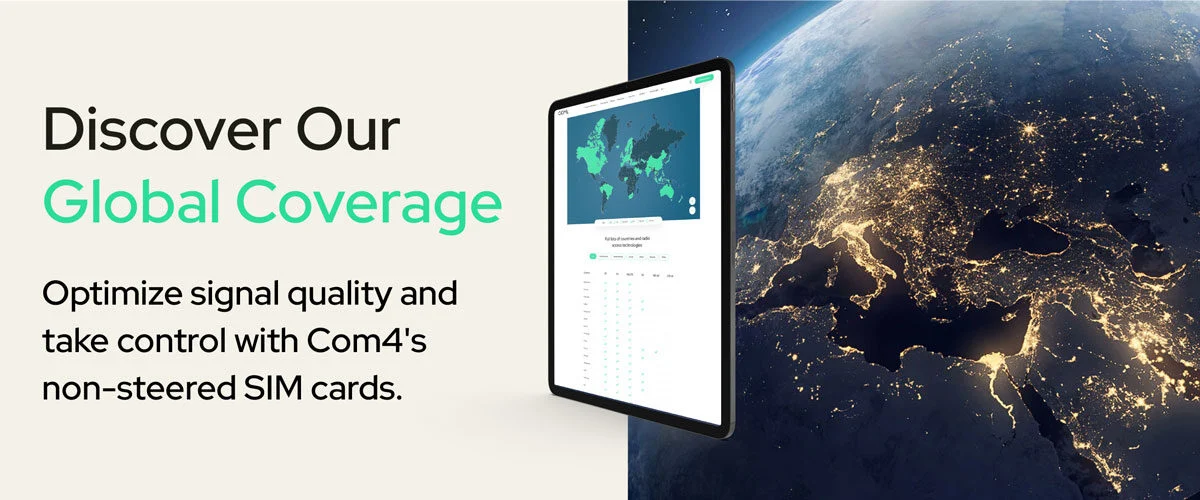
Global reach through a single relationship. Com4 is part of the Wireless Logic Group, Europe's largest IoT connectivity specialist. That gives customers access to more than 750 networks in over 165 countries, with one commercial relationship instead of dozens of national contracts. For customers operating across different countries, this is the difference between a manageable deployment and an unmanageable one.
A platform that gives you control of the whole fleet. Provisioning, deactivation, policy control, real-time usage monitoring, alerts, diagnostics, analytics. Every SIM, every connection, every market in one dashboard. APIs are available for customers who want to integrate connectivity data into their own systems.
Resilience built in. Network fallback strategies that protect mission-critical deployments when signal quality drops. Hybrid cellular-plus-satellite options where coverage demands it. Security and compliance built for European customers operating in regulated industries.
Expertise across the whole lifecycle. Connectivity is one component of a successful IoT deployment, not the whole story. Com4 works with customers from hardware design and SIM strategy through deployment and ongoing operations, drawing on more than two decades of IoT experience and a clear focus on the verticals that define industrial Europe: manufacturing, energy, utilities, logistics, maritime, and robotics.
.webp?width=1200&height=628&name=CMP-billing-article-4%20(1).webp)
Why this matters for the markets Com4 serves
The Nordic, Italian, and Polish footprint isn't an accident. These markets share characteristics that make mobile IoT particularly demanding. Long distances. Demanding climates. Dispersed populations. Strong industrial bases. High expectations for digital infrastructure. They also have very different operator landscapes, regulatory regimes, and language requirements. A connectivity partner that operates in all of them, with local presence, local language support, and a single platform, is rare. That's the position Com4 occupies.
For a manufacturer in northern Italy expanding into Polish production, a Norwegian energy company adding assets in Sweden, or a Finnish logistics operator running cross-border routes through Europe, Com4 removes the friction of operating across markets and lets the connectivity strategy keep up with the business.
Where to start
Mobile IoT deployments tend to fail when connectivity is treated as an afterthought. Bolted on after the hardware is locked in. Networks chosen one country at a time. Management split across multiple operator portals. They succeed when connectivity is treated as a strategic foundation and designed in from the start.
If you're planning a new mobile IoT deployment, or struggling with one already in the field, Com4 is built to help. Talk to us about the verticals you operate in, the markets you need to cover, and the scale you're aiming for. We'll help you design a connectivity strategy that holds up when your devices are actually in motion.
Get in touch with Com4 and let's build something that scales.




.webp)
.jpg)