


Price per gigabyte (PPG) is a convenient benchmark: it is transparent, immediately comparable, and easy to model in a spreadsheet. For this reason, it has become the default competitive variable in MVNO procurement conversations.
However, PPG captures only one input in a multi-variable cost equation. For IoT deployments characterised by high data volumes, global device distribution, or recurring revenue models, optimising for PPG alone can produce decisions that appear cost-efficient at pilot scale but degrade materially as fleet size increases.
Individual devices in categories such as fixed wireless, digital signage, industrial routers, and surveillance cameras now routinely consume 10–50 GB per month. At these consumption levels, structural inefficiencies in billing, network access, and operational tooling compound rapidly into significant margin erosion.
The central problem is not that PPG is a useless metric. It is that it is an incomplete one. A provider offering the lowest data rate may simultaneously introduce costs across roaming compliance, platform capability, network performance, and operational overhead that collectively exceed the savings from a lower rate card.
Total Cost of Ownership: The Correct Analytical Framework
Total Cost of Ownership (TCO) accounts for the full lifecycle cost of an IoT connectivity deployment. Rather than evaluating a single line item, TCO surfaces the interaction effects between pricing, infrastructure, operational processes, and regulatory exposure across the deployment horizon.
The following variables are the primary cost drivers that PPG comparisons systematically obscure.
Network Ownership Model and Roaming Compliance
A provider's underlying network model, whether they operate through native agreements, owned spectrum, or roaming relationships, directly determines whether devices can sustain permanent operation in a given market.
Permanent roaming restrictions are enforced across a growing list of markets. Regulators in Brazil, India, Turkey, and several other regions prohibit or materially restrict long-term device operation on roaming SIMs. The consequences of non-compliance are operational, not merely administrative:
- Network deprioritisation and throughput throttling by the host MNO
- Forced disconnection after defined roaming duration thresholds
- Mandatory migration to local SIM agreements, often requiring physical device recall
- Regulatory penalties and remediation costs that are not bounded by per-GB pricing
- Unified visibility across carriers and geographies without manual aggregation
- Automated SIM lifecycle management (activation, suspension, deactivation) without per-action fees
- Real-time usage monitoring with configurable alerting to prevent overage events
- API integration with existing billing, provisioning, and ERP infrastructure
- Granular reporting for consumption analysis and device-level optimisation
- Throughput degradation during peak demand periods
- Elevated latency that affects real-time application performance
- Restricted access to advanced network features, including network slicing and multi-IMSI capability
- Incompatibility with IoT-optimised power management protocols such as PSM and eDRX
A provider offering attractive PPG rates through roaming-based agreements may present as cost-efficient in early evaluation. The compliance liability this introduces, however, becomes a significant TCO variable in regulated deployment regions.
Com4's carrier-agnostic IoT SIM cards connect devices to over 750 cellular networks across more than 190 countries. Rather than relying on temporary roaming arrangements, Com4 SIMs use Multi-IMSI technology to store multiple subscriber identities and switch profiles as network conditions or regulatory requirements demand. Where eUICC support is required, profiles can be provisioned Over-the-Air without physical device intervention, eliminating the recall costs that roaming-dependent deployments risk at scale.
Connectivity Management Platform Capability
Operational tooling is a direct cost determinant. The functional capabilities of a connectivity management platform affect the labour intensity, error rate, and scalability of fleet operations. Specifically, TCO is materially affected by whether the platform provides:
Where a provider's platform does not deliver these capabilities natively, the OEM must either build equivalent functionality internally or procure it from a third party. The development and licensing costs associated with connectivity management software frequently exceed the savings achievable through a lower base rate.
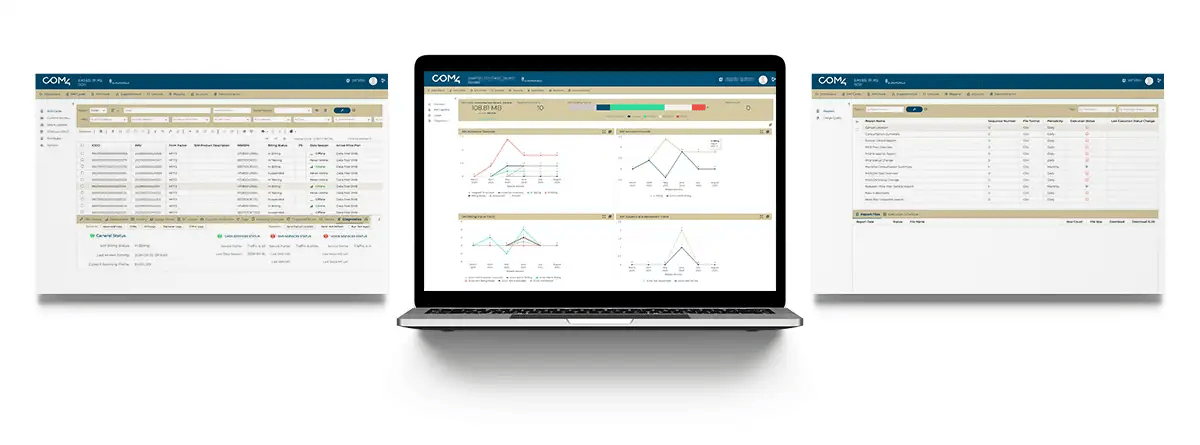
Com4's Connectivity Management Platform (CMP) addresses this directly. It provides centralised control of all SIMs across cellular and satellite networks, supporting both singular and bulk lifecycle actions, real-time usage visibility with historical data, and configurable alerting. Open API access allows teams to integrate CMP data into existing billing and ERP systems, removing the manual aggregation layer that becomes structurally expensive as fleet size grows.
Billing Reconciliation at Scale
IoT device fleets are characterised by high consumption variability. Devices activate, idle, spike, and retire on unpredictable schedules. When multiple carriers are involved, each operating on independent billing cycles with distinct data formats, reconciliation complexity increases non-linearly with fleet size.
Manual reconciliation processes that are viable at 100 devices become operationally unsustainable at 10,000. At scale, the labour cost of billing oversight, the frequency of discrepancy events, and the margin impact of unrecovered billing errors constitute a measurable TCO component that does not appear in any PPG comparison.
Connectivity providers with integrated, automated billing reconciliation infrastructure eliminate this overhead. The value of this capability is real but invisible to PPG-only evaluation frameworks.
Com4 supports flexible billing models designed to reduce reconciliation complexity. The Data Pool model allows organisations to share data across all SIM cards and pay only for average usage per card, smoothing out the consumption variability that makes manual reconciliation error-prone. The Dynamic Data Package model combines a committed baseline with automatic expansion during peak usage, ensuring that billing reflects actual consumption without requiring per-device manual adjustment.

Network Performance Tier
Not all data costs the same to deliver, and not all access agreements provide equivalent performance. Budget-tier connectivity is frequently delivered through deprioritised network access arrangements, which introduces:
For deployments where connectivity is a dependency of the end-user value proposition, including video surveillance, real-time telemetry, and remote management, network performance degradation is not a technical inconvenience. It is a service failure with direct commercial consequences.
Com4 supports all major cellular standards, including 2G, 3G, 4G, LTE-M, NB-IoT, and 5G, as well as satellite connectivity through Non-Terrestrial Networks (NTN). Its non-steered SIM approach prioritises quality of service by automatically connecting devices to the strongest available signal rather than a predetermined carrier. For high-bandwidth deployments, Com4's Fixed Wireless Access solution delivers download speeds of up to 500 Mbps over 4G and 5G infrastructure, providing a cost-effective alternative to wired connections for fixed-site deployments.
Security Architecture
Cellular connectivity delivers security properties that are structurally absent from Wi-Fi-based alternatives. These include default encryption of data in transit, network isolation that prevents traffic interception by co-located devices, and authentication mechanisms managed at the carrier level.
Wi-Fi deployments require the enterprise to implement, maintain, and patch equivalent security controls independently. The administrative overhead, vulnerability surface, and incident response burden associated with this model represent a TCO component that is particularly significant in industrial and healthcare IoT contexts.
Beyond administrative cost, security failures carry reputational and contractual consequences. Customer trust degradation and contractual breach risk are not reflected in PPG comparisons but are real inputs to long-term deployment cost.
Com4 addresses this through a layered security model. Device subscriptions can be segregated into a Private APN, isolating IoT traffic from the public internet and from other tenants on the network. The IoT Secure Tunnel capability protects data transmission end-to-end, while dedicated security management tools provide visibility over device-level threats and anomalies. For deployments in regulated industries such as healthcare and critical infrastructure, this architecture eliminates the security overhead that Wi-Fi-dependent models require enterprises to manage themselves.
Operational Scalability
Many IoT deployments appear operationally efficient during early-phase deployment. With a small fleet, manual processes are manageable, usage anomalies are individually addressable, and billing discrepancies are recoverable. This creates a false positive on operational model viability.
The scaling trap emerges when fleet size increases by an order of magnitude. Processes that absorbed 100 devices with a small team may require proportionally larger teams to manage 10,000 devices under the same model. Without automation, API-driven workflows, and scalable billing logic, operational costs grow faster than the fleet and invert the expected economics of scale.
A TCO assessment must therefore evaluate not only whether the connectivity model functions today but whether it remains economically viable at target deployment scale.
Com4's iSIM and eSIM solutions are designed specifically for scalability. iSIM technology eliminates the physical SIM card entirely, reducing device size, simplifying logistics, and removing a common failure point in high-volume deployments. Combined with Over-the-Air profile provisioning, this enables global fleet rollouts without the SIM variant proliferation and per-market certification overhead that traditional SIM management requires. Com4 has enabled connectivity for over 20 million SIM cards across more than 1,000 customers, providing a proven operational foundation for deployments at enterprise scale.
TCO Evaluation Matrix
The following table defines the factors that belong in a rigorous IoT connectivity evaluation alongside any PPG comparison.
|
TCO Factor |
Why It Belongs in the Evaluation |
|
Network ownership & roaming model |
Determines whether devices can operate permanently in a market without compliance risk or forced migration |
|
Connectivity management platform |
Dictates operational overhead: SIM lifecycle automation, multi-carrier visibility, real-time alerting, and API integration depth |
|
Billing reconciliation infrastructure |
Affects error rates and labour cost at scale; critical in high-variability, multi-carrier fleet environments |
|
Network performance tier |
Deprioritised access introduces latency and throughput degradation that impacts application reliability |
|
Security architecture |
Cellular encryption and network isolation eliminate attack surfaces inherent in shared Wi-Fi infrastructure |
|
Scalability of operational model |
Processes viable at 100 devices often become structurally unsustainable at 10,000+ without automation |
|
SKU and SIM variant complexity |
Regional SIM proliferation increases certification overhead, logistics cost, and production complexity |
|
Remote management capabilities |
Directly determines truck roll frequency; physical interventions are expensive and limit deployment density |
|
Outage recovery SLA |
Unplanned downtime carries direct revenue and reputational cost not reflected in per-GB pricing |
.webp?width=1200&height=628&name=CMP-billing-article-4%20(1).webp)
Applying the TCO Framework in Practice
A structured TCO evaluation begins before rate card comparison. The sequence matters: understanding deployment requirements first prevents the optimisation of a single variable at the expense of the others.
Define the deployment profile precisely
Geographic distribution, target markets, data consumption estimates by device category, billing model, and projected fleet growth trajectory should all be established before engaging providers. Ambiguity in these inputs produces ambiguity in TCO estimates.
Map regulatory exposure by market
For each target geography, determine whether permanent roaming restrictions apply and what the compliance requirements are for commercial IoT deployment at scale. This analysis should precede network selection, not follow it.
Assess platform capability against operational requirements
Request specific technical documentation on platform APIs, SIM lifecycle automation, billing reconciliation processes, and carrier visibility scope. Evaluate these against the operational model you intend to run at target fleet size, not current size.
Model total cost across the deployment horizon
Extend the cost model beyond initial unit economics. Factor in operational overhead, compliance risk exposure, network performance requirements, and the cost of capabilities that must be built or licensed if not provided natively by the connectivity partner.
The Com4 Connectivity Stack
Com4 is part of Wireless Logic Group and provides end-to-end IoT connectivity built on native carrier relationships, proprietary management infrastructure, and a modular product stack designed to address the full range of TCO variables described in this paper.
SIM and eSIM Products
Com4 offers standard IoT SIM cards, eSIM (eUICC), and iSIM formats across multiple form factors. All are carrier-agnostic and support Multi-IMSI technology, enabling automatic network switching across 750+ networks in 190+ countries without manual intervention or device recall. OTA profile provisioning allows SIM configuration to be updated remotely across the entire fleet.
Polaris Connectivity Management Platform (CMP)
The Com4 CMP provides a single interface for managing all SIM subscriptions across cellular and satellite networks. It supports real-time usage monitoring, automated alerts, bulk lifecycle operations, historical reporting, and open API integration. Transparent, usage-based pricing is visible directly within the platform, removing the reconciliation burden associated with fragmented multi-carrier management.
Connectivity Packages
Com4 offers three primary billing models: Pay As You Go for variable-usage deployments where only actual consumption is billed; Dynamic Data Packages that combine a committed baseline with automatic expansion and no payment for unused allocation; and Data Pool, which aggregates consumption across the fleet and bills on average usage per SIM, reducing the impact of individual device variability on total cost.
Security: Private APN and Secure Tunnel
Com4's Private APN isolates customer device traffic into a dedicated network segment, removing exposure to shared public internet infrastructure. The IoT Secure Tunnel extends this protection to the data transmission layer. Both capabilities are available as managed services, eliminating the configuration and patching overhead that equivalent controls require in Wi-Fi deployments.
Fixed Wireless Access
For fixed-site deployments requiring high throughput, Com4's Fixed Wireless Access solution delivers up to 500 Mbps over 4G and 5G networks in select markets. This provides a scalable alternative to wired infrastructure without the installation cost or geographic limitation of physical cabling.
Satellite and Hybrid Connectivity
Com4 supports Non-Terrestrial Network (NTN) satellite connectivity for deployments in locations beyond terrestrial cellular coverage. Hybrid cellular and satellite configurations ensure continuous device operation across maritime, agricultural, and remote industrial environments where terrestrial coverage alone is insufficient.
 IoT Test Lab
Com4's test lab provides performance, security, and interoperability validation for IoT devices prior to deployment. This service reduces the risk of field-level failures that generate support costs and truck rolls, and is particularly relevant for OEMs bringing new hardware categories to market.
The goal is not to provide network access at the lowest possible rate per gigabyte. It is to ensure that the connectivity infrastructure, management tooling, billing model, and security architecture are correctly configured for the deployment from the outset, because correcting structural mismatches at scale is significantly more expensive than selecting the right model at launch.
To discuss your deployment requirements and run a TCO analysis for your specific use case, contact the Com4 team.




.webp)
.jpg)