

.jpeg?width=720&height=720&name=IoT-Connectivity-in-Defence-hero-1%20(1).jpeg)
Half a century later, the traffic is running the other way. The Internet of Things (IoT), a technology shaped mostly by consumer gadgets and industrial sensors, is being pulled back into the defence world it originated from, and it is arriving with a new name: the Internet of Military Things, or IoMT.
For a connectivity provider like Com4, that circularity is worth pausing on. The same building blocks we deploy for smart grids, logistics fleets and connected factories, secure SIM identity, remote device management, resilient multi-network coverage, are now the exact capabilities that defence and government organisations need to modernise bases, protect supply chains and keep sensor networks online in places where connectivity has always been the hardest problem to solve.
This article looks at what defence IoT actually is, why military planners and EU institutions are investing in it now, and what “secure, resilient connectivity” needs to mean when the environment on the other end of the SIM card is not a warehouse or a wind farm, but a forward operating base, a coastline, or a contested urban area.
What Is the Internet of Military Things (IoMT)?
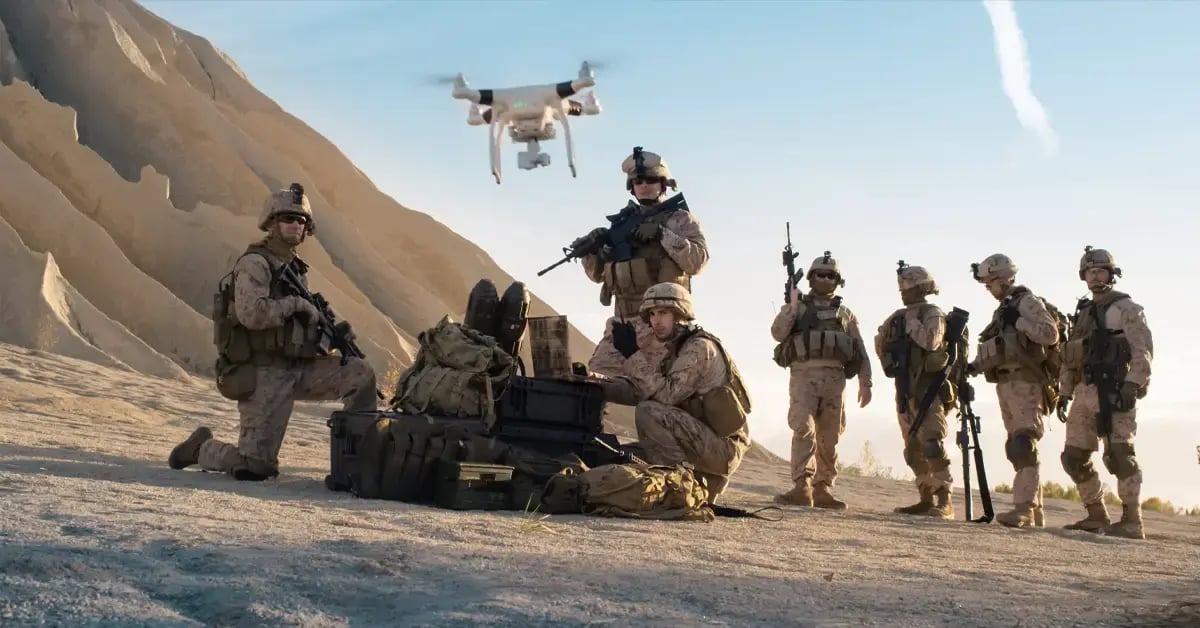
The Internet of Military Things is the defence-specific evolution of consumer and industrial IoT: a network of sensors, wearables, vehicles, drones and command systems that continuously collect, share and act on data to give military commanders situational awareness in real time. Researchers and defence agencies also use closely related terms such as the Internet of Battlefield Things (IoBT) and Defence IoT (DIoT), depending on whether the focus is tactical operations, base infrastructure, or the wider system of connected capabilities.
The concept builds directly on ideas that defence research and technology (R&T) programmes have pursued since the early 2000s, when Network Centric Warfare and Network Enabled Capability (NEC) first treated soldiers, vehicles and platforms as nodes on a network rather than isolated units. What has changed is scale. Where NEC connected relatively few high-value platforms, defence IoT aims to connect thousands, potentially millions, of low-cost sensors and devices across land, sea, air, space and cyber domains, most of it concentrated where future conflict is expected to happen: dense, unpredictable urban environments.

Why Defence Is Investing in IoT Connectivity Now
Three forces are converging to push defence IoT from research pilots into procurement budgets.
- Defence spending is rising sharply, and connectivity is part of the bill. EU member states spent an estimated €418 billion on defence in 2025, a 20% increase on the previous year, with 2026 spending projected to reach €454 billion, or roughly 2.4% of GDP. Equipment procurement alone rose 26% year on year to €115 billion, and defence R&D spending is set to climb toward €20 billion in 2026.
- The market has matured well beyond concept demonstrators. Analysts now size the global Internet of Military Things market at roughly $37 billion in 2025, growing to more than $134 billion by 2035 at a compound annual growth rate above 13%. The broader IoT-in-defence market is separately projected to grow from around $86 billion in 2026 to $165 billion by 2034. Europe is forecast to be the fastest-growing region over that period.
- Urban warfare is reshaping requirements. Military planning documents, including the US Army's “Winning in a Complex World” outlook, point to future conflict concentrating in cities rather than open terrain. That is precisely the environment where IoT connectivity, done properly, earns its keep.
- Heterogeneity without a common standard. In a defence context, sensors, radios and legacy systems from different suppliers, services and even allied nations must interoperate, often while temporarily borrowing civilian networks and infrastructure they don't own, such as commercial cellular coverage in a contested megacity.
- Hostile by design. Defence networks have to assume an intelligent adversary actively trying to jam, spoof, eavesdrop on or hijack the network, and trying to mislead the humans reading its output through disinformation.
- Timing and resilience are mission-critical, not a KPI. Latency between sensing and acting can determine mission outcomes, and networks carrying priority data, medical status among them, must never be allowed to fail entirely.
- Connectivity gaps still limit what's deployable. Unreliable wireless signal in remote or contested locations continues to constrain which devices are actually usable in the field, a reminder that resilient, multi-path connectivity, cellular plus satellite, with automatic failover, isn't a premium feature in defence contexts, it's the baseline requirement.
- GSMA-compliant eSIM and eUICC provisioning. Com4 was the first IoT operator in Europe to implement GSMA-compliant eUICC eSIM subscription management, allowing devices to be provisioned, updated and deactivated remotely and securely, without physically touching hardware deployed in a remote or restricted-access site.
- Private APN and VPN-based isolation. Keeping device traffic off the public internet through a private Access Point Name, with VPN or IPsec tunnels layered on top, is a baseline requirement for any deployment where data confidentiality and network segmentation genuinely matter.
- Multi-network global coverage with automatic failover. Access to 950+ carrier networks across 190 countries means a connected asset, whether it's a border sensor, a logistics container or a remote facility, isn't dependent on a single operator's coverage footprint.
- Satellite connectivity for off-grid and contested locations. Managed LEO satellite connectivity, combined with cellular backup, keeps remote or maritime assets communicating even where terrestrial networks don't reach or can't be trusted.
- SIM-based authentication and end-to-end encryption, aligned with GSMA IoT Security Guidelines, so that every device on the network is uniquely identifiable and its traffic is protected in transit.
- Centralised device lifecycle management, giving operators real-time visibility and remote control over potentially thousands of distributed devices from a single platform, a direct answer to the “cognitive accessibility” problem defence IoT researchers describe: humans can only absorb so much raw sensor data, so the network has to do the filtering.
From ARMS to AUWB-MN: How Defence IoT Has Evolved
Defence IoT did not appear overnight. The European Defence Agency's 2007 ARMS project (“HUGE Network Wireless Connectivity for Autonomous Remote Multi-Sensing Systems”) was one of the earliest attempts to apply multi-sensor networks to military C4ISTAR (command, control, communications, computers, intelligence, surveillance, target acquisition and reconnaissance) systems. It identified a capability gap that still drives investment today: the lack of persistent, 24/7 surveillance across urban and large remote areas.
That gap led to MEDUSA, an EDA joint investment programme that adapted civil IoT architecture to fuse data from RPAS (remotely piloted aircraft), unmanned ground vehicles and soldier-worn sensor nodes into a single situational picture. A follow-on project, WINLAS, is now examining how large networks of heterogeneous sensors behave under the specific stresses of urban warfare, where devices must be small, mobile, self-organising and resilient enough to keep functioning if parts of the network are degraded or destroyed.
NATO's own programme runs in parallel. Beyond land and air, a Saab-led consortium is working toward the Allied Underwater Battlespace Mission Network, aiming to demonstrate a common digital backbone for undersea vehicles and sensors at the REPMUS exercise in 2026, essentially an “internet” for the underwater battlespace. In the US, the Army Research Laboratory's Internet of Battlefield Things Collaborative Research Alliance and DARPA's Ocean of Things programme, which deployed low-cost floating sensor buoys to build persistent maritime awareness, show the same pattern: take the IoT playbook and rebuild it for an environment that is actively trying to jam, spoof or destroy it.
Where Defence IoT Connectivity Delivers Value
Smart, Sustainable Military Bases
Not every application of defence IoT is tactical. A growing share of the investment case is about running military bases the way a well-run smart city runs its infrastructure. By connecting lighting, HVAC, energy, water and security systems into a single dashboard, defence organisations can spot inefficiencies that are invisible in siloed systems, buildings drawing power around the clock with no occupants, or a slow leak showing up as an unexplained spike in water usage.
The civilian precedent is well established. Aberdeen City Council's rollout of IoT-enabled intelligent street lighting across more than 37,000 units cut energy consumption for street lighting by over 50%, saved the city roughly £1.5 million a year, and reduced carbon emissions by 7,500 tonnes of CO₂ annually. Apply the same logic to a military estate with dozens of buildings, and the combination of cost reduction, sustainability progress and improved living conditions for personnel becomes a genuine strategic argument, not just a facilities-management nicety.
ISR and Sensor Networks
Intelligence, Surveillance, Target Acquisition and Reconnaissance (ISTAR) remains the classic defence IoT use case: networks of ground sensors, drones and cameras that give commanders continuous situational awareness across a conflict zone without requiring a soldier to physically patrol every square kilometre. The connectivity challenge here is unusually demanding, sensors must be small, battery-efficient, resistant to jamming, and able to keep transmitting even when parts of the network are compromised.
Logistics, Asset Tracking and Predictive Maintenance
Military logistics chains increasingly resemble commercial supply chains in their reliance on connected tracking, condition monitoring and predictive maintenance, just with higher stakes for downtime and a stronger requirement for tamper-evidence and secure device identity. Equipment and supply tracking, vehicle telematics and fleet health monitoring are consistently cited as some of the most mature, lowest-risk entry points for defence IoT adoption.
The Connected Soldier
Programmes such as the US Army's Connected Soldier initiative integrate wideband radio, biosensors and wearable systems into standard-issue kit, turning each individual into a network node that can share physiological status, location and mission data with nearby vehicles, aircraft and command posts. It is the clearest illustration of the Internet of Battlefield Things thesis: offload the physical and mental burden of information gathering from the warfighter onto a network designed to sense, learn and act on their behalf.

The Hard Part: Why Defence Connectivity Isn't Just Commercial IoT with a Uniform On
Every one of these use cases runs into the same wall: defence environments break the assumptions that commercial IoT connectivity is built on.
What Secure, Managed Connectivity Needs to Deliver for Government and Defence-Adjacent Use Cases
Com4 is not a weapons systems integrator, and this article isn't a claim to be one. But the connectivity layer underneath defence IoT, base infrastructure, logistics, remote-site monitoring, critical national infrastructure and government facilities, is exactly the layer where a specialist IoT connectivity partner adds the most value, and it maps closely to capabilities built for demanding commercial and industrial environments:
Best Practices for Government and Defence Organisations Adopting IoT Connectivity
Organisations evaluating IoT connectivity for defence or defence-adjacent infrastructure should treat a handful of principles as non-negotiable. Use dedicated, encrypted connectivity (private APN, VPN, IPsec) rather than public networks or consumer-grade SIMs for anything touching sensitive data. Build in multi-path resilience from day one, cellular with satellite failover, rather than treating it as an upgrade. Insist on remote, over-the-air device management so compromised or outdated devices can be patched or deactivated without a physical visit. Segment networks so that a breach in one sensor cluster cannot move laterally into core systems. And plan for heterogeneity: procurement decisions should favour connectivity partners whose platforms are carrier-agnostic and standards-based (eSIM, iSIM, SGP.32), rather than locked to a single network or hardware vendor.
The Internet Is Going Home
There's a certain symmetry to where this technology is heading. The internet was built by defence researchers to survive a crisis and then handed to the world; IoT was built by the world's factories, cities and homes and is now being handed back to defence. What connects both eras is the same underlying requirement: a network that stays reliable, secure and useful when it matters most.
For defence and government organisations exploring IoT connectivity for bases, logistics, remote infrastructure or sensor networks, that requirement starts with the same fundamentals commercial IoT has spent two decades refining: secure identity, resilient multi-network coverage, remote manageability and encryption by design. Com4 has spent that time building exactly that stack for demanding, distributed, security-conscious deployments.



-1.webp)

.webp)