

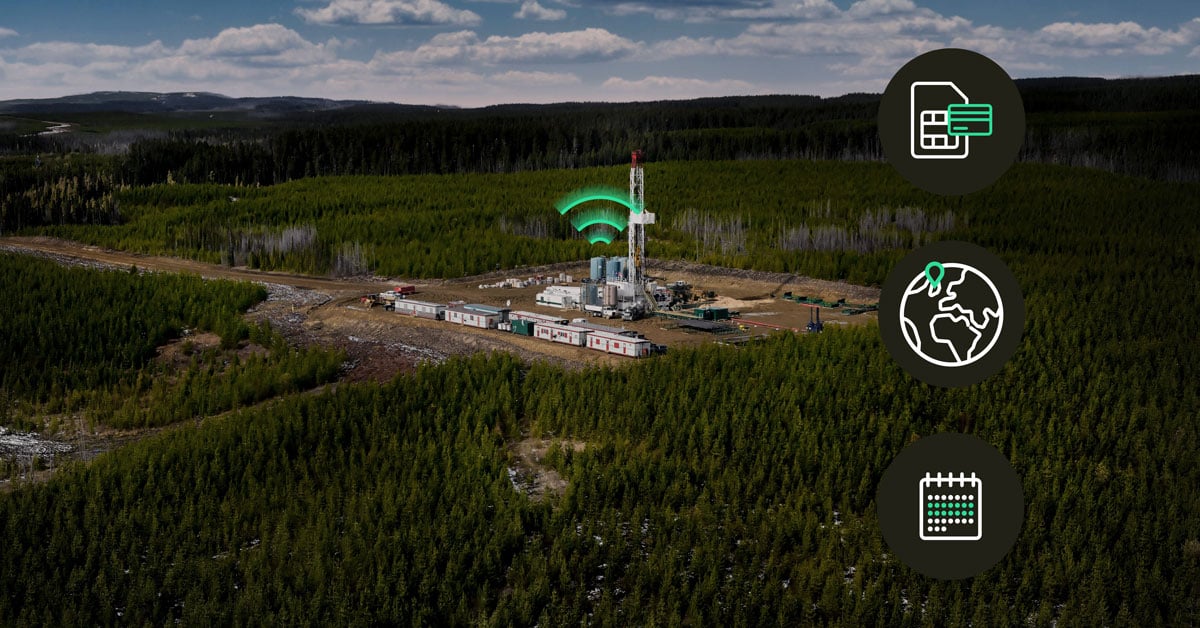
Today's industries demand something fundamentally different: immediate, centralised visibility into assets, equipment, and field activities — across geographies, environments, and network conditions.
Real-time IoT tracking fills that gap. By combining GPS, IoT sensors, and resilient cellular connectivity, organisations can monitor and respond to events as they happen, eliminating delays and guesswork from the operational equation.
This article examines the mechanics of real-time tracking, its impact across industries, and how Com4's IoT connectivity infrastructure enables scalable, secure, and always-on tracking deployments.
What Is Real-Time IoT Tracking?
Real-time tracking continuously monitors assets, people, or systems, delivering live data on location, status, and telemetry. It integrates GPS signals, IoT sensors, and wireless connectivity to stream information about movement, condition, and usage into centralised platforms.
Unlike periodic reporting or manual updates, real-time tracking provides immediate visibility across distributed operations. The result is faster decision-making, proactive maintenance, and a significant reduction in operational risk.
Core Technology Layers
Sensors and Edge Devices Sensors measure GPS coordinates, temperature, vibration, pressure, humidity, and impact. These convert physical parameters into digital signals transmitted continuously over wireless networks.
Communication Networks Reliable communication is the backbone of any tracking system. Key technologies include:
- LTE-M (Cat-M1): Low-power, wide-area cellular optimised for mobile asset tracking with continuous connectivity and network handoff support. Ideal for vehicles, containers, and assets in motion.
- NB-IoT: Optimised for stationary or slow-moving assets in challenging environments such as underground vaults, tanks, or industrial enclosures. Excellent penetration and long battery life.
- 4G LTE / 5G: For high-bandwidth, low-latency applications requiring real-time video or dense sensor telemetry.
- Satellite connectivity: For assets operating beyond cellular coverage — offshore platforms, remote pipelines, polar logistics.
At Com4, we provide multi-network Global IoT SIM Cards that seamlessly switch between networks across 190+ countries, ensuring your tracking devices remain connected regardless of location or environment.
Cloud Platforms and Analytics Raw telemetry from field devices flows into cloud platforms where it is processed, visualised, and acted upon. Platforms range from enterprise solutions like AWS IoT Core and Microsoft Azure IoT Hub to specialised fleet and industrial dashboards.
Edge Computing For latency-sensitive operations — automated fault isolation, emergency shutoffs, or geofence triggers — edge devices process data locally before transmitting. This reduces round-trip time and ensures critical actions happen in milliseconds, not seconds.
Communication Technologies: Choosing the Right Protocol
Selecting the right connectivity technology is one of the most consequential decisions in any IoT tracking deployment.
|
Technology |
Range |
Power Use |
Mobility |
Best For |
|
BLE |
Short (< 100m) |
Very low |
Limited |
Indoor asset tracking, warehousing |
|
NB-IoT |
Wide |
Very low |
Low |
Stationary tanks, meters, manholes |
|
LTE-M |
Wide |
Low |
High |
Vehicles, field equipment, logistics |
|
4G LTE |
Wide |
Medium |
High |
High-data assets, connected machines |
|
Satellite |
Global |
Medium–High |
High |
Remote assets, maritime, polar |
LTE-M is the preferred choice for mobile asset tracking requiring continuous connectivity. Unlike LPWAN technologies such as NB-IoT or LoRa — which are designed for periodic check-ins and cannot support network tower hand-offs — LTE-M maintains a live connection as assets move across geographies.
NB-IoT excels in fixed or slow-moving deployments in environments with poor signal penetration: underground infrastructure, concrete enclosures, and rural installations where deep coverage matters more than mobility.
Com4 supports both LTE-M and NB-IoT across our global network, giving operators the flexibility to match connectivity to use case — and manage everything through a single SIM platform.
Real-Time Tracking Across Industries
Real-time tracking delivers measurable operational improvements across a wide range of sectors.
Fleet and Logistics
Live monitoring of vehicle locations, driver behaviour, fuel consumption, and delivery progress enables dynamic route optimisation and proactive delay response. Geofencing automates alerts when assets leave defined zones, while predictive maintenance data reduces unplanned downtime.
Com4 connectivity supports fleet telematics deployments across Scandinavia and Europe, providing LTE-M SIMs with roaming coverage for cross-border operations.
Energy and Utilities
IoT sensors on substations, transformers, pipelines, and remote generation assets deliver continuous performance data to control centres. Operators detect anomalies early, reduce outage frequency, and support higher renewable penetration through real-time grid balancing.
For remote energy assets — offshore wind, rural solar farms, isolated pumping stations — satellite-backed IoT connectivity from Com4 ensures data reaches the platform regardless of infrastructure availability.

Industrial Manufacturing
Tracking machine uptime, tool usage, and production flow in real time reduces unplanned downtime, identifies bottlenecks, and improves throughput. Vibration and temperature sensors on critical machinery trigger maintenance workflows before failures occur.
Com4's secure APN solutions keep industrial IoT devices on isolated, private network segments — protecting operational data and reducing exposure to external threats.
Smart Buildings and Facilities
Occupancy sensors, air quality monitors, and access control systems provide facility managers with live environmental and security data. Energy management becomes data-driven, and maintenance is triggered by condition rather than schedule.
Healthcare
Tracking critical equipment, monitoring patient movement, and maintaining temperature integrity for drug storage ensures regulatory compliance and protects patient safety. Real-time alerts flag deviations before they become clinical incidents.
Agriculture and Remote Operations
Monitoring pumps, drones, irrigation systems, and remote field equipment in hard-to-reach areas enables proactive maintenance and performance optimisation without costly site visits. NB-IoT and LTE-M connectivity, backed by Com4's multi-network SIM infrastructure, keeps agricultural IoT operational even in areas with limited terrestrial coverage.
Implementation Challenges and How to Address Them
Despite the compelling value of real-time tracking, scaling from pilot to full deployment exposes several technical and operational challenges.
Connectivity Gaps
Remote and dense urban environments present signal challenges. Mitigation requires multi-network SIM cards with automatic network switching — not single-operator SIMs that leave devices offline when coverage is unavailable. Com4's Global IoT SIM connects across multiple network operators per country, with satellite fallback for truly remote deployments.
Device Management at Scale
Provisioning, updating, and monitoring thousands of distributed devices manually is impractical. A managed IoT connectivity platform with remote SIM provisioning, lifecycle management, and centralised diagnostics is essential. Com4's platform enables operators to activate, suspend, and monitor SIMs across the entire fleet from a single interface.
Cybersecurity
Energy and industrial IoT infrastructure is critical infrastructure. Every endpoint is a potential attack surface. Mitigation strategies include:
- Encrypted data transmission (TLS/DTLS)
- Private APNs that isolate device traffic from the public internet
- Network segmentation separating OT and IT environments
- Continuous monitoring for anomalous device behaviour
Com4 provides private APN configurations as standard for enterprise deployments, ensuring device traffic travels over dedicated, secured network paths.
Legacy System Integration
Existing SCADA, ERP, and fleet management platforms were not designed for real-time IoT data ingestion. Open APIs, standard protocols (MQTT, CoAP, REST), and phased integration approaches reduce friction and avoid vendor lock-in.
Data Interoperability
Different sensor vendors use different data formats and protocols. Adopting open standards and unified cloud platforms reduces fragmentation and enables cross-domain analytics.
What to Look for in a Scalable Tracking System
Building a system that delivers real-time visibility at scale requires more than GPS hardware and a dashboard. A robust architecture includes:
Redundant, multi-network connectivity — devices stay online regardless of operator outages or geographic coverage gaps.
Remote provisioning and centralised management — activate, update, and monitor devices without physical intervention.
Open APIs and flexible integration — connect seamlessly with existing workflows without platform lock-in.
End-to-end security — encrypted communication, private network paths, and continuous monitoring from device to cloud.
Global coverage — for operations spanning multiple countries or continents, a single global SIM platform eliminates the complexity of managing multiple local SIM agreements.
.jpg?width=1200&height=628&name=datapool%20(1).jpg)
The Com4 Connectivity Foundation
Com4 provides the cellular and satellite IoT connectivity backbone that makes real-time tracking possible at scale. Our infrastructure supports tracking deployments across fleet logistics, energy, manufacturing, agriculture, and public sector operations — from a single sensor to hundreds of thousands of devices.
Global IoT SIM Cards operate across 190+ countries with multi-network roaming, ensuring devices remain online in any environment. LTE-M and NB-IoT support covers both mobile and fixed asset tracking use cases. Private APNs protect sensitive operational data. Managed lifecycle tools simplify provisioning, monitoring, and cost control across large device fleets. Satellite connectivity options extend coverage to locations beyond terrestrial network reach.
Whether you are deploying a smart metering program, a predictive maintenance system, or a cross-border fleet tracking platform, Com4 provides the connectivity layer that makes live data possible — reliably, securely, and at scale.
 Practical Implementation Roadmap
1. Assess connectivity requirements Map asset locations, operating environments, and mobility patterns. Identify where LTE-M, NB-IoT, or satellite connectivity is required.
2. Define use cases and KPIs Start with high-impact pilots — fleet tracking, transformer monitoring, or fuel tank level sensing. Define measurable outcomes: outage reduction, transport cost savings, or maintenance cost per asset.
3. Select hardware and platform Choose sensors and trackers matched to your environment (powered vs. battery, indoor vs. outdoor, fixed vs. mobile). Validate platform integration with existing systems via open APIs.
4. Establish connectivity and security architecture Deploy global IoT SIMs with private APN configurations. Implement encrypted communication and network segmentation from day one.
5. Deploy, measure, and iterate Run pilot deployments with defined success criteria. Validate connectivity performance, data quality, and integration reliability before scaling.
6. Scale systematically Expand to additional assets and geographies once ROI is validated. Use centralised SIM management to onboard new devices efficiently.
Com4 in Action: Real-World Case Studies
Bane NOR: IoT Connectivity Across Norwegian Rail Infrastructure
Bane NOR, the state enterprise responsible for Norway's 4,200 kilometres of rail infrastructure, needed to deploy a new generation of IoT-connected energy meters across its network. The challenge was significant: while most trains operate domestically, several routes cross into other European countries, requiring IoT SIMs capable of seamlessly switching between multiple national operators without dropping connectivity.
The deployment also introduced a new technical complexity — the CENELEC protocol, a European standard governing communication between electronic measuring systems onboard trains and ground-based settlement systems. Finding a connectivity partner with both the technical flexibility and multi-network roaming capability to support this standard proved critical.
Com4 was selected as Bane NOR's IoT connectivity provider, delivering SIM cards capable of operating across separate networks on different routes and supporting the CENELEC communication requirements out of the box.
"Com4 was the only company that showed the flexibility needed to handle the new CENELEC-protocol requiring a different form of communication with the electricity meters," said the Head Engineer at Bane NOR.
The result is a robust, real-time energy metering system spanning Norway's entire rail network — with reliable data flowing to the Erex energy settlement platform regardless of which operator network a train is running on.
Gomero: Predictive Maintenance for Grid Infrastructure Across 9 Countries
Gomero develops the SIPP solution range — an IoT and AI-powered platform for predictive maintenance of critical grid infrastructure, including transformer bunds. Rather than servicing assets on fixed schedules, Gomero's approach is condition-based: maintain when necessary, driven by real-time sensor data and AI analytics.
The challenge was scale. Gomero operates across nine countries, serving over 100 customers with more than 6,000 transformer bunds secured. Maintaining reliable, secure IoT data transmission across that many geographies — each with different network operators, coverage conditions, and regulatory requirements — required a connectivity partner with true global reach.
Com4 provides the mobile IoT connectivity that powers the real-time data flow underpinning Gomero's management portal, giving Gomero complete visibility into data usage and device performance across all deployments.
"Com4 enables a reliable and efficient connection at all our customers' stations. It is of the utmost importance for us to have a supplier who can guarantee that our communication works smoothly and reliably in all nine countries where we operate."
Com4 also supports Gomero's market expansion, providing commercially attractive global terms and ensuring compliance with local regulatory requirements as the company enters new countries.
Soundsensing: Continuous Environmental Monitoring in Buildings
Soundsensing develops IoT-based noise monitoring solutions that enable property owners to measure and improve indoor sound environments. Their sensors are installed in buildings and transmit continuous environmental data to a cloud platform — where property managers receive actionable insights and alerts.
The solution depends entirely on stable, predictable connectivity. Any interruption in data transmission compromises the accuracy of noise measurements and the reliability of the monitoring service delivered to customers.
With Com4 connectivity, Soundsensing benefits from stable and predictable data usage combined with centralised management. "Reliable connectivity is critical for delivering accurate environmental data. With Com4, we have full visibility into our device performance and data usage, which allows us to maintain service quality and control costs."
This case illustrates a broader principle: for IoT solutions where continuous data streams define service quality, connectivity is not infrastructure — it is the product.
Real-time IoT tracking is no longer a competitive differentiator — it is an operational necessity. As asset fleets grow more distributed and operational environments more complex, the ability to monitor, respond, and plan in real time defines which organisations lead and which fall behind.
The technology stack is mature. The use cases are proven. What separates successful deployments from failed pilots is the reliability and scalability of the connectivity foundation.
At Com4, we provide that foundation — global coverage, secure network architecture, and managed lifecycle tools — so your tracking system delivers live intelligence wherever your assets operate.




.webp)
.jpg)