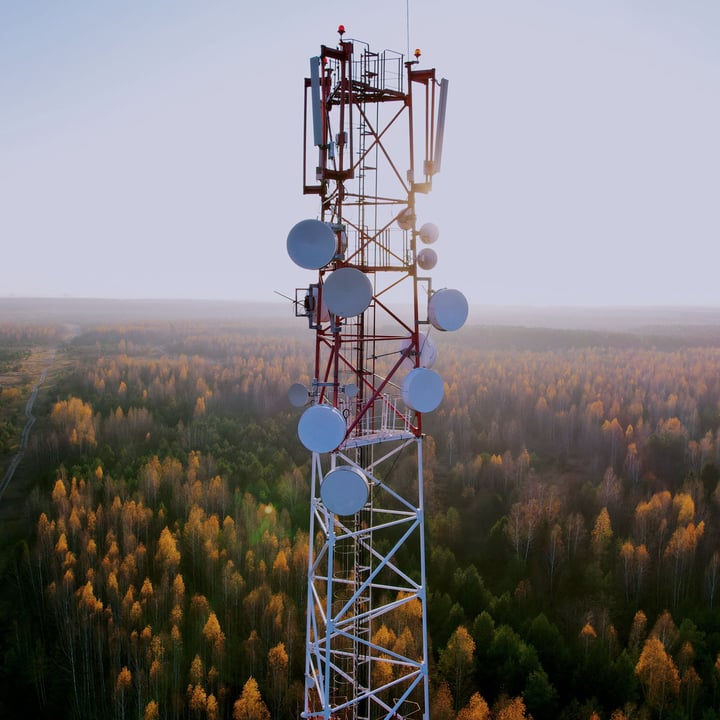
For IoT specifically, LTE and its low-power variants are the connectivity layer behind everything from digital signage on Nordic bus stops to underwater robots on Norwegian fish farms, as the Com4 customer examples further down show.
LTE in plain terms
LTE is a 4G wireless standard developed to deliver significantly faster data speeds and lower latency than the 3G networks that came before it. It was designed from the ground up for data, including web browsing, video, and increasingly, connected devices, rather than being built primarily for voice calls and adapted for data later.
In everyday use, "LTE" and "4G" are often treated as interchangeable. Technically, LTE was the first step toward true 4G speeds, with later refinements (LTE-Advanced, LTE-Advanced Pro) closing the gap to the full 4G standard. For most practical purposes, when you see "LTE" on a device or in a coverage map, it means you're on a 4G-class network.
How LTE works
LTE networks use a flatter, more efficient architecture than earlier mobile generations. Instead of routing calls and data through several layers of switching equipment, LTE moves more of the network intelligence to the base stations (called eNodeBs) and connects them more directly to the core network (the Evolved Packet Core, or EPC). That flatter design reduces the number of hops data has to make, which lowers latency.
A few technical building blocks give LTE its performance:
- OFDMA (Orthogonal Frequency-Division Multiple Access). LTE splits its radio channel into many narrow sub-carriers, letting the network allocate bandwidth efficiently across many connected devices at once, which matters when hundreds of IoT devices share the same cell.
- Carrier aggregation. Newer LTE implementations can combine multiple frequency bands into one connection, increasing available bandwidth without needing new spectrum.
- FDD and TDD variants. LTE can run in Frequency-Division Duplex mode (separate frequencies for upload and download, common across the Nordics) or Time-Division Duplex mode (shared frequency, split by time), depending on the spectrum an operator has available.
- LTE-M (LTE Cat-M1) is a low-power version of LTE built specifically for IoT devices that need moderate data rates, mobility support, and long battery life. Think fleet trackers, payment terminals, and wearables.
- NB- is a related but even lower-power, lower-bandwidth standard optimized for stationary sensors that send small amounts of data infrequently, such as smart meters.
- Standard LTE (Cat-1 and above) still has a place for IoT devices that need higher throughput, such as digital signage streaming updated content or connected point-of-sale systems.
Combined with wider frequency channels and more efficient use of spectrum, this is what gives LTE its speed and responsiveness advantage over 3G.
LTE categories and speed tiers
Not all LTE connections are the same. The LTE standard defines several "UE categories" (device categories), each with a different balance of speed, complexity, and power consumption. This matters directly for IoT hardware selection:
|
Category |
Typical peak download speed |
Power efficiency |
Common use |
|
Cat-1 |
Around 10 Mbps |
Moderate |
Point-of-sale terminals, digital signage, telematics |
|
Cat-4 |
Around 150 Mbps |
Lower |
Routers, higher-bandwidth mobile devices |
|
Cat-6 and above |
300 Mbps and up |
Lower |
Video, high-throughput applications |
|
Cat-M1 (LTE-M) |
Around 1 Mbps |
Excellent |
Mobile or moderate-data IoT sensors, trackers |
|
Cat-NB1 (NB-IoT) |
Tens of kbps |
Best in class |
Stationary, infrequent-data sensors |
Most consumer devices use Cat-4 or higher. Most IoT deployments don't need that much bandwidth, and choosing a lower LTE category, such as Cat-1, Cat-M1, or Cat-NB1, usually means cheaper modules, lower power draw, and longer battery life, without sacrificing the coverage benefits of running on established 4G infrastructure.
Why LTE still matters for IoT
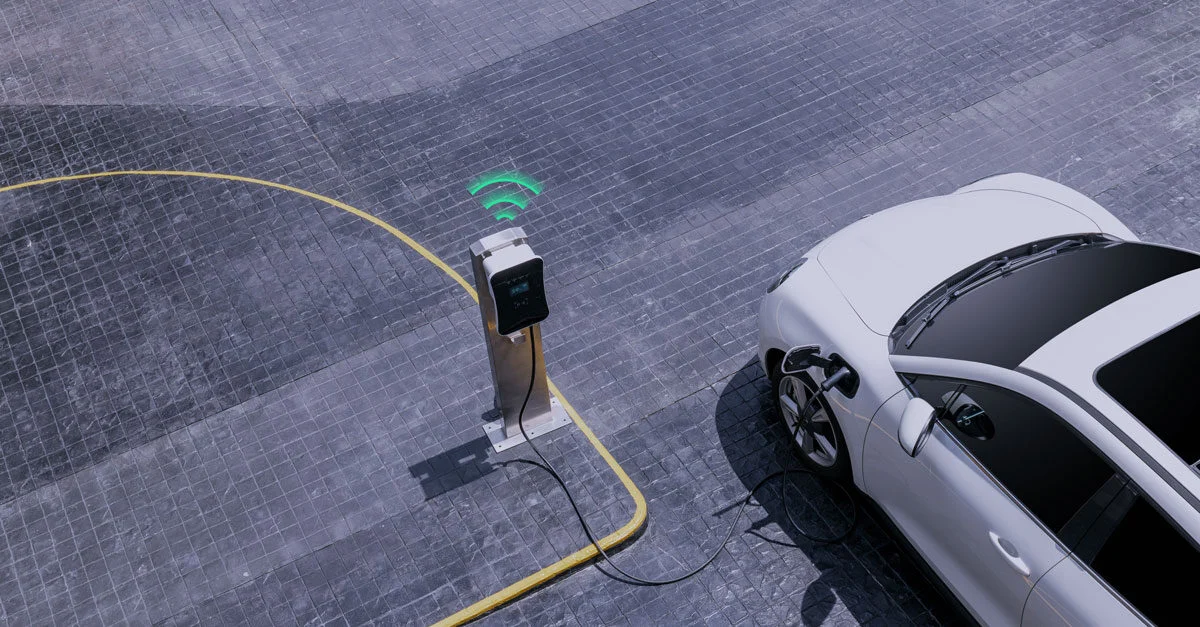
Operators built that shared infrastructure on purpose. LTE was originally built for mobile broadband, not for battery-powered sensors sending a few hundred bytes a day. 3GPP added Power Saving Mode, eDRX, and the narrowband modes to fit the network to that new demand.
Carriers had clear reasons to extend LTE this way instead of building something separate:
-
Existing coverage: They had already spent billions on nationwide LTE, and IoT devices could use it right away.
-
Software over hardware: Many base stations added IoT support through an upgrade, not new equipment.
-
Licensed spectrum: Interference risk stayed low, a real factor for industrial and utility SLAs.
-
Built-in security: SIM-based authentication gave every device the same hardware root of trust operators already used for phones.
The 2G and 3G sunset turned that advantage into a requirement. According to GSA, more than 300 shutdowns have been completed, planned, or are underway across roughly 90 countries as of mid-2026, with North America largely done by 2023 and Europe's 3G going dark through the late 2020s. Devices still running on those old networks need new connectivity. LTE, LTE-M, and NB-IoT are the direct replacement path, already built into the same operator relationships and coverage footprint.
How LTE-powered IoT devices actually save power
LTE was built for smartphones, which stay active all day and recharge nightly. Battery-powered IoT sensors work differently. They transmit rarely and need years of life from one battery. Power Saving Mode (PSM) and Extended Discontinuous Reception (eDRX) are the two 3GPP standards to close that gap.
Power Saving Mode, introduced in 3GPP Release 12, lets a device negotiate two timers with the network. After sending data, it stays reachable for a short Active Timer window, then drops into deep sleep. It stays registered, skipping a full reattach on wake-up. Sleep current falls to the low single-digit microamp range, with a maximum sleep period of 413 days.
eDRX added in Release 13 keeps the device briefly listening for network pages at longer intervals rather than shutting the radio down entirely. LTE-M devices can stretch that cycle past 40 minutes, trading power savings for faster reachability.
Most deployments combine both. An LTE-M device without power saving draws over 1 mA continuously. With PSM and eDRX enabled, average current drops to tens of microamps. That's the difference between months of battery life and years.
Real-world use cases of LTE-powered IoT
Smart metering
HEDNO, Greece's national electricity distributor, is rolling out NB-IoT and LTE-M across 7.7 million meters, with 15-minute readings and remote outage detection. In Sweden, Telia has connected more than two million smart electricity meters using LTE-M (Cat-M1) for utilities including E.ON, Ellevio and Kraftringen.
Asset and fleet tracking
LTE-M and Cat-1 handle mobility. Devices hand over between cells as they move, keeping telemetry close to real time. Logistics, construction equipment, and cross-border cargo tracking rely on this combination.
Precision agriculture
Soil moisture, temperature, and irrigation sensors stay fixed in one spot for years, sending small readings on a set schedule. LTE-M and NB-IoT, paired with PSM and eDRX, routinely deliver 5 to 15 years of battery life, cutting battery visits across large fields.
Other use cases
Smart city sensors track air quality, noise, and parking. Industrial monitoring covers pipelines, tanks, and equipment in hard-to-reach locations. Cold-chain tracking reports temperature and humidity on a schedule or threshold breach.
Each of these use cases runs on the same three LTE strengths: existing coverage, SIM-based identity, and network-level security that unlicensed technologies like LoRaWAN don't provide out of the box.
LTE and LTE-M in Nordic IoT deployments: Com4 customer examples
The clearest way to understand what LTE-based connectivity actually enables is to look at how it's being used today. These examples are all real Com4 customers, spanning standard LTE, LTE-M, and LTE-based fixed wireless access.
ZetaDisplay: keeping digital signage online across the Nordics. ZetaDisplay's screens run in places where fixed lines are difficult or impossible to install, including bus stops, the Oslo Airport Express Train, and Europe's largest digital information board at Oslo Central Station. Each display combines an industrial 4G modem with a Com4 SIM, giving the screen a secure, always-on link to its cloud-based content management system even where Wi-Fi and fiber aren't reliable options. All traffic is protected with VPN and encryption, and time-critical information, such as train departures, can be updated within seconds.
Just Eat Norway: mobile connectivity running a nationwide kiosk network. Just Eat's Norwegian operation moved from fax machines to ISDN and then to mobile networks as its primary communication method. Com4's connectivity now brings older kiosk and terminal hardware online across the country, connecting every device to a central system that restaurant partners use to manage orders and update information. The result, according to Just Eat, has been consistent uptime with no downtime attributed to the connectivity layer.
Soundsensing: LTE-M for compact sensors in dense buildings. Soundsensing builds sensors that listen to building machinery, such as ventilation systems, and use machine learning to flag irregular sounds before equipment fails. The sensors are small and often installed in basements, which makes LTE-M a good fit: it offers enough bandwidth for the sensor's needs, strong power efficiency for long battery life, and the deeper building penetration that LTE-M's design supports. Soundsensing now has more than 1,500 sensors running across 150 buildings, including sites for Statsbygg and Oslo City, on Com4's LTE-M connectivity.
Remora Robotics: cellular and fixed wireless access for real-time monitoring. Remora's autonomous underwater robots clean fish pens in Norwegian aquaculture facilities, and their operations center in Stavanger needs real-time video and sensor data to monitor jobs and train the robots' AI. Com4 provides fixed wireless access and cellular connectivity linking the pens to the operations center, supporting a fleet that more than doubled in size between 2023 and 2024.
Gomero: cellular IoT for predictive maintenance across nine countries. Gomero uses Com4's mobile connectivity to collect real-time data from equipment at customer sites for more than 100 companies across nine countries, enabling a shift from scheduled maintenance to demand-driven, predictive maintenance. Gomero's Head of Technology has credited Com4 with providing a reliable connection across every country they operate in, which matters when equipment condition data needs to arrive consistently regardless of location.
Security considerations of LTE
LTE security rests on three foundations: mutual authentication, layered encryption, and a SIM-based root of trust. Each closes a different kind of risk, and together they give LTE a stronger baseline than 2G or early 3G. A few gaps remain as discussed below, and closing them takes deliberate configuration.
Mutual network authentication
EPS-AKA runs between the SIM and the network's Home Subscriber Server on connection, and each side confirms the other's identity. That two-way check closes a hole in 2G, where fake base stations could intercept traffic because the network was never verified.
Layered encryption keys
Signaling and most user data are ciphered with AES, SNOW 3G, or ZUC. A root key on the SIM derives separate keys for signaling, radio access, and user-plane encryption, so a compromise at one layer does not expose another.
Known security gaps
User-plane integrity protection is optional, so applications should not rely on the network alone to detect tampering. Diameter, the signalling protocol between operators, can expose subscriber location or enable fraud if misconfigured.
Hardening LTE deployments
Keep ciphering and integrity checking on, never accept a null algorithm, and add TLS or application-layer encryption for sensitive payloads. Use private APNs to keep traffic off the open internet, and maintain an OTA path so patches are applied to devices in the field.
SIM-level security protects the network layer. Add encryption at the application layer for anything sensitive, and together, they cover most real-world threats.
LTE vs. 4G vs. 5G: the short version
|
Standard |
Primary use case |
Typical speed |
|
3G |
Legacy voice/data |
Up to a few Mbps |
|
LTE / 4G |
Mobile broadband, general IoT |
Tens to hundreds of Mbps |
|
5G |
High-bandwidth, low-latency use cases |
Up to several Gbps |
For the vast majority of IoT applications, such as asset tracking, metering, remote monitoring, and the digital signage and robotics examples above, LTE-based connectivity (via standard LTE, LTE-M, or NB-IoT) offers the right balance of coverage, cost, and power efficiency. 5G's ultra-low latency and massive bandwidth matter for a narrower set of use cases, like industrial automation or video-heavy applications.
Choosing the right network for your IoT devices
The right network standard depends entirely on what the device needs to do. Work through these questions before specifying hardware:
- How much data does the device send, and how often? Frequent or larger payloads, like ZetaDisplay's content updates, favor standard LTE. Small, infrequent readings, like Soundsensing's sensor data, favor LTE-M or NB-IoT.
- Does the device move? Mobile assets need LTE-M or standard LTE, both of which support handover between cells. Stationary sensors can use NB-IoT's deeper power savings.
- What's the power budget? Battery-powered devices with multi-year lifespans should default to LTE-M or NB-IoT over higher LTE categories.
- What's the deployment environment? Basements, enclosed structures, and remote sites benefit from LTE-M and NB-IoT's stronger signal penetration compared with higher LTE categories.
- Is fixed-line connectivity available? Where fiber or cable isn't practical, such as bus stops or offshore aquaculture sites, LTE-based fixed wireless access can replace it entirely.
Com4 helps businesses match IoT devices to the right underlying network, whether that's standard LTE, LTE-M, NB-IoT, or LTE-based fixed wireless access, and provisions the SIM connectivity to match, so devices stay online wherever they're deployed across the Nordics and beyond.



.webp)
.jpg)